

Lab-Grade Peptides: A Comprehensive Guide to Quality and Purity Standards in 2026
- peptideresearchau
- May 9
- 12 min read
Did you know that as of March 2026, a single third-party verification for a 10mg peptide vial in Australia costs approximately A$800? This high cost often forces researchers to rely on international documentation that may not meet rigorous local standards. You're likely already frustrated by inconsistent batch quality and the constant risk of customs seizures when sourcing from overseas. It's difficult to maintain research continuity when lab-grade peptides arrive without the transparent HPLC or MS documentation required to verify their chemical identity.
We'll help you master the technical standards that define true laboratory grade compounds and show you how to secure high-purity peptides for Australian research. You'll learn exactly how to interpret a Certificate of Analysis to ensure 99% plus purity. This guide provides a detailed overview of the chemical verification process, the importance of domestic shipping, and the regulatory landscape overseen by the TGA to ensure your laboratory work remains precise and uninterrupted.
Key Takeaways
Learn to distinguish between refined laboratory compounds and raw chemical sequences to protect the integrity of your scientific data.
Identify why High-Performance Liquid Chromatography (HPLC) and Mass Spectrometry (MS) are the non-negotiable standards for confirming molecular identity.
Understand the stability profiles of labgrade peptides and how specific synthesis methods influence their resistance to temperature fluctuations.
Navigate the 2026 TGA regulatory environment by identifying the benefits of domestic Australian sourcing for improved research continuity.
Establish a 99%+ purity benchmark for your research compounds using batch-specific documentation to ensure reproducible results.
Table of Contents
Defining Lab-Grade Peptides for Scientific Research
Labgrade peptides represent the pinnacle of chemical synthesis, specifically engineered for precision in controlled environments. Unlike raw chemical materials, which often contain residual solvents or truncated sequences, refined laboratory compounds undergo multi-stage purification to eliminate manufacturing byproducts. Industrial variants frequently prioritize volume over precision, resulting in batch-to-batch inconsistency that can ruin months of pre-clinical work. In the Australian research sector, 99% purity is the accepted benchmark for valid in-vitro and pre-clinical studies. This level of refinement ensures that the observed biological effects result directly from the peptide itself rather than from unintended contaminants.
Ensuring molecular integrity requires a sophisticated process called lyophilization. This freeze-drying technique removes moisture from the peptide while it's in a frozen state. It preserves the delicate structure of the amino acid chain, preventing degradation during transport and ensuring stability for long-term storage. Without this step, even high-purity compounds can lose their efficacy before reaching the lab bench. Meticulous storage protocols are essential for maintaining the chemical properties required for high-stakes scientific inquiry.
The Anatomy of a Research-Grade Compound
Precision begins with the amino acid sequence. The Science of Peptide Synthesis details how solid-phase methods allow for the layer-by-layer construction of these complex chains. Synthesis errors, such as deletion sequences where an amino acid fails to attach to the chain, are common in low-cost manufacturing. These truncated peptides have different molecular weights and can bind to receptors in ways that produce misleading data. During synthesis, Trifluoroacetic acid (TFA) is frequently used as a reagent. However, residual TFA can be cytotoxic to cell cultures and significantly skew experimental results. Refined compounds undergo secondary processing to remove these salts and ensure chemical neutrality. True labgrade peptides are defined by a 99% purity threshold verified through rigorous analytical testing such as HPLC and Mass Spectrometry.
Why Grade Matters in 2026 Research
Purity isn't just a marketing label; it's a technical requirement for reproducibility. Lower-grade peptides introduce uncontrolled variables into your data, making it difficult to replicate findings across different trials. These impurities can interfere with cellular assays, leading to false positives or unexpected toxicity that masks the peptide's true function. If you're establishing a baseline for your study, you can learn more about their fundamental properties in our guide on What are Peptides?. High-purity standards ensure that your research in Australia remains credible, scientifically sound, and compliant with the expectations of peer-reviewed journals.
The Science of Purity: HPLC and Mass Spectrometry
High-Performance Liquid Chromatography (HPLC) serves as the definitive method for quantifying the purity of labgrade peptides. It functions by passing the compound through a column under high pressure, separating the target sequence from any manufacturing byproducts. In a professional chromatogram, the primary peak represents the peptide of interest. Smaller secondary peaks, often called "ghost peaks," indicate the presence of impurities such as residual solvents or deletion sequences. To meet U.S. Pharmacopeia peptide standards, these secondary peaks must be minimal, ensuring the compound reaches the 98% to 99% threshold required for precise research.
While HPLC confirms the quantity of the pure substance, Mass Spectrometry (MS) is required to verify its identity. Mass Spectrometry confirms the peptide sequence matches the intended formula by precisely measuring the molecular weight of the ions. Without MS data, a researcher can't be certain that the high-purity substance in the vial is actually the specific amino acid chain they ordered. It's the difference between knowing a substance is 99% pure and knowing exactly what that substance is.
Avoid suppliers who provide "representative" testing. This practice involves testing one batch and using those results for all subsequent production runs, which ignores the inherent variability in chemical synthesis. In 2026, scientific integrity demands batch-specific testing where every unique production lot is individually verified. Given that independent third-party verification in Australia can cost approximately A$800 per vial, sourcing from a provider that includes these documents as standard is a significant logistical advantage.
Interpreting the Certificate of Analysis (COA)
A legitimate COA is a technical document, not a marketing flyer. It must include a unique batch number, a recent analysis date, and the specific purity percentage. When reviewing the HPLC graph, look for a single, sharp, vertical peak with a completely flat baseline. Red flags in documentation include missing headers, blurred dates, or generic data that lacks a direct link to your specific vial. If the peak appears rounded or has "shoulders," the compound likely contains co-eluting impurities.
The Role of Third-Party Verification
Independent laboratory testing provides an essential layer of supplier transparency. Relying solely on internal manufacturer data creates a conflict of interest that can compromise your data. The current 2026 standard for research compounds includes verifiable digital COAs protected by QR code tracking, allowing you to confirm the results directly with the testing facility. For those seeking verified research materials, you can view our laboratory grade compounds to ensure your project begins with authenticated sequences.
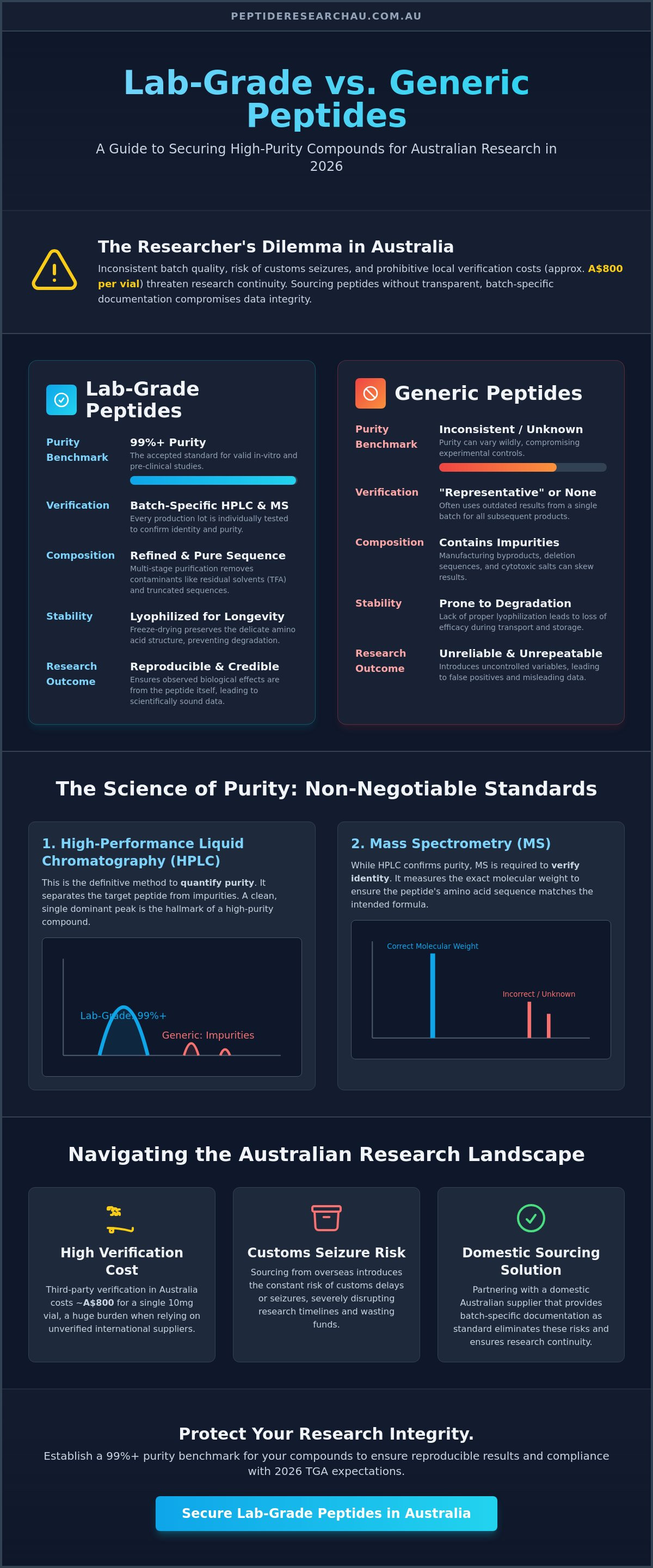
Lab-Grade vs. Generic Peptides: A Comparison
The technical distinction between generic compounds and labgrade peptides often begins at the synthesis stage. Most high-purity research materials are produced via Solid-Phase Peptide Synthesis (SPPS), a method that allows for the meticulous addition of amino acids to a resin-bound chain. This process is superior to liquid-phase synthesis, which generic suppliers frequently use for large, low-cost batches. While liquid-phase is efficient for very short sequences, it struggles with the complexity of longer chains, often resulting in "deletion sequences" where a specific amino acid is missing from the final structure. These structural flaws can lead to catastrophic failures in experimental reproducibility.
Stability during transit is another critical differentiator. Australian researchers face unique challenges, including extreme temperature fluctuations that can exceed 40°C during summer months. Labgrade peptides are professionally lyophilized and vacuum-sealed to withstand these conditions. Generic alternatives often lack proper stabilization, leading to peptide degradation before the vial is even opened. While a generic supplier might offer a lower initial price, the cost-to-value ratio is poor. A failed assay due to degraded material or truncated sequences can waste thousands of dollars in laboratory resources and months of dedicated time.
A significant risk in the 2026 market is the prevalence of "cosmetic grade" materials masquerading as research-grade compounds. These are bulk-produced chemicals intended for topical applications, where purity requirements are significantly lower, often hovering around 90% to 95%. Using these in a controlled lab environment introduces uncontrolled variables that can skew data or cause unexpected toxicity in cellular assays. Authentic laboratory compounds are never "multi-purpose"; they are synthesized specifically for the rigours of scientific study.
Purity and Experimental Integrity
The difference between 95% and 99% purity isn't marginal; it represents a five-fold increase in impurities. These contaminants are often truncated sequences or residual reagents that can bind to receptors and produce false positives. To ensure your project meets the highest benchmarks, refer to our Peptides Australia guide for comprehensive sourcing criteria. High-purity standards are the only way to ensure that the biological response you observe is caused by the peptide itself.
Handling and Reconstitution Standards
Precision doesn't end at synthesis; it extends to how the compound is handled in the lab. Lab-grade compounds require specific laboratory diluents, such as bacteriostatic water, to maintain sterility and stability. The pH of the solution is equally vital. Most peptides are stable within a narrow pH range, typically between 4.0 and 6.0. If the reconstitution process ignores these parameters, the peptide may precipitate out of the solution or undergo rapid hydrolysis. Always use a gentle swirling motion rather than vigorous shaking to avoid mechanical shear, which can break the delicate molecular bonds of the amino acid chain.
Sourcing Lab-Grade Peptides in Australia
Sourcing labgrade peptides within Australia eliminates the high degree of unpredictability associated with international logistics. International shipments often endure transit times of 14 to 21 days. During this window, exposure to uncontrolled environments can compromise the molecular structure of the compounds. Domestic shipping typically reduces this timeframe to 1 to 3 business days, which significantly limits the duration of environmental stress. By choosing a local supplier, researchers avoid the common pitfalls of international customs, where the Australian Border Force may seize shipments that don't meet strict documentation requirements.
The 2026 regulatory environment remains rigorous. The Therapeutic Goods Administration (TGA) issued a formal warning on May 7, 2026, regarding the risks of unapproved peptide products. Most research peptides are classified as Schedule 4 substances under the Therapeutic Goods Act 1989. Domestic sourcing ensures that the materials are managed by entities that understand Australian compliance, providing a layer of safety and reliability that international "grey market" suppliers cannot match. This proximity also simplifies the verification of analytical data, as the supplier operates within the same legal and scientific jurisdiction as the researcher.
Cold-chain logistics are essential given the Australian climate. High-purity labgrade peptides require insulated packaging and validated refrigerants to prevent thermal degradation during the summer months, when ambient temperatures frequently exceed 35°C. Without these precautions, the kinetic energy from heat can cause the peptide chains to denature, rendering the research results invalid. Maintaining this chain from the warehouse to the laboratory bench is the only way to guarantee that the purity stated on the COA matches the reality of the compound in the vial.
Domestic vs. International Shipping
Domestic shipping provides a distinct advantage in terms of both speed and technical support. AU-based customer support teams understand local laboratory standards and can provide immediate assistance regarding batch-specific HPLC data. This eliminates the communication barriers and time zone delays often encountered with overseas vendors. Furthermore, domestic transit avoids the risk of heat-induced degradation that occurs when packages sit in unrefrigerated international sorting facilities for extended periods.
Storage Protocols for the Australian Researcher
Proper storage is the final requirement for maintaining chemical integrity. While lyophilized peptides are stable at room temperature for short periods, long-term storage requires temperatures between -20°C and -80°C. Vials must be protected from light and moisture, which is particularly challenging in humid regions like Queensland or the Northern Territory. To maintain stability, researchers should aliquot the peptide into single-use portions immediately after reconstitution to prevent the molecular damage caused by repeated freeze-thaw cycles.
To ensure your project benefits from reliable domestic logistics and verifiable quality standards, you can buy high-purity research peptides directly from our Australian inventory.
Peptide Research AU: The Standard for Laboratory Grade
Peptide Research AU operates at the intersection of scientific innovation and analytical precision. We provide the Australian scientific community with labgrade peptides that meet or exceed the 99% purity benchmark. Our role as a trusted source for peptides is built on a foundation of transparency and technical excellence. We understand that pre-clinical data is only as reliable as the compounds used in the study. We eliminate the ambiguity of international sourcing by providing high-purity materials directly from our domestic inventory.
Every compound in our catalog is backed by batch-specific documentation. We don't rely on outdated or representative data from third-party manufacturers. Instead, we ensure that the chemical identity and purity of each lot are verified through contemporary HPLC and Mass Spectrometry. This commitment to data integrity allows researchers to focus on their experimental outcomes without questioning the quality of their primary reagents. By maintaining a domestic fulfillment center, we ensure that these high standards are preserved from the moment of synthesis to the point of delivery.
Our Testing and Quality Control
We implement a multi-stage verification protocol for every batch of research compounds. This process ensures that every vial carries our "Research Grade" signature, a marker of chemical excellence and sequence accuracy. Our quality control standards apply to our entire range, including complex sequences like BPC-157 and TB-500. By adhering to these rigorous standards, we provide the consistency required for longitudinal studies and complex cellular assays. Our labgrade peptides are specifically formulated to meet the needs of discerning Australian researchers who require verifiable results.
Supporting the Scientific Community
Our mission extends beyond the supply of chemicals; we aim to empower research into mental and physical wellbeing. We provide the essential tools required for innovative study in a secure and professional environment. Our platform features a secure checkout process and discrete, rapid Australian shipping to ensure your laboratory operations remain uninterrupted. We prioritize the safety and privacy of our clients while maintaining the highest scientific standards in the industry. You can browse our catalog of lab-grade peptides to secure the high-purity compounds necessary for your next research project.
Securing Analytical Precision for Australian Research
Scientific breakthroughs rely on the uncompromising quality of your reagents. As 2026 brings increased regulatory scrutiny and higher standards for analytical verification, the distinction between research-grade compounds and generic alternatives has never been more critical. You've learned that true labgrade peptides require a three-tier verification process: precise sequencing, rigorous lyophilization, and batch-specific HPLC and MS analysis. Maintaining these standards within the Australian environment is essential for ensuring that your research results are both reproducible and credible.
Peptide Research AU supports the local scientific community by offering compounds with 99% plus purity guaranteed. Every vial is verified through independent 3rd-party testing, providing the transparency you need to conduct valid cellular assays. Our localized logistics network offers fast domestic AU shipping to prevent the thermal degradation common in international transit. When your data integrity is on the line, don't settle for unverified materials. We're dedicated to providing the precision required for your most sensitive projects.
Shop Laboratory-Grade Research Peptides at Peptide Research AU to secure the high-purity sequences your project demands. We look forward to supporting your next scientific discovery.
Frequently Asked Questions
What exactly does 'lab-grade' mean for peptides?
Lab-grade is a technical designation signifying a purity level of at least 98% verified through analytical testing. This standard ensures the compound is suitable for in-vitro and pre-clinical study by removing manufacturing byproducts like residual solvents or reagents. It distinguishes these materials from cosmetic or food-grade variants that lack the refinement required for scientific precision.
How do I verify the purity of my peptide batch?
Verification requires a batch-specific Certificate of Analysis (COA) that includes both HPLC and Mass Spectrometry chromatograms. You should always match the batch number printed on your vial to the specific documentation provided by the supplier. Independent third-party verification is the only way to ensure absolute transparency and confirm that the material meets the 99% plus purity threshold.
Are lab-grade peptides legal for research in Australia?
Research peptides are legal for legitimate scientific study but are strictly regulated under the Therapeutic Goods Act 1989. The TGA issued a formal warning on May 7, 2026, regarding the risks of unapproved peptide products. Most of these compounds are classified as Schedule 4 substances; they must be handled according to local laboratory standards and legal requirements.
Why is HPLC testing more important than just a certificate?
HPLC provides the raw chromatographic data necessary to identify specific impurities that a simple percentage might hide. A certificate is a summary of results, but the HPLC graph shows the actual chemical separation of the compound. Identifying ghost peaks in the chromatogram is essential for researchers who need to account for every variable in their experimental assays.
Can I use normal water to reconstitute lab-grade peptides?
No, you must use laboratory diluents like bacteriostatic water or sterile saline to maintain molecular integrity. Normal tap or bottled water contains minerals, ions, and microorganisms that cause rapid hydrolysis and degradation. Using the wrong diluent will alter the pH and potentially render your labgrade peptides biologically inactive within minutes of mixing.
How long can lab-grade peptides be stored at room temperature?
Lyophilized peptides are generally stable at room temperature for approximately 30 days during transit or handling. For long-term preservation, you must store the vials at -20°C or -80°C to prevent gradual molecular degradation. Once you reconstitute the peptide, it becomes significantly more fragile and requires constant refrigeration at 2°C to 8°C.
What is the difference between 98% and 99% purity in research?
The difference represents a doubling of the impurity profile within the sample. A 98% purity level contains 2% contaminants, while a 99% batch contains only 1%. In sensitive cellular assays, that extra 1% of manufacturing byproducts can introduce uncontrolled variables that skew data or cause unexpected cytotoxicity, compromising the validity of your research results.
Why should I choose an Australian supplier over a US-based one?
Choosing an Australian supplier eliminates the risk of customs seizures and significant heat-induced degradation during long-haul shipping. Domestic sourcing also avoids the A$800 cost for local third-party testing that is often necessary to verify unauthenticated overseas shipments. You ensure research continuity by receiving materials within 1 to 3 business days via established local cold-chain logistics.