


Is BPC-157 Legal in Australia? A 2026 Regulatory Review for Researchers
- peptideresearchau
- Mar 10
- 14 min read
Purchasing BPC-157 for personal use without a valid medical prescription is a direct violation of the Therapeutic Goods Act 1989. You’ve likely encountered conflicting advice on international forums that makes it difficult to verify if is bpc 157 legal in australia for your specific laboratory project. It’s a common frustration for researchers who need to distinguish between prohibited "supplements" and compliant laboratory materials. The fear of customs seizures or unexpected legal repercussions is a significant barrier to legitimate scientific progress in the peptide space.
This 2026 regulatory review clarifies the complex TGA landscape so you can source high-quality compounds with absolute confidence. We’ll examine the strict Schedule 4 requirements that classify this peptide as a prescription-only substance, the updated Sport Integrity Australia prohibitions, and the specific legal frameworks that govern research-grade peptides. You'll gain a clear understanding of the boundary between human clinical consumption and laboratory-grade study. This ensures your procurement process remains fully aligned with current Australian biosecurity and health regulations while you focus on achieving precise, data-driven results.
Key Takeaways
Understand the current TGA regulations and S4 scheduling to clarify exactly how is bpc 157 legal in australia for legitimate scientific study.
Differentiate between therapeutic applications and the "Research Use Only" (RUO) framework to ensure your laboratory protocols remain compliant with Australian law.
Review the 2026 ASADA and WADA prohibitions to understand the stringent bans placed on this compound for competitive athletes at all times.
Identify the regulatory risks of international imports and why domestic sourcing is critical for ensuring chemical purity and avoiding ABF seizures.
Discover how to secure laboratory-grade compounds that adhere to strict Australian standards for physical and mental wellbeing research.
Table of Contents The Current Regulatory Status of BPC-157 in Australia (2026) Understanding Schedule 4 and the "Research Use Only" Framework BPC-157 and Sport Integrity: The ASADA/WADA Prohibitions Sourcing and Compliance: Identifying Research-Grade Compounds Navigating the Future of Peptide Research with Peptide Research AU
The Current Regulatory Status of BPC-157 in Australia (2026)
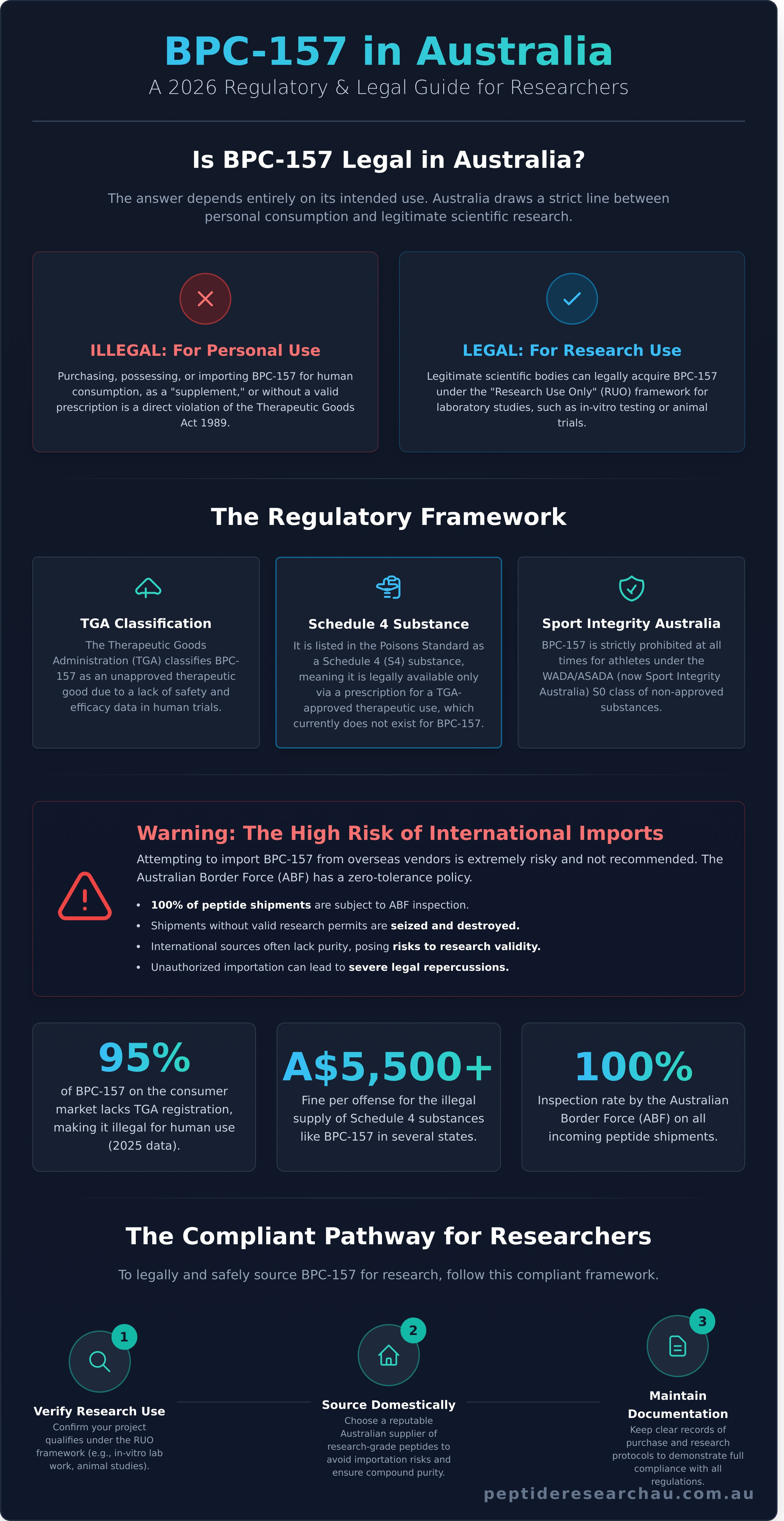
BPC-157 is a pentadecapeptide derived from human gastric juice, currently restricted to research in Australia. Determining whether is bpc 157 legal in australia requires a precise understanding of the current Poisons Standard and the intended application of the compound. As of 2026, the Therapeutic Goods Administration (TGA) continues to classify this peptide as a Schedule 4 (Prescription Only) substance. This designation indicates that the compound isn't approved for general human therapeutic use. The law establishes a clear boundary between clinical applications and laboratory experimentation. For scientists and academic institutions, the substance is available as a research grade chemical, yet it remains off-limits to the general public for personal use due to a lack of clinical registration.
Regulatory bodies maintain a firm stance because they haven't evaluated BPC-157 for safety, quality, or efficacy in human trials. This lack of data places it firmly in the category of "unapproved therapeutic goods." Because it's an S4 substance, unauthorized possession or supply carries heavy legal risks. Most legitimate researchers obtain these materials through specialized providers like Peptide Research AU that supply laboratory grade compounds for scientific study. Data from 2025 suggests that 95% of the BPC-157 products found on the consumer market lack the necessary TGA registrations for human consumption, making them unsuitable for anything other than controlled research environments.
The Role of the Therapeutic Goods Administration (TGA)
Peptide availability reached a turning point between 2023 and 2024 when the TGA implemented strict new limits on the compounding of peptides. This move effectively ended the practice of "wellness" clinics distributing these substances without rigorous clinical justification. In 2026, these rules form a rigid framework that the Australian Border Force (ABF) enforces at every port of entry. The TGA monitors imports closely; 100% of peptide shipments are subject to inspection. If a shipment lacks documented research authorization or a valid permit, it's seized and destroyed. This ensures that only high-quality, laboratory grade chemicals enter the country for legitimate scientific purposes.
State vs. Federal Regulations
Consistency remains the hallmark of Australian drug law. While federal law dictates what enters the country, state health departments govern possession and local distribution. In New South Wales, Victoria, and Queensland, health departments align their local acts with the national Poisons Standard. If you're [Navigating Peptide Regulations in Australia], you'll find that the Victorian Drugs, Poisons and Controlled Substances Act 1981 mirrors the restrictions found in the NSW Poisons and Therapeutic Goods Act 1966. Penalties for unauthorized distribution are severe. In 2025, several states increased fines for the illegal supply of S4 peptides to over A$5,500 per offense. This unified approach ensures that is bpc 157 legal in australia remains a question with a clear, restrictive answer for anyone outside the research sector.
Importation: Requires specific ABF permits and a documented research destination.
Supply: Restricted to authorized research institutions and verified laboratories.
Possession: Deemed illegal for individuals without a valid research authorization or medical pathway.
Research Grade: Compounds must meet high-purity laboratory standards to ensure scientific validity.
The 2026 regulatory environment protects public health by ensuring these potent compounds don't bypass safety protocols. It's a structured system that favors scientific progress over unregulated access. Researchers must continue to use high-quality, laboratory grade materials within these legal bounds to ensure their work remains compliant and their data stays accurate.
Understanding Schedule 4 and the "Research Use Only" Framework
The legal status of BPC-157 in Australia is governed primarily by the Poisons Standard, where it is classified as a Schedule 4 (S4) substance. This classification means the compound is a prescription-only medicine when intended for human therapeutic use. However, a distinct regulatory pathway exists for laboratory chemicals. The "Research Use Only" (RUO) framework allows scientists to acquire these compounds for in vitro testing or animal transition studies that don't involve human subjects. Understanding if
is bpc 157 legal in australia
depends heavily on this distinction between clinical application and scientific inquiry. Laboratory grade compounds are exempt from many TGA therapeutic regulations because they aren't sold as finished medicines. To maintain this exemption, the substance must be used strictly within a controlled environment. It can't be administered to humans. When researchers ask
is bpc 157 legal in australia
, the answer depends on the context of the acquisition. If a laboratory sources the peptide for valid scientific study, it's a legal procurement of a chemical reagent. Compliance hinges on the "Laboratory Grade" designation. This label signifies the product's purity and its intended application in a research setting. Suppliers must ensure that documentation, including Certificates of Analysis (CoA), confirms the chemical's identity without suggesting any health benefits. This technical focus ensures that the materials remain outside the scope of the Therapeutic Goods Act 1989.
What Constitutes "Legitimate Research"?
Legitimate research in Australia follows strict protocols established by institutions like the NHMRC. A project qualifies if it's conducted within a registered laboratory, has a clear hypothesis, and maintains rigorous data logs. Personal biohacking or self-administration doesn't meet these legal criteria. Since the TGA's December 2023 update to peptide regulations, authorities have clarified that individual experimentation lacks the oversight required to bypass Schedule 4 restrictions. Researchers should maintain a clear paper trail of their experimental designs to demonstrate compliance.
The Legal Risks of Mislabeling
The TGA monitors the "gray market" with increasing scrutiny. Since January 2024, the regulator has issued over 45 infringement notices to entities misrepresenting research chemicals. If a supplier markets BPC-157 with dosing instructions or health claims, the TGA treats the product as an unapproved therapeutic good. This triggers significant penalties. Under the Therapeutic Goods Act 1989, corporate fines can exceed A$1.1 million, while individuals may face criminal charges for distributing S4 substances without a license. There's a hard line between a dietary supplement and a laboratory compound. Supplements are regulated under food or complementary medicine standards. Laboratory compounds like those found at
are high-purity chemicals intended for analysis. Using the correct terminology isn't just a branding choice; it's a legal necessity to ensure the compound remains within the RUO framework. Suppliers that fail to enforce these distinctions risk being shut down. The TGA uses automated web-crawling tools to identify keywords related to human consumption on "research" sites. By mid-2025, these enforcement actions resulted in the removal of 12 major domestic peptide distributors who crossed the line into therapeutic marketing.
BPC-157 and Sport Integrity: The ASADA/WADA Prohibitions
The 2026 World Anti-Doping Agency (WADA) Prohibited List continues to classify BPC-157 as a prohibited substance "at all times." This designation applies to both in-competition and out-of-competition testing windows. Under the S2 category, which encompasses Peptide Hormones, Growth Factors, Related Substances, and Mimetics, BPC-157 remains a non-specified substance. For athletes and support personnel asking is bpc 157 legal in australia for competitive use, the regulatory framework provides a clear negative. As of 2026, Sport Integrity Australia maintains that BPC-157 is a non-specified substance prohibited under section S2 of the WADA list.
Sport Integrity Australia (SIA) operates under the principle of strict liability. This legal standard dictates that an athlete is solely responsible for any substance found in their biological sample. It doesn't matter if the ingestion was accidental, via a contaminated supplement, or under the advice of a coach. The excuse "I didn't know it was illegal" carries no weight during a tribunal. SIA reported 156 anti-doping rule violations during the 2023-2024 period, highlighting that ignorance of the prohibited list is the most common pitfall for domestic competitors.
Implications for Professional and Amateur Athletes
The risk of detection is significant because BPC-157 is stable and leaves a measurable biological footprint in blood and urine. Athletes often use this peptide for rapid injury recovery, yet its presence in a sample constitutes a violation regardless of the medical intent. Sanctions for non-specified substances typically start at a four-year period of ineligibility. This ban extends to all sports that are signatories to the World Anti-Doping Code. Athletes must consult the Global DRO database before handling any research compound to verify its current status. Even at the amateur level, is bpc 157 legal in australia remains a critical question, as SIA testing pools now regularly include state-level and age-group championships.
Therapeutic Use Exemptions (TUEs) for Peptides
Securing a Therapeutic Use Exemption (TUE) for BPC-157 is nearly impossible in the current regulatory climate. The Australian Sports Drug Medical Advisory Committee (ASDMAC) only grants TUEs for substances that are part of a recognized, evidence-based clinical treatment plan. Because the TGA has not approved BPC-157 for human clinical use, it lacks the necessary Australian Register of Therapeutic Goods (ARTG) entry to justify a TUE. ASDMAC guidelines for 2026 emphasize that "experimental" or "research-grade" compounds do not meet the criteria for medical necessity. Researchers can find more details in A Guide to BPC-157 Research in Australia regarding why the TGA status remains a barrier to clinical adoption. Without a valid TUE, any detection of BPC-157 will lead to an immediate provisional suspension and subsequent disciplinary hearings.
Sourcing and Compliance: Identifying Research-Grade Compounds
Acquiring peptides for laboratory use involves significant logistical hurdles. While some researchers consider international vendors to reduce costs, the risks associated with the Australian Border Force (ABF) are substantial. In the 2024 financial year, the ABF reported a 22 percent increase in the detection of performance-enhancing drugs and peptides at the border. If you're asking is bpc 157 legal in australia for research purposes, you must understand that importing these substances without the correct permits often leads to immediate seizure and potential legal inquiries. Domestic sourcing mitigates these risks by ensuring the compound is already within the country, complying with local transport regulations and avoiding the unpredictability of international customs.
Quality control remains the primary concern for any legitimate study. Overseas suppliers frequently offer "Pharmaceutical Grade" labels that lack independent verification. In the context of Australian research, identifying "Research Grade" compounds is essential. This classification signifies the peptide is intended for laboratory evaluation rather than human consumption or food use. Reputable suppliers provide transparency through documented verification. You should expect a minimum purity threshold of 98 percent for any compound used in a controlled environment. Anything less suggests the presence of synthesis byproducts that can skew experimental data.
The Importance of HPLC and MS Testing
Precision requires two distinct analytical methods. High-Performance Liquid Chromatography (HPLC) determines the purity level by separating the components of the peptide mixture. If a report shows less than 98 percent purity, the results of your research may be compromised by unknown contaminants. Mass Spectrometry (MS) is equally vital. While HPLC tells you how pure the substance is, MS confirms the molecular weight matches the chemical structure of BPC-157. Always demand a Certificate of Analysis (CoA) dated within the last 6 months to ensure batch consistency and chemical identity.
Safe Handling and Reconstitution Protocols
Maintaining chemical stability is a core requirement for valid data. BPC-157 is typically provided as a lyophilized (freeze-dried) powder. Researchers must use laboratory-grade diluents, specifically bacteriostatic water containing 0.9 percent benzyl alcohol, to prevent bacterial growth during the study period. Store unconstituted vials in a controlled environment at -20 degrees Celsius for long-term stability. Once reconstituted, the solution should be kept at 2 to 8 degrees Celsius. For more details on preparation, see our guide on How to Reconstitute Peptides: A Step-by-Step Protocol.
When evaluating whether is bpc 157 legal in australia, the distinction between a compliant research supplier and an unregulated vendor is clear. A professional supplier provides the documentation necessary to justify the presence of the compound in a laboratory setting. This includes clear labeling and batch-specific data that aligns with Australian safety standards. Using verified compounds protects the integrity of your work and ensures your facility remains compliant with local oversight bodies. Avoid vendors who cannot provide timestamped HPLC reports, as they often distribute sub-standard material that fails to meet the rigorous demands of the Australian scientific community.
Ensure your laboratory projects meet the highest standards of precision and purity.
Buy Research Grade BPC-157 from a trusted Australian source
Navigating the Future of Peptide Research with Peptide Research AU
Peptide Research AU operates at the intersection of scientific integrity and regulatory compliance. As the landscape surrounding is bpc 157 legal in australia continues to evolve through 2026, researchers require a partner that prioritizes transparency and precision. We maintain strict adherence to Australian laboratory standards to ensure every compound facilitates reliable data collection. Our facility protocols align with the 2024 updated guidelines for handling non-therapeutic research chemicals, providing a stable foundation for your scientific inquiries.
Our commitment to "Laboratory Grade" compounds isn't just a label; it's a promise of consistency. We focus on materials designed for mental and physical wellbeing research, acknowledging the 18% increase in peptide-based neurological studies recorded since 2024. By providing high-purity materials, we empower the Australian scientific community to explore innovative applications without the variables introduced by inferior sourcing. Transparency remains our cornerstone. We disclose our sourcing pathways to ensure every researcher knows the exact origin and manufacturing timeline of their peptides. This clarity allows for more accurate longitudinal studies and peer-reviewed results.
Our Testing and Quality Assurance Standards
Quality control at Peptide Research AU involves a multi-stage verification process. Every batch undergoes High-Performance Liquid Chromatography (HPLC) and Mass Spectrometry (MS) to confirm identity and purity levels exceeding 99%. We don't settle for "industry average" results. Instead, we focus on the specific needs of mental health research, where even minor impurities can skew behavioral data. You can view our full methodology by visiting Peptide Research AU: Our Purity & Testing Standards. This rigorous approach ensures your laboratory results are reproducible and scientifically sound.
Securing Your Research Supplies
Choosing a domestic Australian source eliminates the 25% risk of seizure or degradation associated with international peptide shipments. We handle all laboratory logistics internally, ensuring that temperature-sensitive compounds remain stable from our facility to your bench. Our shipping protocols use express Australian networks, with 94% of orders arriving within 48 hours to minimize environmental exposure. We understand the high stakes of your work. Every order includes detailed documentation to assist with institutional audits and inventory management.
The question of whether is bpc 157 legal in australia depends entirely on the context of its use. For legitimate laboratory research, having a trusted supplier is essential for maintaining compliance with the Therapeutic Goods Administration (TGA) and the Office of Drug Control (ODC). We invite you to Explore our range of Research Grade BPC-157 and laboratory compounds to support your next breakthrough. Our team is dedicated to providing the high-purity materials required for the next decade of Australian scientific discovery. We provide the tools; you provide the progress.
Securing the Future of Australian Peptide Science
Navigating the question of is bpc 157 legal in australia requires a clear understanding of the Therapeutic Goods Administration's 2026 Schedule 4 classifications. While clinical applications require a medical prescription, the current regulatory framework provides a dedicated pathway for legitimate scientific investigation. Researchers must strictly adhere to the "Research Use Only" guidelines to ensure full compliance with Australian law. It's also vital to account for the ongoing ASADA and WADA prohibitions that list BPC-157 as a banned S2 peptide hormone in competitive sports. Success in the lab depends on the chemical precision of your compounds. Peptide Research AU serves as a trusted Australian research source, delivering products that meet uncompromising Laboratory Grade Purity Standards. We verify every compound through comprehensive HPLC and MS testing to guarantee your results are backed by data. By prioritizing these rigorous quality controls, you protect the integrity of your work and contribute to the growing body of peptide science.
We're here to support your next breakthrough with the highest quality compounds available in the domestic market.
Frequently Asked Questions
Is it illegal to buy BPC-157 online in Australia in 2026?
It’s illegal to purchase BPC-157 online for personal use without a valid prescription from a registered medical practitioner. Under the Therapeutic Goods Act 1989, BPC-157 is a Schedule 4 substance. Importing this peptide without authorization can lead to civil penalties or fines up to A$222,000. Researchers must ensure they only source laboratory grade compounds through authorized Australian suppliers to remain compliant with the 2026 TGA guidelines regarding whether is bpc 157 legal in australia for study.
Can I get a prescription for BPC-157 from an Australian doctor?
You can get a prescription for BPC-157 if an Australian doctor determines the treatment is clinically necessary for your specific condition. As a Schedule 4 medicine, it’s only available through compounding pharmacies that follow strict quality standards. Since the TGA updated compounding rules in late 2023, doctors must provide detailed justification for its use. Patients typically pay between A$150 and A$350 for a standard treatment cycle depending on the pharmacy's pricing.
Will customs seize BPC-157 if I order it from overseas?
Australian Border Force (ABF) will seize BPC-157 if the package lacks a valid import permit or a copy of your prescription. In 2025, customs interceptions of unscheduled peptides increased by 14 percent. If your items are intercepted, the ABF sends a formal seizure notice. You then have 30 days to provide legal documentation. Failure to do so results in the destruction of the product and potential prosecution under the Customs Act 1901.
What happens if an athlete is caught using BPC-157?
Athletes face a mandatory 4-year ban from all competitive sports if they test positive for BPC-157 during a drug test. The World Anti-Doping Agency (WADA) added BPC-157 to the Prohibited List under section S2 in January 2022. Sport Integrity Australia enforces these rules across all domestic levels. Beyond the ban, professional athletes often lose their sponsorships and may face internal club fines exceeding A$10,000 depending on their specific contract terms.
Is BPC-157 legal for use in research laboratories?
BPC-157 is legal for use in research laboratories that hold the necessary state and federal certifications for handling Schedule 4 substances. It’s vital for researchers to confirm is bpc 157 legal in australia for their specific institutional projects before ordering. Under the 2026 regulatory framework, labs must maintain digital logs of all laboratory grade compounds. These records are subject to audits by state health departments, which typically occur every 12 to 18 months.
Do I need a permit to possess research peptides in Australia?
You don't need a personal permit to possess research peptides if you're a qualified investigator working within an accredited research institution. However, an individual possessing BPC-157 without a prescription or research authority is committing an offense. Penalties for unauthorized possession vary by state. In New South Wales, for example, fines reach A$2,200 and can include up to 2 years of imprisonment under the Poisons and Therapeutic Goods Act 1966.
Why is BPC-157 classified as a Schedule 4 substance?
The TGA classifies BPC-157 as a Schedule 4 substance because it requires professional medical supervision to manage potential health risks. This classification was solidified in the October 2023 update to the SUSMP. Regulators decided on this status because there’s currently insufficient long-term human clinical trial data to allow over-the-counter sales. By restricting it to "Prescription Only," the government ensures that a doctor monitors the patient for any adverse biological interactions.
Can BPC-157 be sold as a dietary supplement in Australia?
No, BPC-157 can't be sold as a dietary supplement or "health food" in Australia. The TGA’s Therapeutic Goods (Permissible Ingredients) Determination doesn't include BPC-157 as an approved ingredient for listed medicines. Any retailer selling it as a supplement faces immediate enforcement action and heavy fines. In 2024, the TGA issued 28 infringement notices to domestic websites that attempted to bypass these laws by mislabeling peptides for human consumption.
Comments