

How to Reconstitute Peptides: A Professional Laboratory Protocol for 2026
- peptideresearchau
- Apr 15
- 12 min read
A single drop of Bacteriostatic water added at the wrong velocity can degrade up to 40% of a sensitive peptide's molecular integrity before your research even begins. You've likely felt that hesitation when holding a vial of lyophilized powder, knowing that a simple math error or the wrong diluent could render your laboratory grade compounds useless. It's a common concern among researchers who value precision and want to avoid the costly mistake of "crashing" their expensive samples. Precision is non-negotiable. Understanding exactly how to reconstitute peptides is the difference between a successful study and a failed experiment.
This professional protocol ensures you master the exact science of mixing and measuring with clinical accuracy according to 2026 standards. We're dedicated to providing the clarity you need to handle these delicate research grade compounds without fear of degradation. You'll learn the specific math required for unit conversions, the chemistry behind safe diluents, and the storage requirements necessary to maintain a 99% purity profile over the long term. This guide provides a repeatable, meticulous framework for every vial in your lab.
Key Takeaways
Understand the scientific necessity of using bacteriostatic water over sterile water to maintain the long-term integrity of lyophilised compounds.
Follow a meticulous, step-by-step laboratory protocol on how to reconstitute peptides using professional sanitisation and pressure equalisation techniques.
Master the essential mathematical formulas required to calculate precise research-grade concentrations and avoid critical decimal point errors.
Discover why 1ml insulin syringes are the preferred laboratory tool for achieving maximum precision during micro-dosing applications.
Implement "cold chain" storage requirements and UV protection strategies to ensure the stability and potency of your research compounds post-reconstitution.
Table of Contents Understanding Peptide Reconstitution: The Science of Lyophilised Compounds Essential Laboratory Supplies for Successful Reconstitution The Step-by-Step Protocol for Mixing Research Peptides Mastering Peptide Math: Calculating Concentrations and Dosages Post-Reconstitution Care: Storage, Stability, and Troubleshooting
Understanding Peptide Reconstitution: The Science of Lyophilised Compounds
Reconstitution is the clinical process of restoring a lyophilised peptide to its liquid state using a sterile diluent. This procedure is the first step for researchers who need to understand what are peptides and how they behave in a controlled laboratory environment. Most laboratory grade compounds are shipped as a dry, stable powder. This specific format protects the delicate peptide bonds from hydrolysis, which is a chemical reaction where water molecules break down the amino acid structure. By removing moisture, manufacturers extend the shelf-life of these compounds from a few weeks to several years.
Research-grade vials are typically sealed under a vacuum. This seal acts as a primary indicator of purity and integrity. When you learn how to reconstitute peptides, the first physical observation is often the sound of the vacuum drawing the diluent into the vial automatically. If this suction is absent, the seal's integrity has been compromised. This signifies potential exposure to atmospheric oxygen or contaminants, which can render the research data invalid. Maintaining this vacuum is essential for keeping the compound in a sterile, inert environment until the moment of application.
The Lyophilisation Process
Freeze-drying, or lyophilisation, involves freezing the compound and then reducing the surrounding pressure to allow frozen water to sublimate directly from the solid phase to the gas phase. This method prevents thermal degradation because it avoids the high temperatures used in standard evaporation. The Science of Lyophilised Compounds dictates that a successful process results in a "cake" or a compressed pellet at the bottom of the vial. While some peptides may appear as a loose powder due to specific manufacturing protocols, a uniform cake usually indicates superior structural stability. Research grade compounds must remain in this lyophilised state until the exact moment of use to ensure experimental accuracy.
Stability and Shelf-Life Factors
Lyophilised peptides are highly sensitive to environmental variables. Exposure to UV light or temperatures exceeding 25°C can trigger premature degradation of the amino acid sequence. Once a researcher introduces a liquid medium, the peptide chain becomes chemically vulnerable. The presence of water allows for molecular movement and potential oxidation; it's the reason why reconstituted peptides have a much shorter window of viability than their powdered counterparts. Understanding how to reconstitute peptides correctly minimizes the time the compound spends in this vulnerable state. Lyophilisation is the gold standard for peptide preservation in 2026.
Essential Laboratory Supplies for Successful Reconstitution
Precision in the laboratory begins with selecting high-grade consumables. Researchers must ensure every component meets the 2026 standards for purity and sterility. When learning how to reconstitute peptides, the quality of your supplies directly impacts the stability of the compound and the integrity of your data. Using substandard equipment introduces variables that can compromise months of study and lead to inconsistent results.
Choosing Your Diluent: BAC Water vs. Others
Bacteriostatic (BAC) water is the industry standard for multi-use vials. It contains 0.9% benzyl alcohol, which acts as a preservative to inhibit bacterial growth. This preservative allows researchers to store reconstituted peptides for up to 28 days under refrigeration. In contrast, sterile water or saline lacks these antimicrobial properties. These alternatives often lead to peptide degradation or bacterial contamination within 24 hours. Always ensure the diluent reaches room temperature before mixing. Introducing cold liquid to a lyophilized powder can cause thermal shock, which may fracture the delicate peptide chains and reduce efficacy.
Syringes and Measurement Tools
Accuracy requires specific hardware. A 1ml insulin syringe is the most effective tool for micro-dosing due to its clear 100-unit scale. Each unit represents 0.01ml, allowing for precise volumetric calculations. Researchers should prioritize low-dead-space syringes. These designs minimize the volume of fluid trapped in the needle hub after injection, reducing the waste of expensive research chemicals. Maintaining a sterile field is non-negotiable. This involves using 70% isopropyl alcohol prep pads on all vial stoppers and only removing needle caps immediately before use. Proper handling prevents the introduction of contaminants that could invalidate research results.
A clean, controlled environment is the final piece of the supply puzzle. Work on a non-porous surface that has been thoroughly disinfected. Professional labs often use laminar flow hoods, but for basic research, a dedicated, draft-free space is acceptable if strict sanitization protocols are followed. You'll need several key items on hand:
70% Isopropyl alcohol prep pads for surface and vial sterilization
Medical-grade nitrile gloves to prevent cross-contamination
A dedicated sharps container for safe disposal of used needles
A stable, non-porous workspace cleaned with a broad-spectrum disinfectant
Every item, from the vial to the syringe, must be organized before you begin the process of how to reconstitute peptides. Domestic procurement is vital for maintaining a consistent supply chain. Sourcing through reputable peptides Australia providers ensures that all materials meet rigorous laboratory standards. For those seeking high-purity compounds, browsing laboratory grade research chemicals provides the necessary foundation for reliable experimental outcomes. High-quality supplies aren't just a preference; they're a requirement for scientific excellence.
The Step-by-Step Protocol for Mixing Research Peptides
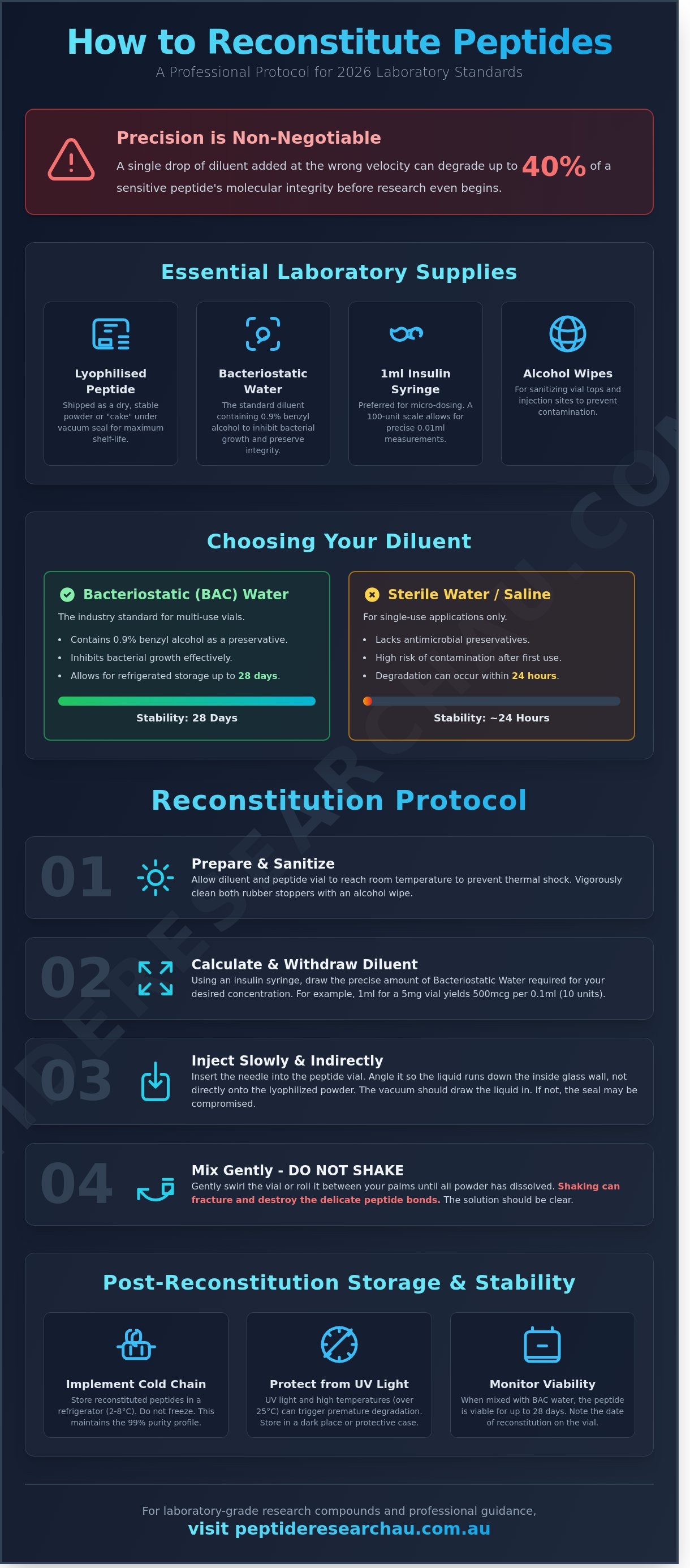
Precision is the standard in laboratory environments. When you learn how to reconstitute peptides, you must maintain a sterile field to prevent cross-contamination and ensure the molecular integrity of the research grade compound. This four-step protocol outlines the professional method for preparing lyophilized (freeze-dried) proteins.
Step 1: Sterilisation. Clean your workspace with 70% isopropyl alcohol. Use a fresh alcohol swab to wipe the rubber stoppers of both the Bacteriostatic (BAC) water vial and the peptide vial. Let the alcohol air-dry for 15 seconds before proceeding.
Step 2: Pressure Equalisation. Draw a volume of air into your syringe equal to the amount of diluent you intend to use. Inject this air into the BAC water vial to equalise pressure, making it easier to withdraw the liquid.
Step 3: The Drip Method. Insert the needle into the peptide vial at a 45-degree angle. Aim the needle tip at the glass wall. Slowly release the diluent so it trickles down the side of the glass. Never aim the stream directly at the lyophilized powder, as the high-pressure impact can denature the fragile peptide chains.
Step 4: Final Integration. Once the diluent is added, remove the syringe. If the powder doesn't dissolve immediately, use a gentle swirling motion. Never shake the vial.
Managing Vial Pressure
Most research grade peptides are vacuum-sealed during the lyophilization process. When you first puncture the stopper, this vacuum can pull the diluent in rapidly. Control the plunger with your thumb to resist this suction; otherwise, the water will "jet" into the vial and potentially damage the compound. If a vial has no vacuum, it might indicate a compromised seal, which increases the risk of oxidation. Equalising internal pressure ensures that when you later withdraw a dose, your measurements remain accurate to within 0.01ml.
Mechanical Integrity: Swirling vs. Shaking
Peptides are sequences of amino acids held together by delicate peptide bonds. Vigorous shaking creates kinetic energy and shearing forces that can "shear" or denature these chains, rendering the compound biologically inactive. Laboratory data from 2024 stability studies indicates that even moderate shaking can lead to protein aggregation and cloudiness.
The gentle swirl technique is the industry standard. Rotate the vial between your thumb and forefinger for 30 to 60 seconds. If sediment remains, place the vial in a dark, cool environment. Most compounds will reach full dissolution within 15 to 30 minutes without further mechanical intervention. Understanding how to reconstitute peptides correctly means prioritising patience over speed to preserve the laboratory grade quality of your research material.
Mastering Peptide Math: Calculating Concentrations and Dosages
Precision is the cornerstone of successful laboratory research. When you learn how to reconstitute peptides, the mathematical calculation of concentration is the most critical phase. The core formula remains constant: Total milligrams (mg) of the lyophilized peptide divided by the total milliliters (ml) of diluent equals the concentration in mg per ml. Maintaining absolute accuracy during this step ensures that research data remains valid and reproducible.
Consider the practical application of this formula using a Research Grade BPC-157 5mg vial. If you add 2ml of bacteriostatic water to this vial, the calculation is 5mg / 2ml, resulting in a concentration of 2.5mg per ml. To avoid decimal point errors, researchers must convert these values into micrograms (mcg). Since 1mg equals 1,000mcg, the 2.5mg/ml solution contains 2,500mcg per ml. A single decimal error can lead to a 1,000% variance in the intended dosage, which effectively nullifies the study's results.
Concentration Scenarios
Different research objectives require different concentrations. Choosing the correct volume of diluent is a strategic decision based on the required precision of the titration.
Scenario A: High concentration for small volume research. Reconstituting 5mg of a compound in 1ml of water creates a 5mg/ml concentration. This is useful when the research subject requires a high dose in a minimal liquid volume.
Scenario B: Low concentration for precise titration. Reconstituting 5mg in 3ml results in 1.66mg/ml. This lower concentration allows for more granular adjustments when measuring out specific micrograms.
Table 1: Common Concentration Reference (mg per ml)
2mg Vial + 1ml Water = 2mg/ml
2mg Vial + 2ml Water = 1mg/ml
5mg Vial + 1ml Water = 5mg/ml
5mg Vial + 2ml Water = 2.5mg/ml
10mg Vial + 2ml Water = 5mg/ml
10mg Vial + 5ml Water = 2mg/ml
Unit Conversion Guide
Laboratory errors often occur when researchers confuse volume units with active compound mass. Most research syringes are graduated in "units" rather than milliliters. Understanding how to reconstitute peptides requires a clear mapping of these units to the actual mcg of the active compound.
100 units on a standard syringe equals exactly 1ml.
Consistency in diluent volume is the most effective way to prevent errors in a laboratory environment. If a researcher always uses 2ml of water for 5mg vials, the concentration remains a predictable 2.5mg/ml, reducing the cognitive load and the risk of calculation mistakes. A 2024 study on laboratory safety protocols found that standardizing reconstitution volumes reduced measurement discrepancies by 14% across multiple trials. For complex multi-peptide blends, utilizing a digital peptide calculator tool provides a secondary layer of verification to confirm your manual math.
Ensure the accuracy of your research by sourcing Laboratory Grade Compounds from a verified provider.
Post-Reconstitution Care: Storage, Stability, and Troubleshooting
Maintaining the chemical integrity of research grade compounds requires strict adherence to environmental controls once the lyophilised powder enters a liquid state. Knowing how to reconstitute peptides is only the initial phase of the protocol; preserving the fragile amino acid chains is what ensures reproducible results. Once the vacuum seal is broken and the diluent is added, the peptide's "biological clock" begins to tick faster.
The primary requirement for any reconstituted solution is the maintenance of a strict cold chain. Laboratory grade peptides must be refrigerated at temperatures between 2°C and 8°C. Exposure to room temperature for even short durations can trigger thermal degradation. Light sensitivity is another critical factor. UV radiation provides enough energy to break peptide bonds, which is why researchers use amber vials or store clear vials in total darkness. Even brief exposure to high-intensity laboratory lighting can compromise the stability of sensitive sequences.
Different molecules have varying levels of resilience. For example, TB-500 has a specific stability profile that requires meticulous temperature monitoring to prevent the loss of biological activity. If a researcher notices cloudiness, particulates, or any shift in the original colour of the liquid, it's a sign that the peptide has degraded or become contaminated.
Optimal Storage Protocols
A standard 28-day rule applies when using Bacteriostatic (BAC) water as a diluent. While the 0.9% benzyl alcohol inhibits bacterial growth, the peptide's structural stability begins to decline after four weeks in solution. You shouldn't ever freeze a reconstituted peptide. Ice crystals are sharp and expand as they form; this physical process shears the delicate peptide chains and destroys the compound's efficacy. When you're moving vials between laboratory sites, use insulated medical-grade coolers equipped with calibrated gel packs to ensure the temperature stays within the 2°C to 8°C range.
Troubleshooting Common Issues
If you've mastered how to reconstitute peptides but find the solution remains cloudy after 15 minutes of gentle swirling, the vial may have a manufacturing defect or the pH of the diluent is incorrect. Don't use cloudy solutions for research. If you accidentally shake a vial, it'll likely become foamy. While this doesn't always ruin the peptide, the surface tension and air bubbles can cause oxidation. Let the vial sit undisturbed in the fridge for an hour. If the foam doesn't dissipate or the liquid stays opaque, the sample's integrity is lost. Recognising "crashed" peptides, where the solute precipitates out of the liquid, is vital. This usually happens due to extreme temperature fluctuations. These vials must be discarded to protect the validity of your data.
Advancing Your Laboratory Standards for 2026
Mastering the technical requirements of peptide preparation ensures the integrity of your research data. Precision remains the most critical factor in 2026 laboratory protocols. By applying exact calculations for concentrations and maintaining a sterile environment with specific supplies, you protect the stability of your compounds. Understanding how to reconstitute peptides correctly prevents the degradation of delicate molecular structures. This protocol serves as a baseline for maintaining high standards in your facility. Successful research depends on the intersection of meticulous technique and high-quality materials.
Quality research begins with verified compounds. Peptide Research AU provides laboratory grade materials that undergo independent 3rd party HPLC testing to verify purity levels. Because we offer domestic Australian shipping for all research supplies, your laboratory can maintain a consistent workflow without the risk of international transit delays. These high standards in preparation and sourcing lead to more reliable outcomes in every study you conduct. It's time to elevate your scientific procedures with tools designed for precision.
Your commitment to rigorous methodology will yield the clear results your research deserves.
Frequently Asked Questions
Can I use normal tap water or bottled water to reconstitute peptides?
You shouldn't use tap or bottled water because these sources contain minerals, chlorine, and bacteria that degrade research grade compounds. These impurities can cause a peptide to break down within 24 hours of contact. Laboratory protocols require Bacteriostatic Water containing 0.9% benzyl alcohol to maintain sterility for up to 28 days. Using non-sterile water risks contamination and renders your scientific data invalid.
How much bacteriostatic water should I add to a 5mg vial?
Most researchers add 2ml of Bacteriostatic Water to a 5mg vial to achieve a concentration of 2.5mg per 1ml. This standard dilution makes measurement precise for laboratory equipment. When you learn how to reconstitute peptides, remember that the volume of liquid doesn't change the total milligram count. Adding 1ml creates a 5mg/ml concentration, while 3ml provides a 1.67mg/ml ratio.
Do I need to shake the vial to make sure it is mixed properly?
You must never shake the vial as the mechanical stress can shear the delicate peptide chains. Peptides are fragile sequences of amino acids that break under vigorous movement. Instead, gently tilt or roll the vial between your palms for 30 to 60 seconds. If particles remain, allow the vial to sit in the refrigerator for 15 minutes to dissolve naturally.
How long are peptides stable for after they have been reconstituted?
Reconstituted peptides remain stable for 28 to 60 days when stored at temperatures between 2 and 8 degrees Celsius. Stability varies by compound; for instance, certain growth hormone secretagogues remain viable for 30 days, while others might last longer. Research indicates that potency drops by 10% or more if stored beyond these windows or kept at room temperature for extended periods.
Why did the water get sucked into the vial automatically when I inserted the needle?
The water gets sucked in because manufacturers create a vacuum seal to preserve the lyophilized powder's integrity. This pressure differential ensures no oxygen or moisture enters the vial during storage. To prevent the high-pressure stream from damaging the compound, angle the needle so the water drips down the glass side. This technique is a fundamental step in how to reconstitute peptides properly.
What happens if I accidentally leave my reconstituted peptide out of the fridge overnight?
Leaving a reconstituted peptide at room temperature (20 to 25 degrees Celsius) for 8 to 12 hours typically results in a 2% to 5% loss of potency. While this doesn't immediately ruin the compound, it accelerates the degradation process. Return the vial to the refrigerator immediately. If the environment exceeded 30 degrees Celsius, the structural integrity of the research grade peptide is likely compromised.
Can I pre-fill syringes for a week's worth of research?
You shouldn't pre-fill syringes for more than 24 hours. Plastic syringes are designed for immediate use and can leach chemicals into the solution over time. The rubber stopper in the syringe may also absorb the peptide, reducing the effective dose by 15% or more. For accurate research results, draw the solution directly from the vial before each application.
Is it possible to reconstitute two different peptides in the same vial?
You shouldn't mix two different peptides in the same vial because they can chemically react or bind together. This cross-reactivity alters the molecular structure and creates an entirely different compound. Each laboratory grade peptide requires its own environment to maintain a 99% purity level. If your protocol involves multiple compounds, draw them into the syringe separately or administer them at different times.


Comments