

How to Prevent Peptide Aggregation in Solution: A Researcher’s Protocol
- peptideresearchau
- May 16
- 11 min read
Peptide aggregation isn't a random failure of technique; it's a thermodynamic inevitability that occurs when the solvent environment fails to stabilize the molecular structure. You've likely faced the frustration of a cloudy solution or irreversible precipitation that renders expensive research materials useless. These inconsistencies disrupt experimental data and compromise the integrity of your results. Understanding how to prevent peptide aggregation in solution requires moving beyond basic reconstitution and mastering the precise manipulation of pH, ionic strength, and dielectric constants.
This protocol provides the scientific techniques necessary to maintain solubility and prevent irreversible clumping during laboratory research. You'll gain a clear, step-by-step methodology for successful reconstitution, including when to implement specific co-solvents or adjust buffer concentrations based on the peptide's primary structure. We'll also analyze the specific chemical markers and sequence properties that predict aggregation. This ensures your research peptides and laboratory diluents are utilized effectively, maintaining a homogenous environment for high-precision study.
Key Takeaways
Identify the molecular drivers of hydrophobic collapse to understand why research peptides undergo self-association into insoluble oligomers.
Learn how to prevent peptide aggregation in solution by calculating the Isoelectric Point (pI) and selecting solvents based on primary sequence analysis.
Implement a low-energy mixing protocol that utilizes temperature equilibration and specific laboratory diluents to avoid mechanical denaturation.
Master advanced troubleshooting techniques to rescue cloudy solutions and restore the monomeric state of temperamental sequences.
Optimize long-term storage stability by utilizing aliquotting strategies that mitigate the structural damage caused by the freeze-thaw trap.
Table of Contents
The Mechanics of Peptide Aggregation: Why Solutions Turn Cloudy
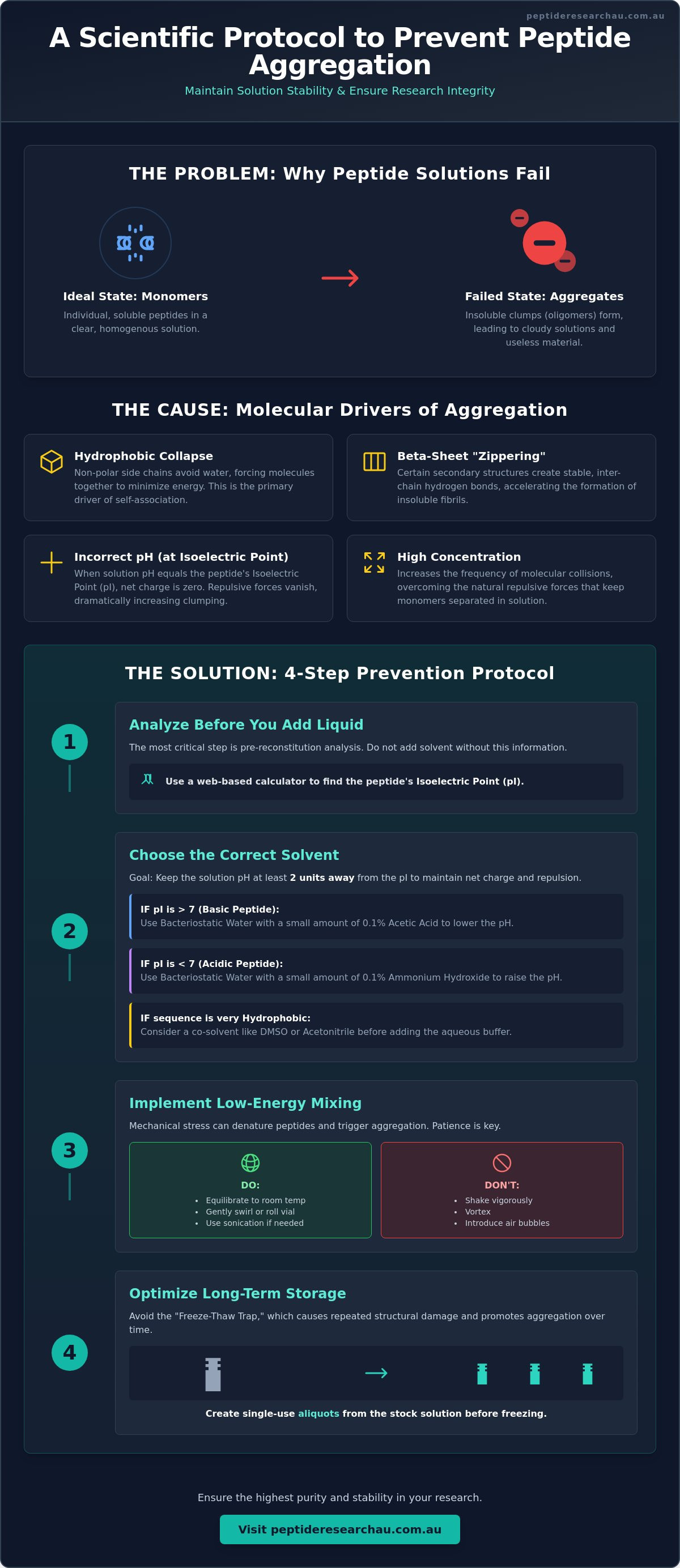
Peptide aggregation is the process where individual peptide monomers self-associate to form insoluble oligomers or larger polymers. This phenomenon represents a significant obstacle in laboratory research, as it alters the effective concentration and bioactivity of the sample. The primary driver is often hydrophobic collapse. In this process, non-polar side chains sequester themselves away from the aqueous environment to minimize free energy. This internal drive forces individual molecules into close proximity, initiating the transition from a clear solution to a heterogeneous mixture. Understanding these molecular forces is the first step in learning how to prevent peptide aggregation in solution.
Researchers must distinguish between reversible association and irreversible covalent aggregation. Reversible aggregates are held together by weak non-covalent forces, such as van der Waals interactions or hydrogen bonding. These can often be dissociated by adjusting the pH or adding specific laboratory diluents. Irreversible aggregation involves the formation of covalent bonds, such as inter-chain disulfide bridges, or extremely stable structures that resist solubilization. Visual confirmation of protein aggregation typically includes visible cloudiness, the presence of "floaties," or a thin, gelatinous film adhering to the vial walls.
The Role of Secondary Structures
The transition of a peptide into a beta-sheet conformation often serves as a "zipper" that accelerates aggregation. These structures allow for extensive inter-chain hydrogen bonding, creating stable, insoluble fibrils. Sequence-specific motifs, such as poly-leucine or poly-isoleucine stretches, significantly increase this risk due to their high hydrophobicity. Additionally, the rate of association is directly proportional to the peptide concentration. Higher concentrations increase the frequency of molecular collisions, which overcomes the repulsive forces that otherwise keep monomers apart.
Thermodynamic vs. Kinetic Stability
A peptide solution may appear perfectly clear immediately after reconstitution but develop turbidity over 24 hours. This occurs because the solution is kinetically stable but thermodynamically unstable. The system must overcome an energy barrier to reach the lower-energy aggregated state. Over time, thermal fluctuations or changes in the environment provide the energy needed to cross this barrier. For researchers, the critical aggregation concentration (CAC) is the specific threshold where the monomeric state becomes energetically unfavorable and spontaneous association begins. Mastering how to prevent peptide aggregation in solution involves keeping the peptide below this concentration or modifying the solvent to raise the energy barrier.
Strategic Solvent Selection: Predicting Solubility Before Reconstitution
Successful reconstitution begins with a sequence-first analysis rather than immediate liquid addition. This "First Principles" approach allows researchers to predict potential solubility issues before they occur. The primary determinant of solubility is the Isoelectric Point (pI). This is the specific pH at which a peptide carries no net electrical charge. When the solution pH matches the pI, the repulsive forces between molecules are at their lowest, which significantly increases the risk of clumping. To understand how to prevent peptide aggregation in solution, you must maintain a pH environment where the peptide remains charged.
For most laboratory applications, Bacteriostatic Water serves as the foundational diluent. It provides a sterile environment and prevents microbial growth during storage. If the peptide sequence contains a high percentage of hydrophobic residues, water alone may be insufficient. In these cases, selecting the correct co-solvent is essential to maintain a monomeric state. Choosing the wrong initial solvent can lead to irreversible precipitation, making pre-reconstitution planning a mandatory step in any laboratory protocol.
Calculating pI and Adjusting pH
Determining the net charge of a sequence is a critical preliminary step. Researchers should utilize web-based pI calculators to identify the peptide's theoretical isoelectric point. A reliable rule of thumb is to target a pH that is at least two units away from the pI. If the peptide is basic (pI > 7), adding a small volume of 0.1% Acetic Acid can lower the pH and improve solubility. For acidic peptides (pI < 7), 0.1% Ammonium Hydroxide is often used to raise the pH. These minor adjustments create electrostatic repulsion between molecules, which is a primary method for how to prevent peptide aggregation in solution.
The Solvent Hierarchy
A systematic approach to solvent selection minimizes the risk of irreversible precipitation. Start with Step 1: Attempt to dissolve the peptide in sterile or bacteriostatic water. This works best for highly charged or short sequences. If the solution remains cloudy, move to Step 2: Use a dilute organic solvent such as DMSO or DMF. These solvents disrupt hydrophobic interactions that water cannot overcome. For extremely stubborn sequences, Step 3 involves tertiary aids like brief sonication or gentle temperature control. Always ensure you are using high-purity Laboratory Diluents to maintain the integrity of your research compounds.
Step-by-Step Protocol to Prevent Aggregation During Mixing
Mechanical stress is a frequently overlooked catalyst for molecular clumping. While previous sections focused on the chemical environment, the physical act of reconstitution requires a low-energy approach to maintain structural integrity. High-energy mixing, such as vigorous vortexing or shaking, can lead to mechanical denaturation. This process unfolds the peptide, exposing its hydrophobic core to the solvent and initiating rapid association. Temperature equilibration is the first essential step in this protocol. Always allow the lyophilized vial to reach room temperature in a desiccator before opening. Opening a cold vial introduces atmospheric moisture, which causes localized clumping and uneven hydration before the solvent is even added.
The order of addition is equally critical. You should always add the solvent to the peptide, never the reverse. Adding dry powder to a liquid often results in the formation of large, insoluble masses that are difficult to disperse. For a baseline understanding of standard handling, researchers should refer to the established Peptide Reconstitution Protocol. By controlling the physical variables of the mixing process, you can significantly improve the success rate of your solution preparation. This meticulous handling is a core component of how to prevent peptide aggregation in solution during the initial hydration phase.
The Gradual Hydration Method
To ensure uniform wetting, direct the solvent down the side of the vial wall rather than dropping it directly onto the lyophilized cake. This allows the liquid to slowly wick into the powder. Swirling the vial gently is superior to shaking because it minimizes the air-water interface. Excessive aeration creates bubbles; these interfaces are high-energy sites where peptides often unfold and aggregate. Conduct a visual check for "fish-eyes," which are translucent gel particles where a hydrated outer shell prevents the core from dissolving. If these appear, allow the vial to sit undisturbed for several minutes to permit deeper solvent penetration.
Managing Concentration Gradients
High-concentration stock solutions are inherently more prone to clumping because the reduced distance between molecules increases the probability of collision and binding. For most research applications, an optimal final concentration ranges between 1 and 5 mg/mL. If your protocol requires a higher concentration, you must be even more vigilant about pH and solvent choice. Using master mixes for multi-peptide complexes can help minimize repetitive handling and environmental exposure. Maintaining a lower concentration is one of the most effective ways how to prevent peptide aggregation in solution, as it keeps the peptide well below its critical aggregation threshold.
Advanced Troubleshooting: Solubilizing Aggregated Sequences
Peptide sequences vary significantly in their propensity for self-association. While certain research peptides, such as TB-500, demonstrate robust stability in standard aqueous environments, others are highly temperamental. If a solution develops turbidity during reconstitution, immediate intervention is required. Understanding how to prevent peptide aggregation in solution after the initial mixing phase involves identifying whether the association is still reversible. Once a peptide forms stable, covalent-linked aggregates, it's often unsuitable for high-precision research. At that stage, the effective molarity and bioavailability are compromised, leading to inconsistent experimental data.
The rescue process depends on disrupting the non-covalent forces that drive molecules together. However, there's a limit to what rescue protocols can achieve. If a sequence has undergone significant chemical degradation or irreversible cross-linking, the sample is "too far gone" for reliable study. Researchers must weigh the cost of the material against the risk of using a non-homogenous solution. For the most reliable results in sensitive assays, it's often more efficient to start with fresh Research Compounds and a refined reconstitution strategy.
Mechanical and Thermal Aids
A common question among researchers is whether sonication will degrade the peptide backbone. When used correctly, sonication provides the kinetic energy necessary to disrupt non-covalent aggregates without cleaving peptide bonds. Implement the 30-second sonication rule: apply ultrasonic energy in short bursts while maintaining the vial in a cold-water bath. This prevents localized overheating which could otherwise lead to thermal denaturation. If the solution remains slightly cloudy, brief incubation at 37°C may increase molecular motion enough to achieve a monomeric state. Use this with caution for heat-sensitive sequences. Centrifugation at 10,000 x g for five minutes serves as a useful diagnostic tool. If a pellet forms, you're dealing with undissolved powder or large aggregates; if the solution remains cloudy, you're likely observing a stable colloidal suspension of oligomers.
Chemical Rescue Agents
If mechanical aids fail, chemical modifiers may be necessary to restore clarity. The "DMSO Drop" technique involves adding 100% DMSO dropwise to a cloudy aqueous solution until the mixture clears. This disrupts hydrophobic interactions that water cannot penetrate. For extremely hydrophobic sequences, adding trace amounts (0.01% to 0.1%) of non-ionic detergents like Tween-20 can stabilize the monomeric form. While some protocols suggest high concentrations of chaotropic agents like 6M Urea, these are frequently incompatible with downstream biological assays. If you must use them, you'll need to dialyze the solution against your final buffer later. Mastering these chemical interventions is an advanced part of how to prevent peptide aggregation in solution when standard methods prove insufficient.
Long-Term Stability: Preserving the Monomeric State
Maintaining the monomeric state over time requires a deep understanding of the "Freeze-Thaw" trap. When a peptide solution freezes, the formation of ice crystals excludes solutes from the crystalline lattice. This exclusion creates localized zones of extremely high peptide concentration. These micro-environments often exceed the critical aggregation concentration, forcing molecules into irreversible contact. Repeated cycles of freezing and thawing exacerbate this effect, progressively reducing the concentration of bioactive monomers. Learning how to prevent peptide aggregation in solution during storage is vital for researchers aiming for longitudinal study consistency.
The transition from a freshly reconstituted solution to a stored stock requires immediate stabilization. Biological activity can drop significantly if the peptide is allowed to aggregate during even a single temperature shift. By implementing standardized storage protocols, you ensure that the structural integrity of your research peptides remains intact. Adhering to established Peptides Australia standards for quality assurance provides a reliable framework for these laboratory procedures.
Aliquotting and Storage Protocols
Single-use aliquots are the gold standard for laboratory research. By dividing the stock solution into individual portions, you eliminate the need for repeated temperature cycling. The choice of storage container also influences stability. While glass is traditional, its surface can sometimes facilitate adsorption or leach ions that catalyze aggregation. Low-protein-binding polypropylene vials are generally preferred to minimize surface-mediated interactions. To ensure maximum stability, follow these temperature standards:
4°C: Suitable only for short-term use, typically under 72 hours.
-20°C: Appropriate for intermediate storage of several weeks.
-80°C: Recommended for long-term preservation of several months or more.
Always use desiccants during the thawing process to prevent condensation from introducing moisture into the vial, which can lead to localized clumping. This simple step is a critical part of how to prevent peptide aggregation in solution when transitioning from deep-freeze storage to active use.
Monitoring for Degradation
Researchers must distinguish between physical aggregation and chemical degradation, such as oxidation or deamidation. While cloudiness indicates physical clumping, chemical changes may not be visible to the naked eye. High-Performance Liquid Chromatography (HPLC) is the most reliable method for verifying monomeric purity after storage. A shift in the retention time or the appearance of secondary peaks often signals that the peptide has begun to associate or degrade. A final checklist for solution integrity includes a visual inspection for turbidity, verification of pH stability, and periodic HPLC analysis for purity confirmation. Implementing these rigorous checks ensures the reliability of your experimental outcomes and the longevity of your research materials.
Optimizing Laboratory Precision and Results
Achieving consistent experimental outcomes requires a meticulous approach to molecular stabilization. By integrating sequence analysis with precise pH adjustments and low-energy mixing techniques, you can effectively bypass the thermodynamic drivers of clumping. Mastering how to prevent peptide aggregation in solution ensures that your research compounds remain in their bioactive monomeric state, preserving the integrity of your data over long-term storage. Success in the laboratory is built on these foundational standards of reliability and precision.
Maintaining high standards in your research requires access to verified materials and specialized supplies. We provide laboratory-grade purity across our full range of products, with Australian-based shipping to ensure rapid delivery to your facility. From essential laboratory diluents like Bacteriostatic Water to multi-peptide complexes, our offerings support the rigorous demands of professional study. Browse Laboratory-Grade Research Peptides and Supplies to secure the high-performance materials necessary for your next phase of discovery. You've prepared the protocol; now secure the quality your research requires.
Frequently Asked Questions
Why does my peptide aggregate immediately upon adding water?
Immediate aggregation typically occurs when the peptide's hydrophobic regions are exposed or the pH of the water is too close to the sequence's isoelectric point (pI). This leads to rapid hydrophobic collapse where molecules associate rather than hydrate. The lack of electrostatic repulsion causes the lyophilized powder to form insoluble masses before it can achieve uniform distribution.
Can I still use a peptide solution if it has become slightly cloudy?
Cloudiness indicates the presence of insoluble oligomers or aggregates that compromise the solution's effective molarity. While some monomeric peptide may remain, the bioactivity and concentration are no longer reliable for high-precision research. Using a heterogeneous solution often results in inconsistent experimental data and poor reproducibility in biological assays.
Does DMSO prevent peptide aggregation better than bacteriostatic water?
DMSO is a polar aprotic solvent that disrupts hydrophobic interactions more effectively than aqueous diluents. It's often necessary for sequences with a high percentage of non-polar amino acids. While it's superior for solubilizing hydrophobic sequences, researchers must verify that the final DMSO concentration is compatible with their specific cell lines or assays.
How does pH affect the aggregation of research compounds?
The pH of the solvent determines the net electrical charge of the peptide molecules. When the pH is at least two units away from the isoelectric point, the molecules carry a similar charge and repel each other. This electrostatic repulsion is a primary mechanism in how to prevent peptide aggregation in solution and maintain a stable monomeric state.
Is sonication safe for preventing clumps in peptide solutions?
Sonication is safe when applied in short bursts of 30 seconds or less while keeping the vial in a cold-water bath. This provides the kinetic energy needed to disrupt non-covalent aggregates without cleaving the peptide backbone. You must avoid excessive heat during this process, as thermal stress can lead to irreversible denaturation and further clumping.
What is the best temperature to store reconstituted peptides to avoid aggregation?
Optimal storage for long-term stability is -80°C, as it minimizes molecular motion and chemical degradation. For immediate use within 72 hours, 4°C is acceptable. If the research requires storage for several weeks, -20°C is the standard; however, you must use single-use aliquots to avoid the aggregate-inducing effects of repeated freeze-thaw cycles.
Can I reverse peptide aggregation once it has occurred?
Reversal is possible for non-covalent aggregates by adjusting the solution pH or adding co-solvents like DMSO. These interventions disrupt the weak forces holding the molecules together. Understanding how to prevent peptide aggregation in solution is critical because if the association involves covalent bonding or stable beta-sheet fibrils, the process is generally irreversible.
Does the concentration of the solution influence the rate of aggregation?
Peptide concentration is a direct driver of the rate of self-association. Higher concentrations increase the frequency of molecular collisions, which overcomes the repulsive forces keeping the monomers apart. Maintaining stock solutions between 1 and 5 mg/mL is a reliable standard to minimize the probability of spontaneous aggregation during research.


Comments