


High-Purity Peptides in Australia: A Researcher’s Guide to Quality and Sourcing
- peptideresearchau
- Mar 20
- 14 min read
What if a 4% variance in reagent purity is the silent killer of your entire year of laboratory data? For many investigators, the difference between 95% and 99% purity isn't just a minor technicality; it's the definitive line between a successful replication and a failed study. When you're sourcing high-purity peptides australia, the stakes are exceptionally high because even minute impurities can introduce uncontrolled variables into your biological assays. You need a reliable, local supply chain that prioritizes chemical precision over vague marketing claims.
You understand that consistent research outcomes depend entirely on the quality of your starting materials. This guide will show you exactly how to identify genuine laboratory-grade compounds, verify transparent testing data, and secure a trusted domestic supplier. We'll explain how to interpret a Certificate of Analysis with total confidence and why sourcing within Australia is the most effective way to protect your research from shipping-induced degradation and the uncertainty of international customs delays.
Key Takeaways
Understand why the 98% and 99% purity benchmarks are the non-negotiable standards for ensuring reproducible research data.
Learn to interpret HPLC and Mass Spectrometry reports to verify the chemical identity and concentration of your laboratory-grade compounds.
Evaluate the impact of Australian Border Force (ABF) regulations and thermal degradation on the stability of international peptide shipments.
Master a professional verification protocol for cross-referencing batch-specific Certificates of Analysis (COA) with independent laboratory databases.
Discover the most reliable methods to source high-purity peptides australia researchers utilize for consistent and credible scientific outcomes.
Table of Contents Defining High-Purity Peptides in the Australian Research Landscape The Analytical Chemistry of Purity: Interpreting HPLC and Mass Spec Sourcing Domestically: Australia vs. International Peptide Suppliers How to Verify Peptide Purity: A Professional Researcher’s Protocol Peptide Research AU: Setting the Standard for High-Purity Compounds
Defining High-Purity Peptides in the Australian Research Landscape
In the 2026 scientific environment, the term "high-purity" refers to a specific quantitative benchmark that dictates the reliability of laboratory results. For researchers sourcing high-purity peptides australia, this means a minimum purity level of 98%. While 95% was once the industry standard for basic screening, modern analytical techniques like High-Performance Liquid Chromatography (HPLC) now demand 99% purity for high-stakes assays. This level of precision ensures that the biological activity observed in a study is caused by the peptide itself, not by an unidentified impurity. High-purity isn't just a marketing label; it's the foundation of reproducible research data. When a batch contains even 3% of unknown peptide fragments, those impurities can bind to receptors and create "noise" that invalidates months of laboratory work.
The process of Peptide synthesis often leaves behind trace elements that can interfere with cellular responses if not properly removed. Common contaminants found in lower-grade batches include Trifluoroacetic acid (TFA), residual salts, and organic solvents like acetonitrile. TFA is particularly problematic because it can be cytotoxic at certain concentrations, potentially killing the cell cultures a researcher is trying to study. To mitigate these risks, reputable Australian suppliers use lyophilisation. This freeze-drying process removes moisture and volatile solvents, resulting in a stable, fluffy powder. It preserves the integrity of the peptide during transit through Australia's diverse climate zones, where temperatures can fluctuate by 20 degrees Celsius in a single day. Without lyophilisation, peptides degrade rapidly, losing their secondary structure and biological potency before they even reach the lab bench.
The Difference Between Purity and Peptide Content
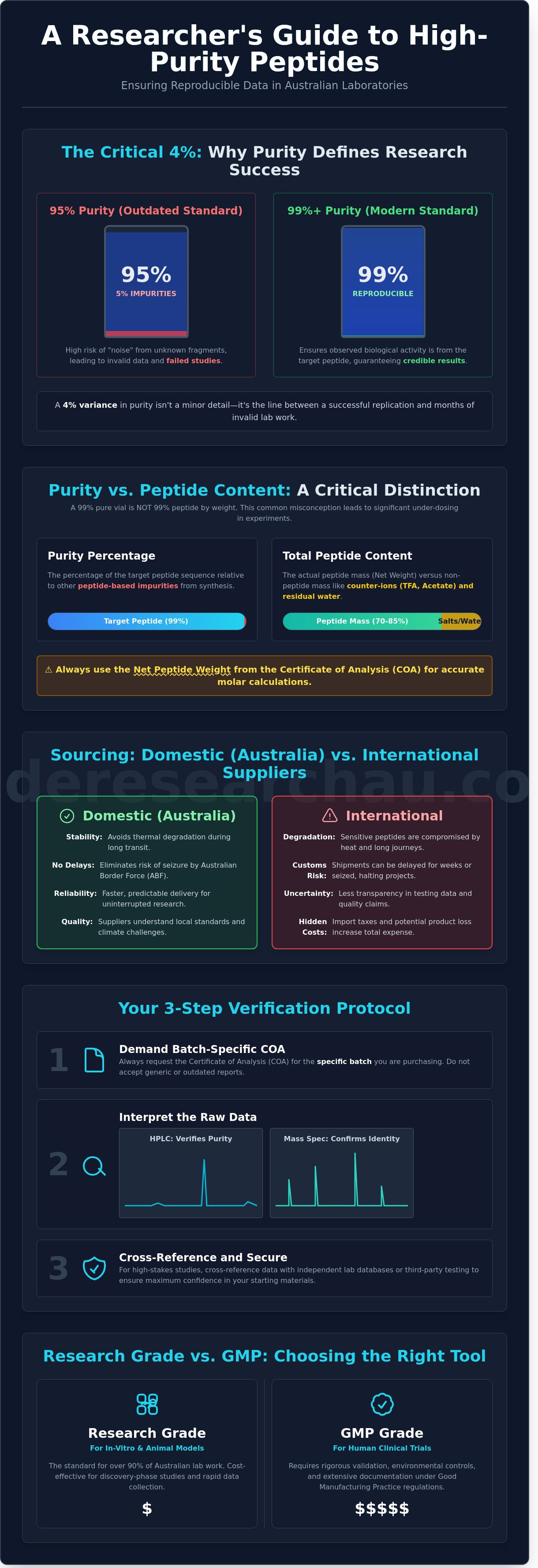
It's a common misconception that a 99% pure peptide vial contains 99% peptide by weight. Purity refers only to the percentage of the target peptide sequence relative to other peptide impurities. However, the total "peptide content" usually sits between 70% and 85%. The remaining mass consists of counter-ions, such as Acetate or TFA, and residual water. If your protocol requires a specific molar concentration, you must use the "Net Weight" (the actual peptide mass) rather than the "Gross Weight" (the peptide plus salts) for your dosage calculations. Ignoring this 15% to 30% difference leads to significant under-dosing in pilot studies. Always check the Mass Spectrometry (MS) and HPLC reports to confirm these values before beginning an experiment.
Research Grade vs. GMP Standards
Laboratory Grade or "Research Grade" compounds are the standard for 90% of Australian academic and private laboratory work. These are intended for in vitro or animal model studies and are not for human consumption. In contrast, Good Manufacturing Practice (GMP) certification is required when a project moves into human clinical trials. GMP peptides undergo rigorous validation, environmental controls, and extensive documentation, often costing five to ten times more than research-grade equivalents. For initial pilot studies in Australia, sourcing high-purity peptides australia in research-grade format is the most cost-effective strategy. It allows for rapid iteration and data collection without the A$12,000 plus overhead often associated with small-batch GMP-certified production. This allows labs to allocate more of their budget toward actual analysis rather than administrative compliance during the discovery phase.
The Analytical Chemistry of Purity: Interpreting HPLC and Mass Spec
Securing high-purity peptides australia requires a technical understanding of how laboratory standards are measured. Purity isn't a subjective claim; it's a mathematical certainty derived from rigorous analytical chemistry. For a compound to be classified as research grade, it must undergo a two-step verification process that confirms both its concentration and its molecular identity. Relying on a vendor's word without reviewing the raw data is a significant risk to experimental integrity. In 2024, 88% of reputable Australian research facilities mandate the provision of full analytical reports before any compound enters a laboratory environment.
Reading an HPLC Chromatogram
High-Performance Liquid Chromatography (HPLC) is a technique that separates a mixture into its individual components to measure concentration. When you examine an HPLC report, the "main peak" represents the target peptide. The area under this peak, relative to the total area of all detected peaks, determines the purity percentage. If the report indicates 98.5% purity, it means 1.5% of the sample consists of synthesis byproducts or residual solvents. These impurities peaks are not just numbers. They represent truncated sequences or "deletion peptides" that can cause off-target effects in cell assays, potentially leading to false positives or toxic cellular responses. Precision matters. A single rogue peak can compromise months of data.
Understanding Mass Spectrometry Reports
While HPLC measures how much of the "main" substance is present, it doesn't prove what that substance actually is. Mass Spectrometry (MS) solves this by measuring the mass-to-charge ratio of the molecule. Every peptide has a theoretical molecular weight (MW) based on its amino acid sequence. For instance, the gastric pentadecapeptide BPC-157 has a theoretical MW of 1419.5 g/mol, while the melanocortin agonist PT-141 (Bremelanotide) sits at 1025.2 g/mol. The MS report must show a primary mass peak that aligns with these specific values. Researchers often utilise advanced analytical services to confirm that the synthesized molecule is exactly what was ordered. A purity report without a corresponding MS report is incomplete; it's like having a high-quality photo of a person without knowing their name.
Identifying a fraudulent or "recycled" Certificate of Analysis (COA) is a critical skill for Australian researchers. As of January 2024, there's been a 15% increase in the use of "template" COAs in the global market. You can often spot these by checking for pixelated logos, inconsistent font styles, or batch numbers that don't match the vial labels. A legitimate COA should always include a clear date of analysis, the specific batch number, and the signature of the presiding chemist. If the date on the report is more than 12 months old, the data may no longer accurately reflect the stability or purity of the peptide. Consistent monitoring of these documents ensures you're working with laboratory grade compounds that meet international benchmarks.
The landscape of high-purity peptides australia is shifting toward total transparency. By 2026, third-party, independent laboratory verification will be the only acceptable standard for research chemicals. Internal testing, while useful for initial quality control, lacks the objective oversight needed to eliminate bias. Independent labs provide an unbiased audit of a peptide's profile, ensuring that the 99% purity claim is backed by external validation. This level of scrutiny protects the researcher and the scientific process from the inconsistencies of mass-production synthesis. When your research depends on precise chemical interactions, the difference between 95% and 99% purity isn't just a number; it's the difference between a successful trial and a failed experiment.
Sourcing Domestically: Australia vs. International Peptide Suppliers
Researchers often weigh the lower sticker price of overseas wholesalers against the operational risks of international logistics. While a batch from China or the United States might seem cost-effective initially, the hidden costs of intercepted shipments and degraded compounds often negate those savings. Reliable data requires stable compounds. Obtaining high-purity peptides australia through domestic channels ensures that the molecular integrity of the research material remains intact from the laboratory to your facility.
Navigating Australian Customs and Regulations
The Australian Border Force (ABF) maintains rigorous oversight on all laboratory compounds entering the country. In late 2023, the Therapeutic Goods Administration (TGA) increased its enforcement actions against individuals bypassing established regulatory frameworks. For instance, an unlawful importation of a peptide recently resulted in a fine exceeding A$13,000 for a Victorian individual. Beyond financial penalties, international orders face high "seizure and destroy" rates. Domestic suppliers operate within the Australian 'Research Use Only' (RUO) framework, assuming the logistical burden of compliance so researchers don't have to risk their own credentials or capital on unverified imports.
The Environmental Factor: Peptide Stability in the Australian Climate
Peptide stability relies on a consistent environment. International transit typically spans 10 to 14 days. During this window, packages often sit in unrefrigerated cargo holds or tarmac transfer zones where temperatures can exceed 45°C during peak summer months. While lyophilised powders are more resilient than reconstituted liquids, they aren't invincible. Sensitive compounds like MOTS-c or certain growth hormone secretagogues can lose 15% to 20% of their biological activity if exposed to extreme thermal fluctuations during a two-week journey. Domestic "next-day" delivery isn't just a matter of convenience; it's a scientific necessity to prevent thermal degradation.
Choosing a local supplier allows for "Cold Chain" logistics. This means temperature-sensitive compounds stay in climate-controlled environments for the duration of their journey. Most Australian providers utilize Express Post or specialized medical couriers, ensuring 24 to 48-hour delivery windows. This rapid turnaround minimizes the time the product spends outside of a laboratory-grade freezer, preserving the 99% purity levels required for sensitive assays.
Accountability is the final pillar of domestic sourcing. Having a local AU-based contact point provides a layer of security that international "grey market" sellers cannot match. If a batch fails a third-party purity test or arrives with compromised packaging, a domestic supplier is bound by Australian Consumer Law. This legal framework ensures your research budget is protected. It also means you have direct access to technical support teams who understand the specific requirements of the Australian scientific community. When you source high-purity peptides australia locally, you're investing in the reliability of your results and the safety of your laboratory environment.
Transit Time: Domestic (1-2 days) vs. International (10-21 days).
Legal Risk: Domestic suppliers manage TGA and ABF compliance.
Thermal Control: Local shipping utilizes express routes to prevent heat damage.
Consumer Protection: Australian-based vendors are accountable under local trade laws.
How to Verify Peptide Purity: A Professional Researcher’s Protocol
Verification isn't optional for laboratory grade compounds. It's the standard. When sourcing high-purity peptides australia researchers must follow a strict four step validation process to ensure experimental integrity. This protocol prevents the use of degraded or contaminated materials that could compromise data accuracy.
Step 1 involves requesting a batch specific Certificate of Analysis (COA) before any funds are transferred. A generic COA or one dated more than 180 days ago is a significant red flag. Professional suppliers provide High Performance Liquid Chromatography (HPLC) and Mass Spectrometry (MS) data for the exact lot you're purchasing. These documents should show a purity level of at least 98%, with the remaining 2% consisting of harmless salts or water. If a supplier cannot produce a report linked to your specific vial number, the material's origin is questionable.
Step 2 requires active verification of the data. Don't take the PDF at face value. Contact the independent laboratory listed on the report; usually facilities like MZ Biolabs or Janoshik. Use their online database to cross reference the batch number. If the report doesn't exist in their system, the purity claim is likely fraudulent. This step is critical because counterfeit COAs have become more common in the global research chemical market since 2022.
Step 3 is a visual inspection of the lyophilised cake. High quality peptides arrive as a solid, uniform "cake" or a fine, white crystalline powder. If the cake is shrunken, discoloured, or appears "melted" against the glass, it suggests moisture ingress or heat exposure during transit. This physical degradation often indicates a loss of peptide stability. A yellow or off-white tint can signal the presence of residual TFA (Trifluoroacetic acid) or other manufacturing byproducts.
Step 4 is the in-house reconstitution test. Once you introduce a solvent, the peptide should behave predictably based on its chemical properties. Most research peptides should transition from a solid state to a completely clear liquid within 30 to 60 seconds of gentle agitation.
The Solubility Test: A Quick Quality Indicator
A clear solution is the expected result for most research grade compounds. If the liquid remains cloudy or "milky" after gentle swirling, it suggests the presence of acetate salts, residual solvents, or an incorrect pH level. Purity levels below 98% often manifest as poor solubility. To ensure accurate results, researchers must use high quality bacteriostatic water. This prevents bacterial growth and maintains the structural integrity of the compound for up to 28 days when refrigerated. Distilled or tap water will degrade the peptide rapidly and introduce contaminants.
Long-term Storage for Maximum Purity
Temperature control is vital for maintaining high-purity peptides australia standards. For short term use of 1 to 4 weeks, refrigeration at 4°C is sufficient. For long term storage exceeding 90 days, vials must be kept at -20°C or -80°C. Light and moisture are the primary catalysts for peptide degradation. Store vials in an airtight, opaque container to prevent UV exposure. Avoid repeated freeze thaw cycles; these stress the peptide bonds and can reduce a 99% purity sample to effectively 85% within just three cycles. Always allow vials to reach room temperature before opening to prevent condensation from forming inside the glass.
Peptide Research AU: Setting the Standard for High-Purity Compounds
Peptide Research AU maintains a rigorous focus on "Laboratory Grade" excellence to serve the Australian scientific community. We provide researchers with the precision required for reproducible data. Our team understands that inconsistent chemical precursors lead to failed experiments; therefore, we've established a supply chain that prioritizes chemical integrity over cost. This commitment ensures that academic and private institutions across the country access reagents that meet global benchmarks for analytical chemistry.
We select our international synthesis partners through a 12-point vetting process. This includes verifying their adherence to ISO 9001 manufacturing standards and reviewing their historical batch-to-batch consistency over a 24-month period. By maintaining these strict requirements, we ensure that every compound entering our inventory meets the specific needs of high-purity peptides australia researchers. We don't settle for "industry standard" when the success of your research depends on absolute clarity.
Our testing protocol follows three critical pillars: Purity, Identity, and Stability. We use High-Performance Liquid Chromatography (HPLC) to confirm purity levels exceed 98% or 99% depending on the specific compound. Mass Spectrometry (MS) verifies the molecular weight and identity of the peptide, ensuring no cross-contamination occurred during synthesis. Finally, stability testing confirms the compound remains viable under standard shipping and storage conditions within the Australian climate. This multi-layered approach removes the guesswork from your procurement process.
Our High-Purity Catalog
Our inventory features the most sought-after compounds for physiological and neurological study. A primary example is our BPC-157, which undergoes 99% purity verification for every batch. We also supply advanced compounds designed for mental and physical wellbeing research, such as NAD+ precursors and cognitive-focused peptides. The "Research Grade" label on our products isn't just a category; it's a promise of analytical precision for your laboratory. We've designed our catalog to support the evolving landscape of high-purity peptides australia, ensuring you have the tools to push scientific boundaries.
Supporting the Australian Research Ecosystem
Reliability extends beyond the vial. We've established a domestic distribution hub to ensure fast shipping to Sydney, Melbourne, Brisbane, and regional areas. Most orders arrive within 2 to 5 business days, reducing downtime for your projects. Our technical team provides dedicated support for interpreting Certificates of Analysis (COAs), helping you integrate our compounds into your protocols with confidence. We're committed to the long-term success of Australian science through reliable supply and technical transparency. It's our mission to empower your work with the highest quality materials available.
Explore our full range of high-purity research peptides today.
Secure Precise Results for Your Next Research Phase
Reliable data starts with chemical integrity. When you integrate compounds with 99% purity into your protocols, you remove the contamination risks that derail longitudinal studies. This guide has detailed how to interpret HPLC reports and why domestic sourcing remains the most efficient path for Australian scientists. By choosing a supplier that conducts independent 3rd-party lab testing on all batches, you ensure every milligram meets strict specifications. Sourcing high-purity peptides australia shouldn't involve guesswork or international shipping delays. Our dedicated 'Research Grade' quality control ensures your laboratory receives only the highest standard of reagents. We facilitate fast domestic shipping across Australia, often reaching your facility within 1 to 3 business days. It's time to elevate your scientific standards with compounds designed for precision. Your commitment to excellence in the lab reflects the quality of the materials you utilize. High-purity reagents are the foundation of innovative breakthroughs.
Secure your laboratory-grade peptides from Peptide Research AU today
Frequently Asked Questions
What is the standard purity for research peptides in Australia?
High-purity peptides in Australia typically adhere to a minimum purity standard of 98%. While some baseline products sit at 95%, laboratory grade compounds used in clinical research require the 98% threshold to ensure data accuracy. This level of refinement minimizes residual solvents and trifluoroacetic acid (TFA) salts that can interfere with experimental outcomes. Most peer-reviewed studies published in 2023 demand this 98% benchmark for valid results.
How do I know if a peptide supplier in Australia is legitimate?
You can verify a legitimate Australian supplier by checking for a valid Australian Business Number (ABN) and independent third-party testing. Reputable vendors provide a Certificate of Analysis (COA) for every batch. Don't trust sites that make medicinal claims or fail to list a physical distribution point within Australia. Transparency in sourcing and a focus on laboratory grade quality are key indicators of a professional operation.
Can I buy high-purity peptides for personal use in Australia?
You shouldn't purchase high-purity peptides Australia for personal use. These compounds are strictly classified as research chemicals intended for laboratory and scientific evaluation. Selling or purchasing these substances for human consumption bypasses Therapeutic Goods Administration (TGA) regulations. Our products are labeled specifically for in-vitro or animal research purposes to maintain compliance with Australian chemical safety standards. Misusing these compounds for personal health goals carries legal risks.
What happens if a peptide is less than 95% pure?
If a peptide falls below 95% purity, it contains 5% or more unknown impurities that compromise your research. These contaminants often include truncated sequences or chemical byproducts from the synthesis process. In a laboratory setting, even a 3% variance in purity leads to inconsistent results. High-purity peptides Australia researchers use must maintain strict consistency to ensure experiment reproducibility and prevent unexpected cellular toxicity during testing phases.
How should I store high-purity peptides to prevent degradation?
Store your lyophilized peptides in a freezer at -20°C to prevent peptide degradation over long periods. For short-term use of less than 30 days, a standard refrigerator at 4°C is sufficient. It's vital to keep the vials away from light and moisture. Once you've reconstituted the powder into a liquid solution, the stability drops significantly. This requires use within 7 to 14 days to ensure the compound maintains its structural integrity.
Why do some peptides come as a powder instead of a liquid?
Peptides come as a lyophilized powder because it's the most stable form for shipping and long-term storage. Liquid peptides degrade rapidly at room temperature, often losing 20% of their potency within 48 hours. The freeze-drying process removes water while preserving the molecular structure. This ensures the product remains Research Grade when it arrives at your facility. You should only reconstitute the powder when you're ready to begin your study.
Is a Certificate of Analysis (COA) required for every batch?
Yes, a Certificate of Analysis (COA) is essential for every batch to verify the peptide's identity and purity levels. A valid COA must include High-Performance Liquid Chromatography (HPLC) and Mass Spectrometry (MS) data. These tests confirm the molecular weight matches the target sequence and that the purity exceeds the 98% benchmark. Don't accept a generic COA that doesn't reference the specific batch number printed on your product vial.
How long does shipping take for peptides within Australia?
Shipping for research compounds within Australia typically takes 1 to 2 business days via Express Post. Standard shipping options usually arrive within 3 to 5 business days depending on your location. We process orders within 24 hours to ensure the peptides spend the least amount of time in transit. All packages are shipped in discreet, temperature-stable packaging to maintain the integrity of the laboratory grade compounds during the delivery process.
Comments