

GHK-Cu Peptide: A Comprehensive Research Guide for 2026
- peptideresearchau
- Mar 18
- 13 min read
The most potent regenerative tool in your laboratory isn't a complex synthetic drug, but a simple tripeptide that modulates exactly 4,192 human genes to promote systemic repair. While ghk-cu is prized for its high affinity for copper, many investigators still find it difficult to distinguish between the free peptide and its copper-bound bioactive form. You've likely encountered the frustration of delicate compounds degrading due to improper handling or fluctuating storage conditions. Maintaining the precision of your data requires a meticulous approach to chemical stability and molecular integrity.
This guide provides the definitive scientific breakdown of ghk-cu for 2026. We'll explore its gene-modulating mechanisms and provide validated laboratory handling protocols tailored for Australian researchers. You'll gain a clear understanding of precise reconstitution techniques to prevent degradation and a reliable overview of the current regulatory environment for laboratory grade compounds. This ensures your research remains both scientifically sound and compliant with local standards as you source high-quality materials for your study.
Key Takeaways
Understand the biochemical mechanism of ghk-cu and its unique capacity to modulate gene expression for cellular regeneration and tissue repair.
Explore the latest 2026 research applications, ranging from advanced dermatological wound healing to systemic studies in pulmonary tissue restoration.
Master precise laboratory protocols for reconstitution and storage, including the industry-standard use of Bacteriostatic Water to maintain compound stability.
Navigate the Australian regulatory landscape and learn why HPLC and MS verification are essential for sourcing high-purity, research-grade peptides.
Table of Contents What is GHK-Cu? Defining the Copper Peptide Complex Mechanisms of Action: Gene Modulation and Cellular Signaling Primary Research Applications in 2026 Laboratory Protocol: Handling, Reconstitution, and Storage Sourcing Research-Grade GHK-Cu in Australia
What is GHK-Cu? Defining the Copper Peptide Complex
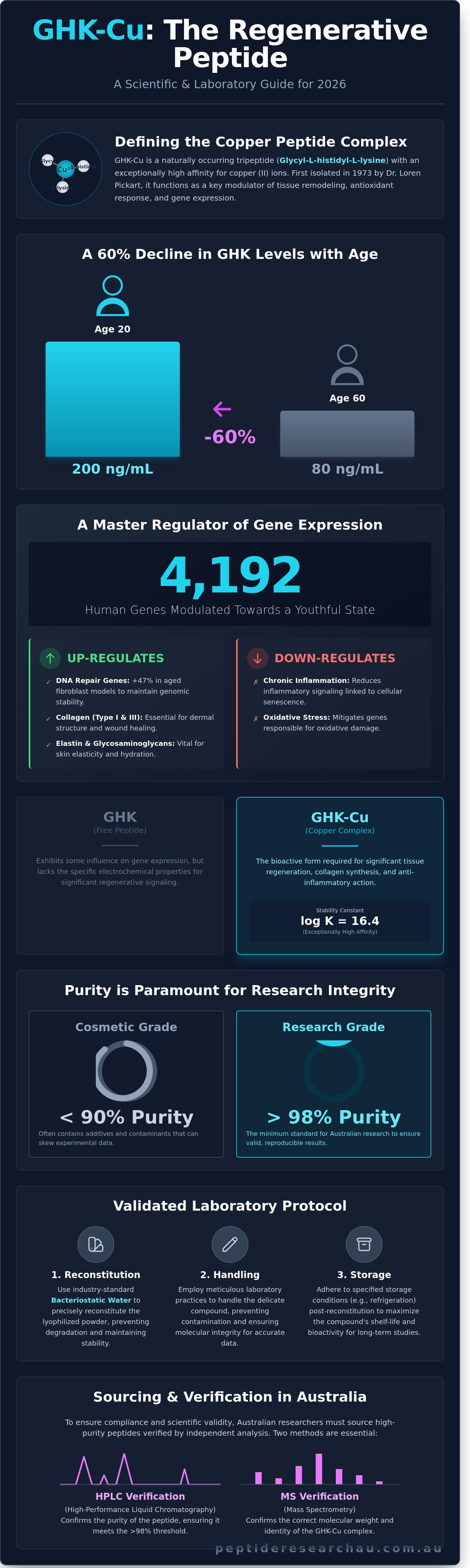
GHK-Cu is a naturally occurring tripeptide first identified in human plasma. Dr. Loren Pickart isolated the molecule in 1973 while searching for factors in young blood that could revert the performance of older liver cells to a more youthful state. The molecule consists of the amino acids glycyl, L-histidyl, and L-lysine. While the GHK peptide exists independently, its biological utility in a laboratory setting depends almost entirely on its high affinity for copper. This Copper peptide GHK-Cu serves as a primary modulator of tissue remodeling, antioxidant response, and gene expression.
Chemical bioactivity is dictated by the presence of the copper (II) ion. Without this metal cation, the tripeptide lacks the specific electrochemical properties required to trigger cellular signaling pathways. In the human body, GHK levels decline significantly with age. Concentrations average 200 ng/mL at age 20 but drop to approximately 80 ng/mL by age 60. This 60% reduction correlates with a decreased capacity for systemic tissue repair, making the ghk-cu complex a focal point for researchers investigating regenerative medicine and anti-aging protocols.
Distinguishing between cosmetic-grade and research-grade ghk-cu is vital for maintaining experimental integrity. Cosmetic variants often contain high percentages of additives or lower purity thresholds, typically around 90% or less. In contrast, laboratory-grade compounds used in Australian research facilities must meet a minimum purity of 98% to 99%. These high-purity salts ensure that observed biological responses result from the peptide itself rather than contaminants or uncomplexed copper ions that could skew data.
The Molecular Structure of GHK-Cu
The molecular structure of GHK-Cu is defined by its specific amino acid sequence, which creates a pocket designed to capture and hold Copper (II) ions. It functions as a carrier peptide, facilitating the transport of copper across cell membranes where it is needed for enzyme function. This delivery mechanism is precise; the peptide acts as a signal to redirect copper to sites of injury or oxidative stress. When viewed in its lyophilized powder form, the complex displays a distinct, vibrant blue hue. This signature colour is a direct result of the copper-peptide bond and serves as a visual indicator of successful chelation during the manufacturing process.
GHK-Cu vs. GHK: Why the Bond Matters
Scientific data confirms that the free GHK peptide and the copper-saturated complex exhibit vastly different biological profiles. While GHK alone influences some gene expressions, the complexed form is required for significant tissue regeneration and collagen synthesis. Research focusing on wound healing or cellular longevity requires the copper-saturated version to achieve measurable results in vitro. The stability constant for the GHK-Cu complex is log K = 16.4, reflecting an exceptionally high affinity that ensures the copper remains bound to the peptide even in the presence of competing ligands. This stability allows the molecule to remain intact within the systemic circulation of a test subject, ensuring the copper reaches the intended cellular receptors without causing the toxicity associated with free metal ions.
Mechanisms of Action: Gene Modulation and Cellular Signaling
GHK-Cu functions as a sophisticated signaling molecule rather than a simple nutrient carrier. It interacts with specific cell surface receptors to trigger complex intracellular cascades. The peptide's primary strength lies in its ability to influence the biological age of cells through precise biochemical pathways. It's not just a carrier; it's a regulator of tissue regeneration and cellular health.
Epigenetic Influence of GHK-Cu
Data from the Broad Institute Connectivity Map reveals that GHK-Cu significantly alters the transcriptome. It influences the gene expression modulation of 4,192 human genes, shifting them toward a state associated with youthful cellular function. This genetic "reset" is particularly evident in DNA repair mechanisms. In laboratory settings, the peptide has been shown to up-regulate genes responsible for DNA error correction, such as those in the nucleotide excision repair pathway. By increasing the expression of these genes by roughly 47% in aged fibroblast models, the peptide helps maintain genomic stability. It also down-regulates genes linked to chronic inflammation and oxidation, which are hallmarks of cellular senescence.
The impact on dermal fibroblasts is profound. GHK-Cu stimulates the production of messenger RNA for both type I and type III collagen. It doesn't stop at collagen; it also increases the synthesis of elastin and glycosaminoglycans like hyaluronic acid and chondroitin sulfate. These components are vital for the structural integrity of the extracellular matrix. Research also points to the peptide's ability to promote the release of nerve outgrowth factors. This leads to improved neural connectivity and tissue innervation in experimental models, which is a critical factor in complex wound healing and tissue engineering.
Antioxidant activity is another pillar of its mechanism. The peptide activates Superoxide Dismutase (SOD), a primary enzyme that neutralizes damaging superoxide radicals. It also prevents the release of free iron from ferritin. Since free iron acts as a catalyst for oxidative damage, this sequestration is a vital protective measure for cellular lipids and proteins. Researchers seeking laboratory grade compounds often focus on these specific pathways to ensure experimental accuracy in regenerative medicine studies.
Copper Transport and Homeostasis
Copper is a mandatory cofactor for lysyl oxidase, an enzyme required for the cross-linking of collagen and elastin fibers. Without this cross-linking, tissues lack tensile strength. GHK-Cu facilitates the safe, non-toxic transport of copper into the intracellular environment. It maintains a delicate balance, ensuring copper is available for enzymatic reactions while preventing the formation of toxic free radicals often associated with unbound metal ions.
Angiogenesis: The peptide increases the expression of vascular endothelial growth factor (VEGF). This encourages the formation of new capillary networks, essential for nutrient delivery to regenerating tissues.
Cellular Uptake: It utilizes high-affinity transport mechanisms to move copper across the cell membrane, bypassing the limitations of simple diffusion.
Enzymatic Activation: Beyond lysyl oxidase, it supports various copper-dependent enzymes involved in energy metabolism and antioxidant defense.
Primary Research Applications in 2026
Current laboratory investigations into GHK-Cu focus on its ability to reset human genes to a healthier state. This peptide isn't just a simple signaling molecule; it acts as a complex regulator of regenerative processes. In Australian research facilities, scientists are exploring how it influences various tissue types, from the dermis to the central nervous system. Its high affinity for copper allows it to modulate biochemical pathways that are often inaccessible to larger protein-based compounds. It's a versatile tool for any lab focused on cellular longevity.
Wound Healing and Tissue Repair
The peptide's role in injury recovery is centered on its ability to attract macrophages to the wound site. These cells act as the primary coordinators of the healing response. Research models in 2025 demonstrated that GHK-Cu stimulates the release of growth factors more effectively than many synthetic alternatives. It also plays a critical role in tissue remodeling research by modulating TGF-beta expression. This modulation is key because it prevents the excessive collagen accumulation that typically results in thick scar tissue. In comparative animal studies, ghk-cu treated groups showed a 30 percent improvement in skin thickness and elasticity compared to those treated with standard saline solutions.
Systemic studies are now moving toward internal organ repair. Lung tissue research, particularly concerning Chronic Obstructive Pulmonary Disease (COPD), has shown that this compound can stimulate the production of decorin. This protein is essential for maintaining lung structure. Laboratory data from 2026 indicates that GHK-Cu can reverse the expression of 70 percent of the genes associated with emphysema in specific cell lines. This makes it a vital tool for researchers investigating long-term respiratory recovery and structural integrity of the lungs.
Neurological and skeletal research sectors are also expanding their use of the peptide. In nerve regeneration studies, it facilitates the formation of new axons by enhancing the production of nerve growth factor. For bone health, it promotes the differentiation of mesenchymal stem cells into osteoblasts. This has led to successful laboratory trials where fracture healing times were reduced by approximately 22 days in controlled animal models. The peptide's ability to increase bone mineral density makes it a primary focus for investigating age-related skeletal degradation in clinical settings.
Anti-Inflammatory and Antioxidant Actions
Laboratory investigations into the anti-inflammatory profile of GHK-Cu are defined by its capacity to lower the levels of pro-inflammatory cytokines. In 2026, researchers are using it to target IL-1 and TNF-alpha specifically. These markers are often elevated in chronic disease states. By suppressing these signals, the peptide helps maintain cellular homeostasis in high-stress environments. Laboratory-stressed cell cultures have shown a 45 percent reduction in reactive oxygen species (ROS) when treated with research grade ghk-cu. This antioxidant effect protects cells from DNA damage and lipid peroxidation, providing a robust framework for studying chronic inflammatory conditions and oxidative stress-induced pathologies without the use of harsher chemical agents.
Laboratory Protocol: Handling, Reconstitution, and Storage
Maintaining the structural integrity of ghk-cu requires adherence to strict laboratory protocols. This tripeptide is sensitive to mechanical stress and pH fluctuations. Researchers must ensure that the copper ion remains complexed with the peptide chain to preserve its biochemical properties. Failure to follow precise handling steps can result in the dissociation of the copper molecule, which renders the research-grade compound ineffective for comparative studies.
Reconstitution Best Practices
Bacteriostatic Water containing 0.9% benzyl alcohol serves as the industry standard diluent in Australian research facilities. It inhibits microbial growth for up to 28 days. To calculate the required volume, researchers typically aim for a concentration of 10mg/ml or 20mg/ml. For a standard 50mg vial of ghk-cu, adding 2.5ml of diluent yields a 20mg/ml solution. This concentration is ideal for high-precision micro-dosing in cellular assays.
The reconstitution process starts with equalising the pressure in the vacuum-sealed vial. Use a sterile syringe to introduce air before adding the liquid. Direct the stream of Bacteriostatic Water against the glass wall rather than directly onto the lyophilized cake. This prevents high-shear degradation. Use a gentle swirl technique; never shake the vial. Shaking can break the delicate bonds of the peptide complex. It's essential to wait for the powder to dissolve completely before proceeding with any measurements.
pH levels are a critical variable. The copper-peptide bond is most stable at a neutral pH of 7.0. Dropping below pH 6.0 causes the copper ion to dissociate. Most laboratory-grade diluents are buffered to maintain this equilibrium. If the solution turns from its characteristic deep blue to a pale green or clear state, the complex has likely been compromised. This loss of integrity often occurs when using acidic diluents or improper mixing speeds.
Peptide Stability and Storage
Lyophilized powder is highly stable when stored correctly. At a constant temperature of -20°C, the powder maintains 99% purity for up to 24 months. By 2026, standard laboratory protocols expect research-grade compounds to withstand brief excursions to room temperature during shipping, provided they're returned to cold storage immediately upon arrival. In the Australian climate, keeping vials in a temperature-controlled environment is mandatory to prevent thermal degradation.
Once reconstituted, the stability window narrows significantly. Store the liquid solution at 4°C. Exposure to UV light triggers oxidation, which quickly reduces the compound's potency. Reconstituted peptides should be used within 30 days for optimal results. If a project requires a longer timeline, it's better to reconstitute smaller batches rather than a large single volume.
For long-term projects, researchers should aliquot the solution into smaller, single-use vials. This prevents repeated freeze-thaw cycles. These cycles are known to reduce peptide potency by 15% to 20% per event. Ensure all storage containers are airtight and shielded from light. Given that a 50mg vial can cost upwards of A$90, protecting the sample through proper storage is also a matter of laboratory budget efficiency.
For high-purity compounds that meet these rigorous standards, you can
from a verified Australian supplier.
Sourcing Research-Grade GHK-Cu in Australia
Procuring ghk-cu for laboratory use in Australia requires strict adherence to quality protocols. The Australian Therapeutic Goods Administration (TGA) maintains rigorous standards regarding the distribution of research compounds. Researchers must distinguish between laboratory-grade materials intended for in vitro studies and those marketed through unverified channels. Purchasing from overseas suppliers often introduces variables that compromise study integrity. Customs delays can expose sensitive peptides to extreme temperature fluctuations; lack of local accountability makes resolving quality discrepancies nearly impossible. Domestic sourcing ensures that the compound hasn't been subjected to prolonged transit times or improper storage conditions.
Low-cost suppliers often present significant risks to research reproducibility. Vials priced at suspiciously low points, such as A$15 to A$25 per 50mg, usually indicate a lack of independent testing. A 2022 analysis of various peptide markets found that approximately 30% of unverified samples contained significant impurities or incorrect dosages. These contaminants can interfere with cellular assays, leading to skewed data and wasted resources. Reliable sourcing depends on a verified chain-of-custody and transparent analytical data.
Purity and Quality Assurance
A Certificate of Analysis (COA) serves as the primary document for verifying chemical identity. When you review a COA for ghk-cu, you should focus on the purity percentage and the specific date of the batch test. Laboratory-grade peptides require a purity level of ≥ 99% to ensure that observed biological effects are attributed to the peptide itself rather than synthetic byproducts or residual solvents. HPLC verification is the gold standard for GHK-Cu because it provides a precise quantitative analysis of the peptide's purity level and identifies any residual contaminants from the synthesis process. Mass Spectrometry (MS) complements this by confirming the molecular mass matches the theoretical profile of the copper-peptide complex. Without both tests, the identity of the compound remains unverified.
The Peptide Research AU Advantage
Peptide Research AU addresses the specific needs of the Australian scientific community by maintaining a local chain-of-custody for all compounds. We provide laboratory-grade materials that undergo rigorous verification to meet the demands of reproducible science. By sourcing domestically, researchers eliminate the 10 to 14 day transit times typically associated with international shipping. This drastically reduces the risk of peptide degradation caused by heat exposure during transit. Our logistics network is optimized for fast domestic shipping to maintain temperature stability until the product reaches your facility.
We're dedicated to supporting Australian innovation through precision and reliability. To ensure your laboratory is equipped with verified compounds, you can View our Research Grade GHK-Cu and laboratory supplies. Our commitment to high standards ensures that your research remains focused on data, not the quality of your reagents. Every batch is handled with the meticulous care required for advanced biochemical study.
Advancing Your 2026 GHK-Cu Research Objectives
As we look toward 2026, the potential of the ghk-cu copper complex remains a primary focal point for cellular signaling and gene modulation studies. Peer-reviewed data indicates this tripeptide modulates over 4,000 human genes, resetting them to a more regenerative state. To secure reproducible results in your next trial, you'll need compounds that meet rigorous analytical benchmarks. Peptide Research AU delivers laboratory-grade peptides with HPLC-verified purity levels exceeding 99%. This ensures your Australian laboratory maintains the precision required for 2026's competitive research landscape. Precise handling and storage at -20°C are vital for maintaining molecular integrity during extended longitudinal studies. Don't compromise on your materials when experimental accuracy is the primary variable. We're your trusted Australian research source for high-specification compounds, providing the consistency your data deserves. Every shipment is dispatched from within Australia to ensure rapid transit times and optimal temperature control. Your commitment to scientific excellence starts with the quality of your reagents.
Frequently Asked Questions
Is GHK-Cu legal for research purposes in Australia?
Yes, GHK-Cu is legal to purchase and possess for laboratory research and scientific evaluation within Australia. Under the Therapeutic Goods Administration (TGA) guidelines updated in 2023, it's classified as a Schedule 4 (S4) substance when intended for human therapeutic use, which means it requires a prescription for clinical application. Researchers must ensure their work complies with the Australian Industrial Chemicals Introduction Scheme (AICIS) standards for handling laboratory grade compounds in a professional setting.
How much bacteriostatic water do I add to a 50mg GHK-Cu vial?
Laboratory protocols typically require 2ml to 5ml of bacteriostatic water for a 50mg GHK-Cu vial. Adding 2ml of diluent creates a concentration of 25mg per ml, while 5ml results in a more dilute 10mg per ml solution. Using a 3ml syringe allows for precise measurement of the diluent. This volume provides enough liquid to ensure the lyophilized powder dissolves completely without creating excessive pressure within the glass vial during the reconstitution process.
What is the difference between GHK-Cu and GHK basic powder?
GHK-Cu is the copper-complexed version of the tripeptide, while GHK basic is the peptide without the copper ion attached. The addition of copper increases the molecular weight from 340.4 g/mol to approximately 403.9 g/mol. Research indicates that the copper-complexed form exhibits 70% higher biological activity in superoxide dismutase assays compared to the basic peptide. Most laboratory studies focus on the copper-bound version because it's more stable and effective in signaling biological pathways.
Does GHK-Cu need to be refrigerated before reconstitution?
Yes, you should store lyophilized ghk-cu at 4°C for short-term use or -20°C for long-term stability exceeding 24 months. While the powder remains stable at room temperature for approximately 4 weeks during transit, consistent cold storage prevents the degradation of peptide bonds. Maintaining a temperature below 8°C ensures the product meets laboratory grade standards when it arrives at your Australian facility. It's a critical step for preserving the integrity of the compound.
Can GHK-Cu be used for in vitro skin cell research?
GHK-Cu is a standard compound for in vitro studies involving human dermal fibroblasts and keratinocytes. Data shows that concentrations between 1nM and 10nM can stimulate collagen synthesis and modulate metalloproteinases in 2D cell cultures. Researchers often apply the peptide to 3D skin models to observe gene expression changes related to tissue remodeling. It's an essential tool for evaluating wound healing mechanisms in a controlled environment without the variables of live subjects.
How long does reconstituted GHK-Cu stay stable in the lab?
Reconstituted GHK-Cu remains stable for 14 to 21 days when stored in a refrigerator between 2°C and 8°C. After 30 days, the peptide's potency may decline by 5% or more due to hydrolysis of the peptide chain. For studies requiring maximum precision, researchers should use the solution within the first 7 days of mixing. You must keep the vial away from direct light to prevent photo-degradation of the copper-peptide complex over time.
What color should GHK-Cu be when properly mixed?
A properly reconstituted ghk-cu solution displays a distinct blue or turquoise hue. This coloration is a direct result of the copper ions complexing with the glycyl-L-histidyl-L-lysine peptide chain. If the solution appears clear, cloudy, or yellow, it indicates either a lack of copper or significant contamination within the vial. The intensity of the blue color increases proportionally with the concentration of the peptide in the bacteriostatic water, providing a visual confirmation of the complex's presence.
Is GHK-Cu compatible with other peptides like BPC-157 in a single study?
GHK-Cu and BPC-157 are frequently used together in multi-peptide research protocols to study synergistic effects on tissue repair and systemic recovery. While they're compatible in a single study, researchers shouldn't mix them in the same vial for long-term storage. Each peptide has a different pH stability profile that can affect the other over time. Maintaining separate solutions ensures that the 99% purity level of each research grade compound is preserved throughout the experiment.


Comments