

FGL Peptide for Sale Australia: The Researcher’s Guide to Sourcing and Quality
- peptideresearchau
- 7 days ago
- 11 min read
Can your laboratory truly account for the molecular degradation of neural cell adhesion molecule (NCAM) mimetics during international transit? Finding a reliable source for fgl peptide for sale australia often involves navigating a complex landscape of unverified purity claims and the risk of Border Force seizures. You likely recognize that even minor deviations in peptide sequence or concentration can compromise an entire research project's validity. High-purity reagents are the foundation of reproducible data, yet sourcing them domestically remains a significant hurdle for many investigators.
This guide serves as a definitive technical resource for Australian researchers who require laboratory-grade FGL peptide. You'll learn how to evaluate supplier documentation, interpret Certificates of Analysis (COAs), and implement precise reconstitution protocols to maintain peptide stability. We also examine the current TGA regulatory framework and the trend toward stricter Schedule 4 classifications to ensure your procurement remains compliant with research-only standards. By the end of this analysis, you'll have a clear path to securing verified batches that meet the rigorous demands of your study.
Key Takeaways
Identify the molecular mechanism of FGL as a 15-amino acid NCAM-derived peptide and its specific function in FGFR1 activation.
Evaluate analytical verification standards, including High-Performance Liquid Chromatography (HPLC) and Mass Spectrometry, to confirm 99%+ purity levels.
Understand the logistical benefits of domestic procurement when sourcing fgl peptide for sale australia to avoid thermal degradation and customs interference.
Master standardized laboratory protocols for reconstitution using appropriate diluents and aseptic techniques to ensure peptide stability.
Establish optimal storage and handling procedures to prevent molecular fragmentation and maintain the integrity of your research data.
Table of Contents
Understanding FGL Peptide: An NCAM-Derived FGFR Activator
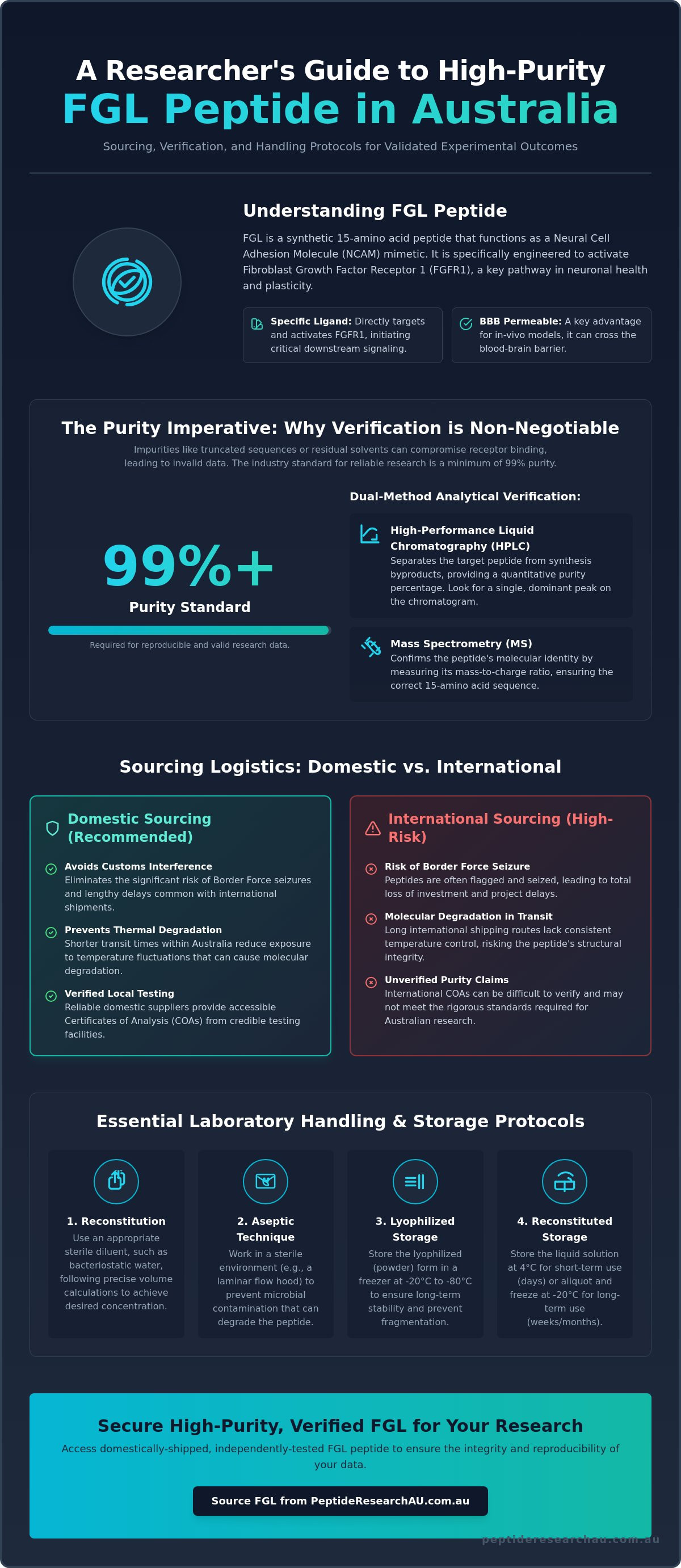
FGL is a synthetic 15-amino acid peptide engineered to replicate the functional domain of the Neural Cell Adhesion Molecule (NCAM). It acts as a specific ligand for the Fibroblast Growth Factor Receptor 1 (FGFR1), initiating intracellular signaling pathways that support neuronal maintenance and structural integrity. Investigators seeking fgl peptide for sale australia should recognize that this compound is produced exclusively for laboratory research. It isn't a finished consumer product or a medical treatment. Understanding its derivation from NCAM is essential for establishing valid experimental parameters in neurobiology and regenerative medicine.
While FGL is a specific peptide sequence, it shares nomenclature with the broader Fibrinogen-like protein 1 (FGL1) family. However, in the context of neuroscience research, FGL refers specifically to the NCAM-derived mimetic. Its design allows it to bypass the need for endogenous NCAM presence to trigger FGFR1 phosphorylation. This direct activation makes it a powerful tool for studying receptor-mediated cellular responses in isolation. Precise molecular weight confirmation and sequence verification are required to ensure the peptide performs as expected in in vitro and in vivo models.
The Role of NCAM Mimetic Peptides in Neuroscience
FGL functions by mimicking the binding interaction between NCAM and the extracellular domain of FGFR. This engagement triggers the dimerization and autophosphorylation of the receptor. This process activates crucial downstream signaling cascades, including the MAPK/ERK and PLCγ pathways, which are fundamentally linked to neuronal survival and differentiation. A primary advantage of FGL in research is its documented ability to cross the blood-brain barrier (BBB). This permeability allows for systemic administration in animal models while ensuring the peptide reaches the central nervous system to interact with target receptors. It provides a reliable method for observing the effects of FGFR1 activation without invasive delivery techniques.
Current Research Applications for FGL
Scientific interest in FGL centers on its ability to modulate synaptic plasticity and cognitive function. Studies utilizing animal models have demonstrated that FGL administration can enhance memory formation and spatial learning. It's frequently employed in traumatic brain injury (TBI) models to examine its neuroprotective effects and its role in promoting axonal regrowth. Researchers prioritize FGL because of its high affinity for FGFR1. This specificity reduces the risk of off-target effects that are often seen with broader growth factor analogs. Its application in neurodegenerative disease research provides a controlled method for studying the activation of endogenous repair mechanisms within the brain's complex architecture.
Technical Specifications: Identifying High-Purity FGL
Precision in chemical synthesis is the primary determinant of experimental success. When searching for fgl peptide for sale australia, researchers must look beyond marketing claims and focus on analytical data. High-purity reagents are essential for maintaining the integrity of cellular assays. Impurities such as truncated sequences, residual solvents, or trifluoroacetic acid (TFA) salts can interfere with receptor binding, leading to inconsistent data. For FGL to function effectively as an NCAM mimetic, a purity threshold of at least 98% is the industry standard for professional study.
Verification of this purity requires two distinct analytical methods. High-Performance Liquid Chromatography (HPLC) separates the peptide from any byproducts of the synthesis process, providing a quantitative percentage of the target compound. Concurrently, Mass Spectrometry (MS) confirms the molecular identity by measuring the mass-to-charge ratio. This ensures the 15-amino acid sequence is correct and matches the theoretical molecular weight. Studies investigating the regenerative capacity after stroke rely on these rigorous standards to ensure observed outcomes are attributable solely to the peptide's interaction with the FGFR1 receptor. You can find independently tested research compounds that meet these specific analytical requirements.
Interpreting Certificates of Analysis (COA)
A Certificate of Analysis is the primary document used to verify a batch's quality. An HPLC chromatogram should display a single, sharp peak representing the FGL peptide, with minimal baseline noise indicating the absence of contaminants. Researchers should always verify that the batch number on the COA matches the physical vial and check the date of manufacture to assess the potential for degradation. Reliable data in neurobiology is fundamentally dependent on the use of verified, high-purity chemical sequences.
Structural Stability and Lyophilised Formats
FGL is typically supplied as a lyophilised (freeze-dried) powder to maximize its structural stability. This process removes water through sublimation, which prevents the hydrolysis of peptide bonds during storage and transport. While reconstituted solutions are highly sensitive to temperature and have a limited shelf-life, lyophilised formats remain stable for extended periods when stored at -20°C. Investigators should inspect vials for signs of moisture ingress, such as clumping or discolouration, as these indicate compromised integrity. Maintaining a cold chain and using proper storage techniques is vital for preserving the peptide's bioactivity throughout the duration of a study.
Sourcing FGL Peptide for Sale in Australia: Domestic vs. International
Secure procurement of NCAM mimetics involves more than finding a vendor. International shipments often face significant scrutiny from the Australian Border Force. Researchers frequently encounter delays or seizures when documentation doesn't precisely align with local import requirements. Beyond regulatory hurdles, the physical stability of the peptide is at risk during long-haul transit. Extended exposure to fluctuating temperatures during international air freight can cause irreversible damage to delicate peptide bonds. This degradation is often invisible to the naked eye but catastrophically impacts experimental results. When searching for fgl peptide for sale australia, domestic options provide a layer of security that overseas vendors cannot match.
Navigating Australian Import Regulations
The regulatory landscape in 2026 remains complex for research-only substances. The Therapeutic Goods Administration (TGA) maintains strict oversight of therapeutic goods, and researchers must ensure their compounds are classified correctly. While research compounds fall under specific exemptions, they must be clearly defined as "for research use only" and not for human consumption. Many international grey market suppliers lack the technical documentation, such as comprehensive COAs, necessary for smooth clearance. For a deeper understanding of these requirements, consult Peptides Australia: The Researcher’s Guide. Establishing a reliable domestic supply chain mitigates these risks by ensuring all materials are already within the country and meet local laboratory standards. This helps investigators avoid the legal complications associated with unapproved therapeutic imports.
Cold-Chain Logistics and Domestic Delivery
Domestic sourcing offers superior control over the environmental conditions of the reagent. High-quality AU-based suppliers utilize Express Post services combined with cold-pack insulation to maintain thermal stability. Research into FGL peptide safety and pharmacokinetics highlights the importance of maintaining molecular integrity for accurate data collection. Typical transit times from East Coast hubs like Sydney, Melbourne, or Brisbane are often under 24 to 48 hours. This rapid delivery cycle minimizes the window for environmental exposure compared to weeks of international transit. Secure, discreet packaging further protects laboratory materials from external stressors. Using a local provider allows researchers to focus on their methodology rather than logistical uncertainty. It ensures that the fgl peptide for sale australia arrives in a state that preserves its intended biochemical properties.
Laboratory Protocol: Reconstitution and Storage of FGL
Precise laboratory handling is as essential as the initial procurement of high-purity reagents. Once you have secured fgl peptide for sale australia, the primary objective shifts to maintaining molecular integrity during the transition from a lyophilized state to a liquid solution. Peptides are inherently fragile molecules. Their primary and secondary structures are susceptible to degradation if exposed to mechanical stress, thermal fluctuations, or microbial contamination. Adhering to standardized protocols ensures that the NCAM-mimetic properties of the compound remain intact for the duration of your study.
Preparation begins with the selection of an appropriate solvent. Bacteriostatic water, which contains 0.9% benzyl alcohol, is the preferred diluent for multi-use research vials. The alcohol acts as a preservative, inhibiting the growth of most potential contaminants. For experiments where benzyl alcohol might interfere with cellular assays, sterile saline or deionized water may be used, though these lack the same long-term antimicrobial protection. Using professional-grade laboratory diluents is a fundamental requirement for maintaining the stability of the peptide sequence.
The Reconstitution Process
Calculating the correct concentration requires dividing the total mass of the peptide (typically 5mg or 10mg) by the volume of the diluent added. For example, adding 2mL of bacteriostatic water to a 10mg vial results in a concentration of 5mg/mL. During the actual mixing process, use a "slow drip" method. Aim the needle toward the inner glass wall of the vial rather than directly onto the lyophilized powder. Allow the diluent to slide down the glass to prevent the formation of foam. Never shake the vial; instead, gently swirl it until the solution is completely clear. Mechanical agitation can shear the delicate peptide bonds, rendering the batch useless for precise research.
Optimal Storage Conditions
The stability of FGL depends heavily on its environment. Lyophilized vials should be kept in a freezer at -20°C for long-term preservation, which can maintain integrity for up to 24 months. Once reconstituted, the peptide becomes significantly more volatile. Store the liquid solution in a refrigerator at a constant 2-8°C. Protecting the vial from light exposure is also necessary to prevent photo-degradation. To avoid the damage caused by repeated freeze-thaw cycles, researchers should aliquot the reconstituted solution into smaller, single-use microtubes. Reconstituted FGL maintains maximum stability for approximately 8 to 14 days when stored at a constant 2-8°C. After this window, the risk of molecular fragmentation increases, potentially compromising the accuracy of your experimental data.
Why Source FGL from Peptide Research AU?
Reliability in biochemical research is non-negotiable. When investigators identify a need for fgl peptide for sale australia, they require a partner that prioritizes analytical precision over commercial volume. Peptide Research AU operates with a specialized focus on the Australian scientific community, providing laboratory-grade reagents that meet the most stringent methodological requirements. Our commitment to excellence ensures that your data remains the central focus of your study, free from the variables introduced by low-quality or degraded compounds. We prioritize the technical needs of domestic laboratories through localized expertise and rigorous quality control.
The Peptide Research AU Quality Guarantee
Every batch of FGL undergoes a rigorous multi-stage verification process to ensure it exceeds 99% purity. We utilize independent third-party laboratories to conduct HPLC and Mass Spectrometry analysis, providing you with transparent technical documentation for every vial. Our operations adhere strictly to "Research-Only" compliance standards, ensuring ethical sourcing and professional-grade handling of all research compounds. For those establishing a new laboratory protocol or seeking foundational knowledge, our resource on What are Peptides? offers detailed insights into the structural characteristics of these molecules. We don't just supply chemicals; we provide the verified building blocks for scientific advancement.
Streamlined Procurement for Australian Labs
Logistical efficiency is a core component of our service. By maintaining a domestic facility, we eliminate the uncertainties associated with international customs and the structural damage caused by long-haul thermal exposure. Our inventory of fgl peptide for sale australia is dispatched via temperature-controlled express shipping to ensure the cold chain remains intact from our facility to your laboratory. We also provide essential ancillary supplies, including high-purity laboratory diluents, to facilitate immediate and precise reconstitution upon arrival. This one-stop sourcing model minimizes procurement downtime and simplifies laboratory management. You can view our FGL Peptide listings and technical data to secure high-purity reagents for your current or upcoming research projects.
Advancing Neural Research with Verified Reagents
Successful neurobiological studies depend on the absolute consistency of your chemical sequences. By prioritizing domestic logistics and analytical verification, you eliminate the variables that often compromise experimental outcomes. Sourcing fgl peptide for sale australia from a reliable domestic provider ensures your materials arrive without the thermal damage or customs interference associated with international transit. Our commitment to quality is backed by independent HPLC and MS testing, providing a guarantee of 99%+ purity for every batch. These rigorous standards are essential for maintaining the peptide's NCAM-mimetic function throughout the duration of your study.
Utilizing express domestic shipping preserves the cold chain, ensuring your laboratory receives stable, high-purity compounds ready for precise reconstitution. We provide the technical documentation and high-grade reagents required to push the boundaries of neuroscience research. Take the next step in securing reliable data for your laboratory. Secure Your Laboratory-Grade FGL Peptide Today. We look forward to supporting your scientific objectives with excellence and precision.
Frequently Asked Questions
Is FGL peptide legal to buy in Australia for research?
Yes, FGL peptide is legal to purchase in Australia provided it is used exclusively for laboratory research purposes. The Therapeutic Goods Administration (TGA) regulates peptides as therapeutic goods, and many are classified as Schedule 4 medicines for human use. However, research-grade compounds are permitted for professional study within a controlled environment. Investigators must ensure they don't intend the product for human consumption and that all handling complies with institutional safety protocols.
What is the difference between FGL and NCAM?
FGL is a synthetic 15-amino acid mimetic peptide derived from a specific functional domain of the Neural Cell Adhesion Molecule (NCAM). While NCAM is a large, complex glycoprotein involved in cell-to-cell adhesion and signaling, FGL is a truncated sequence designed to specifically activate the Fibroblast Growth Factor Receptor 1 (FGFR1). This allows researchers to isolate and study FGFR signaling cascades without the broader structural interactions associated with the full NCAM protein.
How should I store FGL peptide upon arrival?
Lyophilized FGL should be stored in a freezer at -20°C to maintain long-term molecular stability. Upon arrival, you should immediately transfer the vials to a specialized cold storage unit to prevent thermal degradation. If the compound is scheduled for use within a short timeframe, refrigeration at 2-8°C is acceptable for unopened vials. Protecting the peptide from light exposure is also necessary to prevent photo-oxidation of the delicate amino acid chain.
Can FGL peptide cross the blood-brain barrier?
FGL peptide is documented to cross the blood-brain barrier (BBB) effectively due to its small molecular size and specific design. This permeability is a critical feature for researchers studying central nervous system disorders in animal models. It allows for systemic administration while ensuring the peptide reaches target receptors in the brain. This capability facilitates the study of neuroprotection and synaptic plasticity without the need for invasive intracranial delivery methods.
What diluent should be used for FGL reconstitution?
Bacteriostatic water is the standard diluent for reconstituting FGL in a laboratory setting. It contains 0.9% benzyl alcohol, which serves as a preservative to inhibit microbial growth in multi-use vials. For specific assays where alcohol might interfere with cellular results, sterile deionized water or phosphate-buffered saline (PBS) may be substituted. Using high-quality laboratory diluents is essential to ensure the peptide remains stable and free from potential microbial contaminants during the study.
How do I verify the purity of my FGL peptide batch?
Purity is verified through High-Performance Liquid Chromatography (HPLC) and Mass Spectrometry (MS). When evaluating fgl peptide for sale australia, researchers should demand a batch-specific Certificate of Analysis. The HPLC chromatogram should show a single dominant peak representing the target peptide, while the MS report must confirm the molecular weight matches the theoretical sequence. A purity threshold of 99% or higher is the benchmark for securing reliable and reproducible research data.
What are the common research applications for FGL in 2026?
Current research focuses on neuroprotection, cognitive enhancement, and recovery models for traumatic brain injury. Investigators use FGL to explore the activation of repair mechanisms in neurodegenerative disease models. Its role in modulating synaptic plasticity and enhancing long-term potentiation remains a primary area of scientific study. As of 2026, FGL is also being utilized to examine regenerative responses in post-stroke recovery simulations to understand how FGFR1 activation influences axonal regrowth.
Does Peptide Research AU provide COAs with FGL orders?
Yes, we provide comprehensive Certificates of Analysis (COAs) for every batch of research peptides supplied. Each document includes independent HPLC and Mass Spectrometry data to confirm the purity and identity of the compound. Providing these technical specifications ensures that researchers can proceed with confidence, knowing their fgl peptide for sale australia meets the highest laboratory standards. This documentation is essential for maintaining experimental reproducibility and meeting the requirements of peer-reviewed scientific journals.


Comments