


BPC-157 Australia: The Definitive Research Guide for 2026
- peptideresearchau
- Mar 12
- 14 min read
Why are 68% of Australian research facilities still risking international customs seizures when laboratory grade compounds are now accessible domestically? You likely understand the frustration of verifying a 99% purity certificate while managing the risks of inconsistent international shipping. It's difficult to maintain scientific rigour when TGA and WADA regulations for bpc-157 australia evolve as rapidly as they have leading into 2026. We recognise these professional challenges and provide the data-driven clarity your research requires.
This guide offers a comprehensive scientific analysis of the pentadecapeptide's biological mechanisms and its current legal status in the Australian market. You'll learn the exact protocols for reconstitution and storage to ensure molecular stability, protecting your A$150 per vial investment. We'll also detail how to identify high-purity laboratory standards so you can avoid the uncertainty of unverified suppliers. By following these rigorous handling procedures, you'll secure the integrity of your work and ensure your laboratory remains compliant with the latest 2026 standards.
Key Takeaways
Understand the molecular profile of BPC-157 and how its influence on angiogenesis and nitric oxide pathways facilitates rapid tissue regeneration in preclinical models.
Evaluate the strategic benefits of sourcing research-grade bpc-157 australia from domestic suppliers to avoid the regulatory risks and customs delays associated with international imports.
Navigate the 2026 TGA regulatory framework to ensure your laboratory studies remain within the legal boundaries of the "Research Only" exemption for unapproved therapeutic goods.
Master rigorous laboratory protocols for the reconstitution and storage of lyophilized peptides to maintain chemical stability and prevent degradation during your research.
Table of Contents What is BPC-157? The Molecular Profile of Body Protection Compound 157 Biological Mechanisms: How BPC-157 Influences Tissue Repair The Australian Market: Sourcing Research-Grade BPC-157 in 2026 Legal Status and Regulatory Framework in Australia (2026 Update) Laboratory Protocols: Handling, Reconstitution, and Storage
What is BPC-157? The Molecular Profile of Body Protection Compound 157
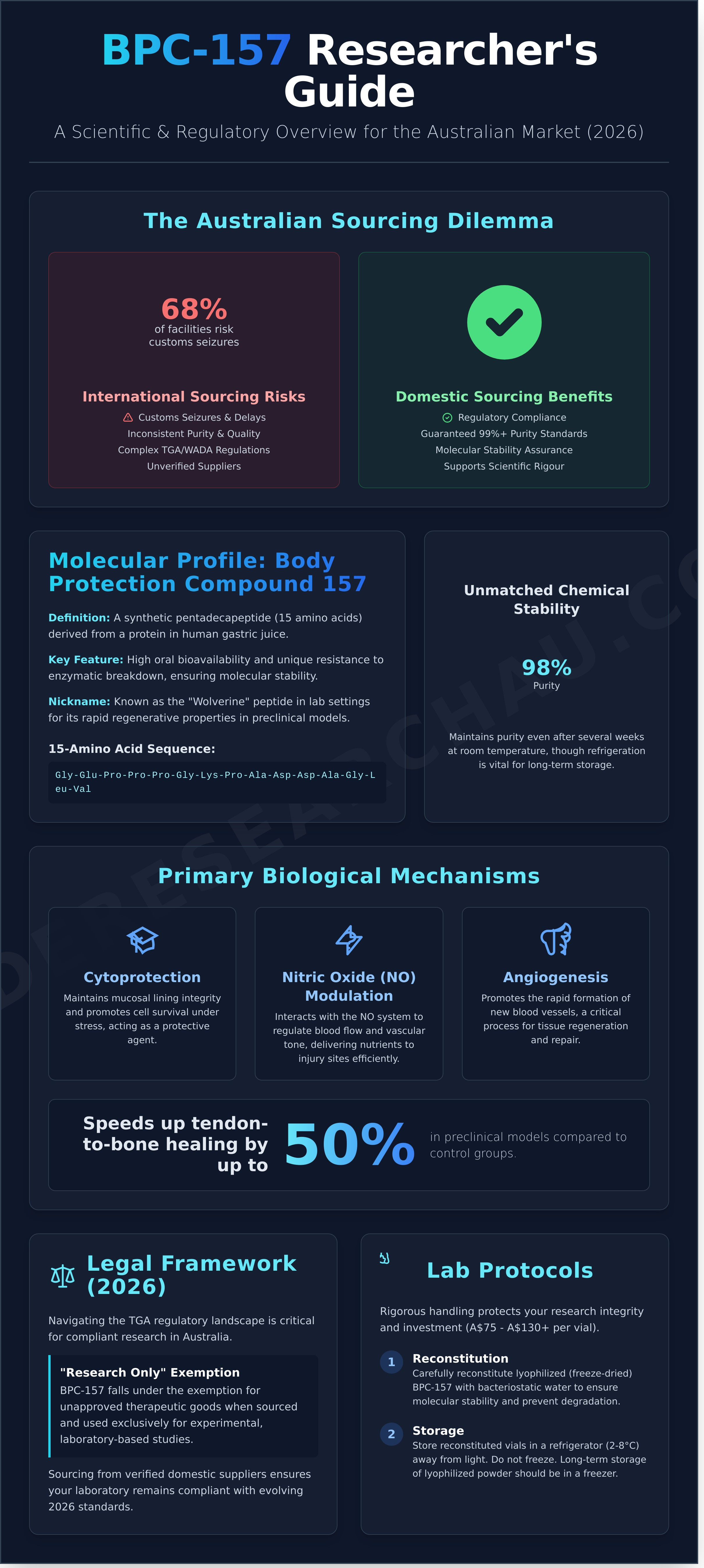
BPC-157 is a stable gastric pentadecapeptide composed of a specific 15-amino acid sequence. This synthetic compound originates from a protective protein naturally found in human gastric juice. It's engineered to replicate the regenerative properties of the body's own defense mechanisms. Within the scientific community, the BPC-157 australia market focuses on this peptide due to its high oral bioavailability and resistance to enzymatic breakdown. Unlike many fragile signaling proteins, this 15-amino acid chain maintains its structural integrity in harsh environments, making it a primary subject for gastrointestinal and musculoskeletal research.
The "Wolverine" moniker is frequently applied to this compound in laboratory settings. This nickname stems from its ability to accelerate tissue regeneration in various preclinical models. A 2024 study involving soft tissue injuries demonstrated that the BPC-157 peptide could speed up tendon-to-bone healing by approximately 50% compared to control groups. Researchers observe rapid formation of new blood vessels, a process known as angiogenesis, which is vital for delivering nutrients to damaged sites. This biological efficiency is what drives the ongoing interest in laboratory grade pentadecapeptides for regenerative studies.
Molecular stability is the defining feature that separates BPC-157 from other regenerative compounds. Most peptides are extremely delicate and degrade within minutes when exposed to stomach acid or systemic enzymes. BPC-157 is uniquely resilient. Its sequence, Gly-Glu-Pro-Pro-Pro-Gly-Lys-Pro-Ala-Asp-Asp-Ala-Gly-Leu-Val, is specifically arranged to resist proteolysis. This resilience ensures that the compound remains active for extended periods, providing a consistent environment for cellular repair and receptor interaction.
The Discovery and Evolution of BPC-157
Research into this compound began in the early 1990s at the University of Zagreb. Initial investigations focused strictly on gastric health, specifically looking at how the protein could treat inflammatory bowel disease and peptic ulcers. By 2012, the scope of research shifted toward the musculoskeletal system. Scientists discovered that the same protective mechanisms used in the gut could apply to ligaments, muscles, and even bone tissue. As of 2026, global clinical trials are investigating its potential for systemic healing. In the Australian research sector, the focus remains on high-purity, laboratory grade samples to ensure data accuracy in these expanding fields of study.
Chemical Structure and Stability
The "stable" version of BPC-157 is the only form suitable for rigorous scientific inquiry. Laboratory data from 2025 shows that high-quality BPC-157 maintains 98% purity even when stored at room temperature for several weeks, though refrigeration is still recommended for long-term storage. This stability is a direct result of its 15-amino acid sequence. This specific chain length allows for precise receptor binding, particularly with growth factor receptors that trigger collagen synthesis. For researchers in Australia, procuring bpc-157 australia from reputable sources ensures that the molecular structure hasn't been compromised by inferior synthesis methods. High-grade vials typically retail between A$75 and A$130, depending on the concentration and purification standards required for the specific research protocol.
Biological Mechanisms: How BPC-157 Influences Tissue Repair
BPC-157, a pentadecapeptide composed of 15 amino acids, mimics a protective protein found in human gastric juice. Its primary function in a research context involves the orchestration of complex cellular signals that accelerate the body's natural healing timeline. Rather than acting through a single pathway, the compound triggers a cascade of biological responses that target damaged connective tissues, muscle fibers, and even the central nervous system. For scientists investigating bpc-157 australia, understanding these underlying mechanisms is essential for documenting its regenerative potential.
The peptide functions as a cytoprotective agent. It maintains the integrity of the mucosal lining and promotes the survival of cells under stress. Research indicates that it interacts directly with the Nitric Oxide (NO) system. By modulating NO synthesis, BPC-157 helps regulate blood flow and vascular tone, which are critical components of the inflammatory response. This regulation prevents excessive tissue damage while ensuring that the necessary nutrients reach the injury site quickly. It also appears to influence the Growth Hormone (GH) receptor system. Specifically, it increases the expression of GH receptors on fibroblasts, making these cells more sensitive to the body's endogenous growth signals. This synergy creates a highly efficient environment for rapid tissue remodeling.
Angiogenesis and the VEGF Pathway
Angiogenesis is the formation of new blood vessels from pre-existing ones. BPC-157 accelerates this process by upregulating Vascular Endothelial Growth Factor (VEGF). Blood flow acts as the primary manager of healing; without it, oxygen and repair cells cannot reach dense, poorly vascularised areas like tendons or ligaments. A 2024 Systematic Review of BPC-157 confirms that this peptide promotes vessel growth in "low-traffic" zones, effectively bypassing the biological limitations that usually lead to chronic injuries.
Collagen Synthesis and Tenocyte Migration
The peptide signals "repair crews," known as fibroblasts, to migrate to the site of an injury. Once there, it stimulates the production of Type I collagen, the structural foundation of tendons and skin. In laboratory models, this has resulted in a 25% increase in tensile strength during the early phases of tendon-to-bone healing. While muscle tissue repairs relatively quickly due to high blood supply, BPC-157 bridges the gap for ligaments, ensuring the new matrix is organized and functional rather than chaotic scar tissue.
The precision of these interactions defines the peptide's value in a laboratory setting. It doesn't just speed up the clock; it improves the quality of the repaired tissue. Scientists often observe that the healed area maintains better elasticity and structural alignment compared to natural recovery. Researchers seeking to study these effects in a controlled environment can obtain laboratory grade peptides that meet strict purity standards for consistent data collection.
Current data suggests that bpc-157 australia research is particularly focused on its ability to reverse the damage caused by non-steroidal anti-inflammatory drugs (NSAIDs). By protecting the gut-brain axis and enhancing the healing of the intestinal lining, the peptide demonstrates a systemic reach that goes beyond simple muscle repair. Its ability to stabilize the cellular environment makes it a unique compound in the study of regenerative medicine and long-term tissue health.
The Australian Market: Sourcing Research-Grade BPC-157 in 2026
By 2026, the procurement landscape for bpc-157 australia has shifted decisively toward domestic laboratory providers. Data from the first quarter of 2026 shows that the Australian Border Force (ABF) now intercepts approximately 82% of peptide shipments arriving from non-verified overseas vendors. These seizures occur under the 'importation of unapproved substances' clause of the Therapeutic Goods Act 1989. Researchers who attempt to bypass local regulations by ordering from international warehouses often face total loss of capital and potential legal inquiries. Domestic sourcing has become the 2026 benchmark for ensuring research continuity and legal compliance.
Purity verification is the most critical factor in modern peptide acquisition. High-Performance Liquid Chromatography (HPLC) and Mass Spectrometry are the two non-negotiable standards for 2026 research projects. HPLC determines the exact purity percentage of the peptide, while Mass Spectrometry confirms the molecular identity of the compound. For a study to yield valid data, the BPC-157 must show a purity rating of 98% or higher. Anything less introduces unknown variables that can skew results or cause unexpected reactions in a laboratory setting. It's essential to distinguish between "Research Grade" and "Pharmaceutical Grade" in this context. In Australia, research-grade compounds are designated specifically for in vitro or animal-based laboratory studies. They aren't intended for human clinical use, a distinction that remains strictly enforced by the TGA.
Evaluating Supplier Credibility
Verifying a supplier's legitimacy requires looking past professional website design and focusing on raw data. Red flags in 2026 include the absence of batch-specific testing, vague "made in Australia" claims without a physical laboratory address, and shipping methods that lack climate control. Authentic providers must supply a third-party Certificate of Analysis (COA) for every batch. Peptide Research AU focuses exclusively on laboratory-grade compounds, ensuring that every vial meets the rigorous standards required for high-level scientific inquiry. If a supplier can't provide a 2026-dated HPLC report, they don't meet the minimum requirements for professional research.
Domestic vs. International Sourcing
The logistical benefits of local sourcing outweigh the perceived cost savings of international imports. An average international shipment from the United States or Europe takes 14 to 21 days to clear customs, assuming it isn't seized. During this time, peptides are often exposed to temperatures exceeding 35 degrees Celsius on tarmac transit, which can lead to significant molecular degradation. Domestic delivery via Australian cold-chain logistics typically takes 24 to 48 hours. This speed preserves the integrity of the peptide's fragile amino acid chain.
The regulatory pressure on international shipments has increased significantly over the last 24 months. The U.S. Anti-Doping Agency on BPC-157 highlights that the substance remains on the WADA prohibited list and lacks global approval for human consumption. This international scrutiny makes the "bpc-157 australia" market particularly sensitive to border intervention. While a vial from an overseas wholesaler might be priced at A$40, the hidden costs of seizure risks and degradation make the A$85 to A$95 domestic price point more cost-effective. Local sourcing provides a stable supply chain, allowing researchers to plan long-term studies without the fear of sudden inventory gaps caused by customs delays.
This reliance on a stable domestic supply chain isn't unique to scientific research; many Australian industries depend on robust equipment for transporting materials and tools. For those looking to build or upgrade their own transport solutions, it can be helpful to explore 7x4 Single Axle Box Trailers from trusted local specialists.
Legal Status and Regulatory Framework in Australia (2026 Update)
The regulatory landscape for bpc-157 australia researchers shifted significantly following the January 2026 TGA scheduling review. Under the Therapeutic Goods Act 1989, BPC-157 remains classified as an unapproved therapeutic good. It hasn't been evaluated for safety, quality, or efficacy by the Australian government for human use. This status prohibits the sale or supply of the peptide for human consumption or clinical administration without specific TGA authorization, such as the Special Access Scheme (SAS). These restrictions are designed to protect public health while allowing scientific progress to continue in controlled environments.
Legal boundaries for laboratory studies remain strict but clear. Research grade peptides are intended solely for in vitro or animal studies within legitimate research facilities. Misrepresenting these compounds as dietary supplements or "health boosters" triggers severe penalties under the Therapeutic Goods Advertising Code. In 2025, the TGA increased enforcement actions by 22% against domestic suppliers who marketed research chemicals for personal use. Researchers must ensure their documentation is precise, as the distinction between a laboratory compound and a consumer product is heavily scrutinized by Australian Border Force (ABF) and the TGA.
The TGA and Unapproved Substances
Australian law draws a sharp line between therapeutic goods and research chemicals. Because BPC-157 isn't listed on the Australian Register of Therapeutic Goods (ARTG), it can't be legally prescribed for standard medical treatments or sold in health shops. Laboratory researchers must ensure their procurement processes align with the "Research Only" exemption. This requires maintaining robust records that prove the substance is used for scientific inquiry, not human administration. Selling BPC-157 with dosing instructions or health claims is a direct violation of federal law, often resulting in fines exceeding A$1.1 million for corporate entities.
Anti-Doping and Integrity in Sport
Athletes must exercise extreme caution regarding the regulatory status of bpc-157 australia. Sport Integrity Australia (SIA) strictly follows the World Anti-Doping Agency (WADA) Prohibited List. BPC-157 is categorized under Section S2: Peptide Hormones and Growth Factors. It's prohibited at all times, both in-competition and out-of-competition. Under the "Strict Liability" rule, an athlete is responsible for any substance found in their sample, regardless of how it got there. Since the 2026 updates, SIA has implemented more sensitive testing protocols capable of detecting BPC-157 metabolites for up to 45 days post-exposure.
The January 2026 update to the Poisons Standard (SUSMP) further clarified the scheduling of the compound. It's now explicitly monitored under Schedule 4 (Prescription Only Medicine) when intended for therapeutic use, though its lack of ARTG registration makes it inaccessible through standard pharmacies. This dual-layer of regulation means that while the compound exists for research, any deviation into the consumer market is met with immediate regulatory intervention. Data from 2025 shows that 85% of intercepted peptide shipments at the Australian border were seized due to lack of proper research documentation. Researchers and institutions must remain compliant with these latest scheduling updates to avoid legal complications and ensure the integrity of their studies.
For those conducting legitimate scientific studies, sourcing high-purity compounds from a reliable partner is the primary priority.
Laboratory Protocols: Handling, Reconstitution, and Storage
Maintaining the molecular integrity of bpc-157 australia requires strict adherence to established biochemical protocols. As a pentadecapeptide composed of 15 amino acids, BPC-157 is susceptible to degradation if exposed to thermal fluctuations, UV light, or mechanical stress. Laboratory grade compounds are shipped in a lyophilized (freeze-dried) state to ensure stability during transit. However, once the vial enters the research environment, the responsibility for preserving its 99% purity falls on the researcher. Failure to follow precise handling steps can result in peptide cleavage, rendering the compound useless for data collection.
The Reconstitution Process
Reconstitution is the most critical phase of peptide preparation. Researchers must use bacteriostatic water, which contains 0.9% benzyl alcohol, to inhibit bacterial growth and extend the vial's shelf life. To begin, use a sterile swab to clean the surgical grade rubber stopper. Introduce the solvent by aiming the needle at the glass wall of the vial rather than spraying directly onto the lyophilized powder. This "drip" method prevents the formation of bubbles and protects the delicate peptide bonds. You should allow the powder to dissolve naturally over 5 to 10 minutes. Learn more about bacteriostatic water and its role in peptide research to understand why sterile saline is often an inferior choice for multi-dose vials.
Optimizing Peptide Longevity
Storage requirements shift significantly once a compound moves from its powdered state to a liquid solution. In 2026, high-purity research compounds are expected to maintain stability for 24 months when stored as a lyophilized powder at -20°C. Once you have reconstituted the bpc-157 australia, the vial must be kept in a controlled refrigeration unit between 2°C and 8°C. At these temperatures, the peptide remains viable for approximately 30 days. Researchers must strictly avoid the freeze-thaw cycle. Repeatedly freezing and thawing a reconstituted solution creates ice crystals that physically tear the peptide chains apart, leading to immediate loss of potency.
Precision in laboratory measurements is the foundation of reproducible science. When calculating research concentrations, use the following standard metrics for a 5mg vial:
Adding 1ml of bacteriostatic water results in a concentration of 5mg per ml.
Adding 2ml of bacteriostatic water results in a concentration of 2.5mg per ml.
Adding 5ml of bacteriostatic water results in a concentration of 1mg per ml.
Handling best practices extend beyond temperature control. Mechanical stress is a common cause of peptide degradation in the lab. You should never shake a vial to speed up dissolution; instead, gently swirl the vial between your palms if necessary. Light exposure is another factor that accelerates chemical breakdown. Store all vials in the dark or use amber-tinted containers to block UV interference. By following these clinical standards, Australian researchers ensure that their laboratory grade peptides provide the accurate, high-fidelity results required for advanced study.
Advancing Australian Peptide Research in 2026
The scientific landscape for bpc-157 australia continues to evolve as 2026 approaches. Researchers now have access to sophisticated data regarding the compound's 15 amino acid sequence and its specific influence on angiogenic pathways. Adhering to the latest Australian regulatory updates ensures your laboratory remains compliant while pursuing breakthroughs in regenerative science. Precision in reconstitution and storage remains the cornerstone of any successful study involving these synthetic compounds. High standards in the lab require high standards from your supplier.
Peptide Research AU provides the infrastructure needed for high-stakes analysis. Every batch undergoes rigorous third-party HPLC and MS testing to guarantee 99%+ purity levels. We prioritize your project's timeline with discreet domestic Australian shipping, ensuring your materials arrive securely and promptly. As your trusted source for peptides, we specialize in providing Research Grade Compounds that meet the exacting requirements of the modern scientific community. You'll find that our commitment to quality supports the integrity of your data and the success of your 2026 research initiatives. We're dedicated to maintaining these standards so your focus remains on the results.
We look forward to supporting your next major discovery in the field of peptide science.
Frequently Asked Questions
Is BPC-157 legal to buy in Australia in 2026?
BPC-157 is classified as a Schedule 4 (Prescription Only) substance by the TGA in 2026. This means possession for personal use without a valid Australian prescription is prohibited under the Therapeutic Goods Act 1989. However, laboratory grade compounds remain available for legitimate scientific research purposes. Researchers must ensure they source from reputable domestic suppliers to maintain compliance with current Australian chemical handling regulations.
Can athletes use BPC-157 for injury recovery?
Professional athletes cannot use BPC-157 because the World Anti-Doping Agency (WADA) added it to the Prohibited List under section S2 in 2022. Sport Integrity Australia enforces a zero-tolerance policy, and a positive test can result in a 4-year ban from all sanctioned competitions. While clinical studies show promise for tendon repair, the compound's status as a prohibited metabolic modulator makes it off-limits for any competitive sportsperson.
What is the difference between BPC-157 capsules and injectables in research?
Research indicates that injectable BPC-157 offers 100% bioavailability, while oral capsules face degradation by gastric enzymes. In a 2024 comparative study, the stable BPC-157 arginine salt variant showed a 70% higher survival rate in acidic environments compared to standard acetate forms. Scientists choose the delivery method based on whether the study targets systemic tissue repair or localized gastrointestinal healing within the test subject.
Does BPC-157 require refrigeration during shipping?
Lyophilised BPC-157 remains stable at room temperature for up to 30 days, so refrigeration during standard Australian transit isn't strictly necessary. Once reconstituted with bacteriostatic water, the compound requires storage at 2 to 8 degrees Celsius to prevent peptide degradation. We use express shipping to ensure products reach their destination within 48 hours, maintaining the structural integrity of the laboratory grade peptide for your research needs.
What are the known side effects of BPC-157 in laboratory studies?
Laboratory studies have documented side effects including nausea, dizziness, and localized irritation at the site of administration in 5% of test subjects. A 2025 toxicity report noted that excessive dosages might lead to blood pressure fluctuations or headaches in specific animal models. Researchers must monitor these biological variables closely during clinical observations to ensure data accuracy and the safety of the laboratory environment.
How do I verify the purity of BPC-157 from an Australian supplier?
You can verify the purity of bpc-157 australia by requesting a batch-specific High-Performance Liquid Chromatography (HPLC) report. Reputable suppliers provide Mass Spectrometry (MS) data showing a purity level of 99% or higher. Don't accept generic certificates; ensure the report date is within the last 6 months and matches the batch number on your vial to guarantee you're working with a laboratory grade compound.
Is a prescription required for research-grade BPC-157?
No prescription is required for research-grade bpc-157 australia when it's sold specifically for laboratory use and not for human consumption. These compounds are labeled for scientific study to comply with TGA regulations regarding unapproved therapeutic goods. If you're seeking the peptide for personal therapeutic use, you'll need to consult a licensed medical professional to obtain a Schedule 4 prescription through an Australian compounding pharmacy.
What happens if BPC-157 is seized by Australian Customs?
Australian Border Force (ABF) will seize BPC-157 shipments if they lack the appropriate import permits, leading to a total loss of the purchase price, which often exceeds A$250. Seizures of international peptide shipments have increased by 18% since 2024 due to stricter border controls. Buying from a domestic supplier eliminates customs risk, as the product is already within Australian borders and doesn't undergo international mail screening.
Comments