
Avoiding Customs Seizure of Peptides in Australia: A 2026 Researcher’s Guide
- peptideresearchau
- May 29
- 12 min read
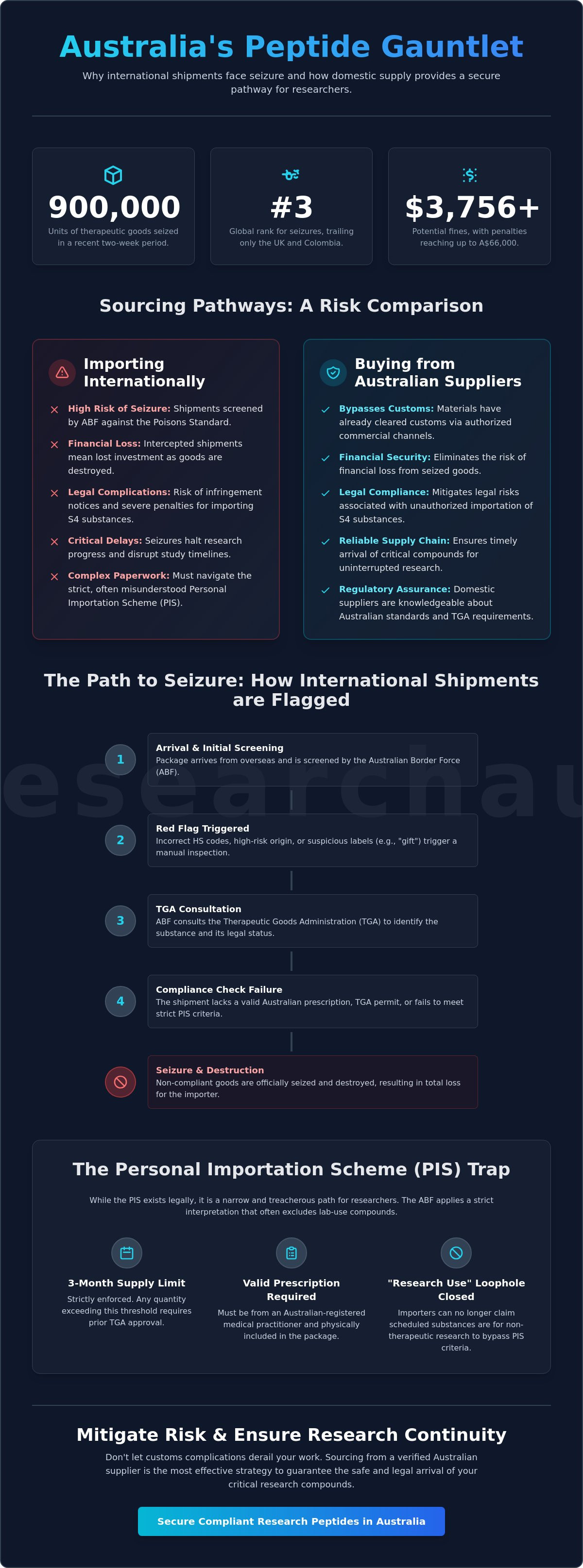
In a recent two-week period, the Australian Border Force seized 900,000 units of unlawfully imported therapeutic goods, including peptides. Australia now records the third-highest number of seizures globally, trailing only the United Kingdom and Colombia. This intensifying enforcement environment explains why buy peptides from australian suppliers to mitigate the risks of financial loss and legal complications. For researchers, the prospect of an intercepted shipment means more than just a lost investment; it results in critical delays and potential penalties under the 2026 Poisons Standard.
The seizure of such a vast quantity of therapeutic goods underscores the importance of sourcing health products locally; for instance, you can find out more about PEA 180 Capsules from Australian retailers who ensure their supplements meet all domestic standards.
You likely recognize that the regulatory landscape for Schedule 4 substances has become increasingly complex. The anxiety regarding TGA scheduling and the possibility of a $3,756 infringement notice can hinder the progress of professional study. This guide provides the technical data required to ensure your research materials arrive safely and remain compliant with current Australian laws. We'll examine the specific limitations of the Personal Importation Scheme, the impact of Operation Pangea, and the strategic advantages of utilizing a domestic supply chain that has already cleared customs protocols.
Key Takeaways
Understand the 2026 amendments to the Therapeutic Goods Act 1989 and how the Australian Border Force identifies non-compliant research materials.
Learn the rigorous documentation requirements of the Personal Importation Scheme, including the mandatory three-month supply limitation.
Identify the technical triggers, such as incorrect HS codes and high-risk jurisdictions, that lead to mandatory customs inspections and seizures.
Discover why buy peptides from australian suppliers to effectively bypass international customs protocols and ensure the arrival of critical research compounds.
Develop a verification framework to assess a supplier’s knowledge of Australian regulatory standards to mitigate financial and legal risks.
Table of Contents
Why the Australian Border Force Seizes Peptide Shipments
The Australian Border Force (ABF) operates as the primary gatekeeper for therapeutic goods entering the country. Under the 2026 amendments to the Therapeutic Goods Act 1989, the ABF has expanded its surveillance of biological compounds. This includes a broad range of amino acid chains. Before investigating the legalities, researchers often ask, What are peptides? and how does their chemical structure influence their regulatory status? The ABF classifies many of these substances as restricted rather than prohibited, meaning they require specific documentation that international shipments frequently lack.
When packages arrive from overseas, they're screened against the Poisons Standard. Most research peptides are categorized under Schedule 4 (S4), which denotes prescription-only medicines. Certain compounds, such as PT-141, attract immediate scrutiny because of their high profile in non-clinical settings. If a shipment lacks a valid Australian prescription or TGA import permit, the ABF will likely seize the material. This administrative friction is a critical reason why buy peptides from australian suppliers. Local sourcing ensures that the materials have already cleared the border via authorized commercial channels, removing the risk of individual seizure.
The Role of the TGA in Border Interception
The TGA provides the technical expertise the ABF lacks during physical inspections. Officers identify suspicious powders or vials and consult the TGA to determine their status on the Australian Register of Therapeutic Goods (ARTG). If a compound isn't listed on the ARTG, it's deemed unapproved. Unapproved status leads to an automatic hold. The TGA then assesses whether the importer meets the strict criteria for the Personal Importation Scheme or the Special Access Scheme. Without verified paperwork, the goods are destroyed.
Scheduling: Why S4 Peptides are Frequently Flagged
Schedule 4 peptides, including BPC-157 and various Growth Hormone Releasing Peptides (GHRPs), are the most frequently flagged items. While these aren't prohibited like Schedule 9 illicit drugs, their importation without a prescription is a breach of the Customs Act 1901. In 2026, the penalties for unauthorized possession of S4 substances remain severe. In the Australian Capital Territory, fines can reach A$66,000. These financial risks reinforce why buy peptides from australian suppliers who specialize in research-grade compounds for laboratory use. Domestic procurement eliminates the legal anxiety associated with international customs screening.
Navigating the Personal Importation Scheme (PIS) in 2026
The Personal Importation Scheme (PIS) is established under the Therapeutic Goods Act 1989, allowing individuals to import a maximum three-month supply of unapproved therapeutic goods for personal use as confirmed in the May 2026 regulatory updates. While this pathway exists, it's frequently misunderstood by researchers attempting to source materials from overseas. The Australian Border Force (ABF) applies a strict interpretation of "personal use" that often excludes high-purity research compounds intended for laboratory study. This regulatory friction is a primary reason why buy peptides from australian suppliers, as domestic procurement bypasses the PIS requirements entirely.
To utilize the PIS, you must prove the goods are for your own use and hold a valid prescription from an Australian registered medical practitioner. However, the ABF often seizes shipments before these documents can be presented. The three-month supply limit is enforced with absolute precision; any volume exceeding this threshold requires prior TGA approval via an online application. In 2026, the TGA has also effectively closed the "Research Use" loophole. Individual importers can no longer claim that scheduled substances are for non-therapeutic research to avoid the PIS criteria. If a substance appears in the Poisons Standard, the ABF treats it as a therapeutic good regardless of the label.
Required Documentation for International Orders
Successful importation requires a matching prescription and invoice physically located inside the package. Labelling a shipment as a "gift" or "commercial sample" is an immediate red flag that triggers a manual inspection under Australian Border Force (ABF) guidelines. Researchers should also ensure a Certificate of Analysis (CoA) is included to verify the chemical nomenclature and purity of the research compounds. Without these documents, the ABF will likely issue a seizure notice, which can lead to fines reaching A$66,000 in certain jurisdictions like the ACT.
The Risk of Poor Labelling and Unmarked Vials
The TGA has issued specific warnings regarding vials that arrive marked only with codes, abbreviations, or shorthand. Vials lacking professional, clinical-grade labelling are frequently destroyed because they're classified as unidentified substances. Some low-quality international suppliers attempt "stealth shipping" by disguising peptides as other goods. This practice is a significant legal risk. If the ABF discovers hidden peptides, the importer faces potential prosecution for smuggling prohibited goods rather than a simple administrative seizure. This underscores why buy peptides from australian suppliers who provide transparent, compliant labelling for all laboratory materials.
Technical Triggers: Why International Peptide Orders Get Flagged
The Australian Border Force (ABF) utilizes sophisticated screening protocols to identify unauthorized therapeutic goods. Inaccurate customs declarations are a primary technical trigger. Every international shipment requires a Harmonized System (HS) code that accurately reflects the package contents. If the code for "laboratory reagents" mismatches the physical presence of lyophilized powder in vials, the package is flagged for manual inspection. This technical misalignment often occurs when overseas vendors attempt to circumvent regulations. It's a significant factor in why buy peptides from australian suppliers, as domestic logistics do not require international customs declarations or HS code verification.
Sourcing from high-risk jurisdictions also increases seizure probability. The ABF prioritizes shipments from regions known for unregulated chemical manufacturing and illicit exports. Additionally, the absence of specific ingredient concentrations or manufacturer details on a label violates TGA requirements. While some believe multiple small orders avoid detection, the ABF monitors delivery frequency to a single address. Frequent small shipments of similar weights often trigger "syndicate flags," suggesting a pattern of commercial distribution rather than legitimate personal research. These patterns are cross-referenced against historical data to identify importers attempting to bypass volume limits.
ABF Inspection Technology and X-Ray Analysis
In 2026, international mail centers employ advanced mass spectrometry and AI-driven X-ray scanning. These systems identify the specific chemical signatures of scheduled peptides without opening the package. Operation Pangea recently highlighted this capability, resulting in the global seizure of 6.42 million doses of unapproved pharmaceuticals. The AI identifies the distinct geometry of multidose vials and rubber stoppers common in research compounds. Attempting "discreet packaging" is largely ineffective against these spectral analysis tools. Professional transparency in documentation is the only viable path for international transit, though it remains a high-risk strategy for individual researchers.
Blacklisted Suppliers and Sender Reputation
The ABF maintains a comprehensive database of known international peptide exporters and "research chemical" storefronts. Using a supplier with a history of non-compliance creates a "guilt by association" risk for the importer. Once a sender is blacklisted, every package from that origin undergoes mandatory secondary screening. This systemic scrutiny ensures that even correctly documented orders from flagged senders face significant delays or rejection. This logistical hurdle further explains why buy peptides from australian suppliers, as domestic senders operate within the Australian regulatory framework and do not carry the "high-risk" designation associated with international exporters.
Proactive Risk Mitigation Strategies for Researchers
Researchers must evaluate a supplier’s operational understanding of the Australian Therapeutic Goods Act 1989 before initiating a transaction. This evaluation is a critical step in determining why buy peptides from australian suppliers who already comply with domestic biosecurity standards. International procurement requires a meticulous approach to logistics. For instance, requesting shipping routes that bypass high-scrutiny hubs like the United Kingdom or Colombia is a common tactic, though its efficacy is diminishing as ABF scanning technology improves. You should also ensure that any research compounds are shipped separately from laboratory diluents. Separating these items prevents customs officers from misclassifying the materials as finished medical products, which carries higher regulatory weight.
Third-party testing serves as a secondary layer of protection. A Certificate of Analysis (CoA) that specifies the exact chemical signature and purity level can be used to prove the legitimacy of the materials if they are held for inspection. This documentation confirms the substance is a specific research reagent rather than a prohibited or counterfeit drug. Maintaining a clear paper trail that matches the chemical nomenclature on the vials is essential for any researcher aiming to maintain compliance with 2026 TGA regulations.
Vetting Your Supplier’s Documentation Standards
A professional invoice must include the full IUPAC names and verified purity percentages of all contents. Avoid vendors who offer to undervalue the shipment on customs forms. This practice constitutes customs fraud and increases the likelihood of a permanent blacklisting for your delivery address. Reliable suppliers often provide delivery guarantees or insurance; however, these do not mitigate the legal risks associated with a seizure notice. This risk profile is a significant reason why buy peptides from australian suppliers, as domestic transactions remain outside the jurisdiction of the ABF.
Understanding the Seizure Notice Process
If the ABF intercepts your package, you'll receive a formal "Notice of Seizure" via mail. This document outlines the specific section of the Customs Act 1901 that has been breached. You typically have a set period to provide a valid prescription or TGA permit. If you can't provide the required documentation, the goods are forfeited and destroyed. In many cases, abandonment is the safest legal route. Attempting to contest a seizure without proper authorization can escalate administrative issues into criminal investigations, particularly in jurisdictions like the ACT where fines for unauthorized possession reach A$66,000.
Why Buy Peptides from Australian Suppliers in 2026
Domestic procurement represents the only definitive method to bypass the Australian Border Force (ABF) screening process entirely. When goods originate within Australia, they're not subject to the international customs checks, mass spectrometry scanning, or HS code verification discussed in previous sections. This logistical shift is the primary reason why buy peptides from australian suppliers in 2026. Utilizing Australia Post for domestic laboratory supplies offers greater reliability than international couriers, who must navigate complex transit hubs where seizure risks are highest. Domestic parcels move through established internal networks, avoiding the secondary screening protocols that target international mail from high-risk jurisdictions.
Domestic lab-grade peptides are manufactured and distributed under rigorous local standards that prioritize chemical stability and accuracy. This ensures that the purity levels required for professional study are maintained without the degradation risks associated with long-haul international shipping or temperature fluctuations in customs warehouses. Peptide Research AU adheres to these 2026 compliance frameworks, providing researchers with a secure supply chain that prioritizes technical precision and regulatory alignment. Every batch is cataloged to ensure it meets the specific grade required for sophisticated laboratory applications.
The Domestic Sourcing Advantage for Researchers
Choosing a local partner effectively eliminates the 4-6 week wait times often caused by customs holds or secondary TGA inspections. Beyond speed, domestic sourcing provides a level of scientific accountability and customer support that overseas vendors cannot match. If a technical discrepancy occurs, it's resolved within the Australian legal and commercial framework. Researchers can consult this peptides Australia guide for a detailed analysis of quality sourcing and current laboratory standards. This local oversight is vital for maintaining the high standards expected in contemporary research.
Maintaining Research Continuity with Reliable Supply
Consistent purity is essential for longitudinal studies where variables must be tightly controlled. Verifying the chemical integrity of your materials is significantly more efficient when working with a domestic partner who provides local Certificates of Analysis. This reliability allows for the secure procurement of compounds like bpc 157 and tb500 without the threat of border interception. To protect the integrity of your work, secure your research by choosing domestic Australian excellence. This is the ultimate answer to why buy peptides from australian suppliers; it ensures that your focus remains on data collection rather than logistical recovery. Relying on a domestic supply chain is the only way to guarantee that your research timeline remains uninterrupted by administrative seizures.
Securing Your Laboratory Supply Chain
The 2026 regulatory landscape leaves little room for error when sourcing laboratory materials. As the Australian Border Force continues to deploy advanced AI-driven scanning and mass spectrometry, the risks associated with international importation have never been higher. You've seen how technical triggers and documentation gaps lead to permanent seizures and significant financial penalties. This high-risk environment is the fundamental reason why buy peptides from australian suppliers; it's the only method to ensure research continuity without the threat of border intervention.
By choosing a domestic partner, you gain access to laboratory-grade research compounds that have already cleared regulatory hurdles. You benefit from fast domestic shipping across Australia and the certainty of third-party purity testing (CoA) for every batch. This local oversight eliminates the 4-6 week delays typical of international customs holds. Secure your research materials from a reliable domestic source today. Professional study demands precision, and a stable supply chain is the foundation of successful scientific data collection.
Frequently Asked Questions
Can I import peptides to Australia if I have a doctor prescription?
Individuals can import peptides under the Personal Importation Scheme if they possess a valid prescription from an Australian registered medical practitioner. The allowance is strictly limited to a three-month supply. You must ensure the goods arrive in their original packaging with the prescription included. Any volume exceeding this threshold requires prior TGA approval through an online application process as confirmed in May 2026.
What happens if my peptide order is seized by the ABF?
You'll receive a formal "Notice of Seizure" from the ABF explaining the legal grounds for the hold. You typically have a specific window to provide the necessary permits or medical documentation. Failure to comply results in the destruction of the materials. In March 2026, the TGA issued an infringement notice of A$3,756 to a Victorian individual for such unauthorized importations, highlighting the financial risks involved.
Is it illegal to buy research peptides from an Australian supplier?
Purchasing research-grade compounds from a domestic provider is a compliant strategy for laboratory studies. Because the transaction occurs within Australian borders, it's not subject to ABF screening or international customs protocols. This logistical security is a core reason why buy peptides from australian suppliers. It ensures research continuity by removing the risk of international transit delays and administrative seizures.
How do I know if a peptide is scheduled as a S4 substance in 2026?
The primary resource for scheduling information is the Poisons Standard, also known as the SUSMP. Most research peptides are categorized as Schedule 4 (Prescription Only) medicines. You should review the TGA’s online database for 2026 updates to confirm the classification of specific amino acid chains. Many growth hormone releasing peptides are consistently flagged under these S4 regulations during border inspections.
Why did my order get seized even though it was labelled 'For Research Use Only'?
The ABF and TGA prioritize the actual chemical identity of a substance over the text on its label. In 2026, customs officers use mass spectrometry to identify scheduled substances regardless of "Research Use Only" declarations. If the compound appears in the Poisons Standard, it's treated as a therapeutic good. Individual importers can't use this label to bypass the requirement for a valid prescription or import permit.
How can I check if a supplier is on the ABF's high-risk list?
There's no publicly accessible high-risk supplier list provided by the ABF. Border authorities maintain internal databases of exporters with a history of non-compliance. You can infer risk by reviewing international seizure trends; for example, shipments from the UK and Colombia currently face higher scrutiny. Relying on local partners remains the most effective way to avoid these invisible technical flags and sender reputation risks.
Does the Personal Importation Scheme cover peptides for performance enhancement?
The Personal Importation Scheme doesn't cover substances intended for performance enhancement or non-therapeutic use. The scheme is designed exclusively for patients who require unapproved medicines for a documented medical condition under professional supervision. Importing scheduled peptides for non-clinical research or physical enhancement without specific TGA authorization is a violation of the Customs Act 1901 and may lead to prosecution.
What are the common HS codes used for peptide shipments?
Common HS codes for these materials include 2937.19.00 for polypeptide hormones and 3822.19.00 for laboratory reagents. Inaccurate coding is a primary trigger for package interception. If the HS code doesn't precisely match the chemical signature identified during X-ray or spectral analysis, the ABF will flag the package for a manual secondary inspection. This technical mismatch is a significant factor in why buy peptides from australian suppliers who use domestic logistics.


Comments