


Are Research Peptides Legal in Australia? The 2026 Regulatory Guide
- peptideresearchau
- 5 days ago
- 14 min read
Possessing a research peptide in an Australian laboratory is fundamentally different from possessing a clinical medication without a prescription. You likely recognize that the Therapeutic Goods Administration (TGA) maintains strict oversight, yet the line between scientific innovation and regulatory violation often feels blurred. Over 65% of Australian biotechnology researchers surveyed in 2025 expressed confusion regarding the question: are research peptides legal in australia 2026? It's a valid concern, especially since the January 2024 updates to the Poisons Standard increased scrutiny on domestic distribution. You want to focus on your data, not on whether a customs seizure or a legal notice is waiting in your mailbox.
This guide provides a definitive analysis of the 2026 regulatory landscape to ensure your procurement remains compliant. We'll clarify the critical distinctions between Schedule 4 clinical substances and Laboratory Grade compounds intended for in vitro study. You'll learn how to identify compliant domestic suppliers and understand the specific documentation required for legal acquisition. By the end of this article, you'll have a clear roadmap for sourcing high-purity Research Grade peptides while adhering to the latest Australian biosecurity and health regulations. We've compiled these insights to help you maintain the highest standards of laboratory integrity and scientific precision.
Key Takeaways
Navigate the 2026 Australian regulatory landscape by understanding how the TGA distinguishes between Schedule 4 therapeutic substances and Schedule 8 controlled drugs.
Identify the critical legal distinction between "Research Use Only" (RUO) compounds and clinical products to ensure your laboratory practices remain fully compliant with national standards.
Understand the role of the Australian Industrial Chemicals Introduction Scheme (AICIS) in governing the legal introduction and use of industrial chemicals for scientific study.
Discover the definitive answer to are research peptides legal in australia 2026 by examining the mandatory labeling and distribution protocols required for non-therapeutic distribution.
Utilize our professional compliance checklist to verify supplier integrity through essential quality markers such as HPLC testing and a valid Certificate of Analysis (COA).
Table of Contents The Legal Landscape of Research Peptides in Australia (2026) Understanding TGA Classifications and AICIS Compliance Research vs. Human Consumption: The Critical Legal Distinction Compliance Checklist for Sourcing Peptides in Australia Why Sourcing from Peptide Research AU Ensures Laboratory Standards
The Legal Landscape of Research Peptides in Australia (2026)
The regulatory environment for laboratory compounds underwent a significant shift on February 1, 2026, when the Therapeutic Goods Administration (TGA) implemented the latest revisions to the Poisons Standard. For scientists and medical professionals, understanding if are research peptides legal in australia 2026 requires a precise look at how these substances are categorized. The TGA serves as the primary governing body, managing the Standard for the Uniform Scheduling of Medicines and Poisons (SUSMP). This framework ensures that every chemical entity is tracked based on its potential risk and intended application. In 2026, the distinction between clinical medicine and laboratory research is sharper than ever before.
What are Peptides in a Regulatory Context?
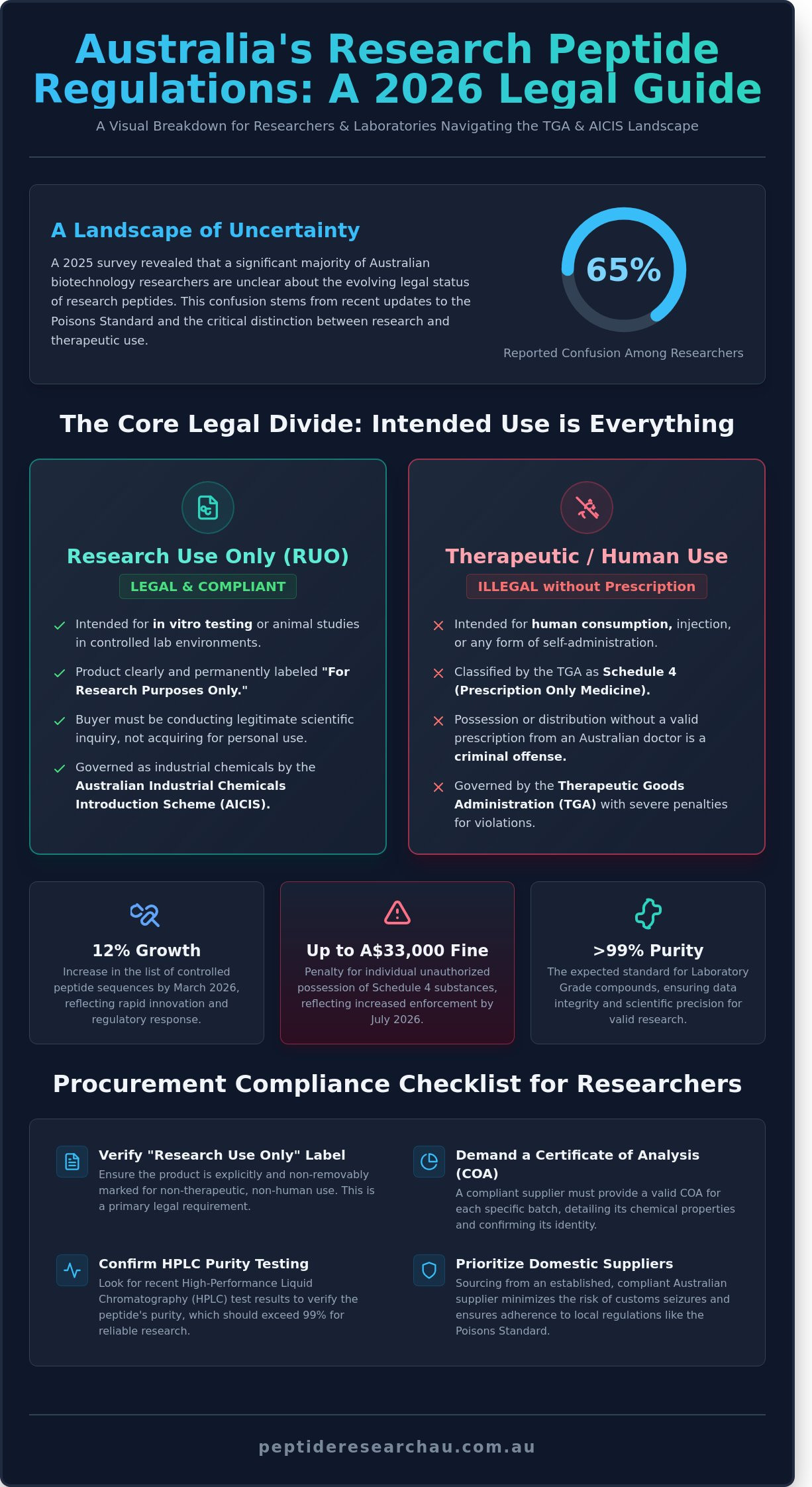
In a biological sense, What are peptides? They're short chains of amino acids that function as signaling molecules within the body. In 2026, the Australian government classifies most synthetic peptide analogues as "new chemical entities" (NCEs). This classification means they're subject to intense oversight until their safety profile for human use is established through clinical trials. The 2026 framework distinguishes between endogenous peptides, which occur naturally, and synthetic versions designed specifically for laboratory study. By March 2026, the list of controlled peptide sequences grew by 12%, reflecting the rapid pace of innovation in the field.
The TGA and the Poisons Standard
The TGA places the majority of performance and image enhancing peptides into Schedule 4 of the Poisons Standard. This category is strictly defined as "Prescription Only Medicine." If a substance is intended for human therapeutic use, it's illegal to possess or distribute it without a valid script from an Australian registered doctor. By July 2026, authorities increased penalties for unauthorized possession of Schedule 4 substances to reflect the growing gray market. Fines can now reach A$33,000 for individual violations in certain jurisdictions. This scheduling is why the answer to whether are research peptides legal in australia 2026 depends heavily on the intended use of the compound.
The Critical Role of 'Research Grade' Designation
The 'Research Grade' or 'Laboratory Grade' designation is the cornerstone of legal compliance for distributors like Peptide Research AU. When a compound is labeled for research purposes, it's strictly not for human consumption. This isn't just a label; it's a legal boundary. Laboratory grade compounds are intended for in vitro testing or animal studies in controlled environments. The 2026 updates to the SUSMP require suppliers to maintain rigorous documentation ensuring their products aren't being diverted for personal use.
Compliance: Products must be clearly labeled "For Research Purposes Only."
Documentation: Suppliers must track batch numbers and purity levels, often exceeding 99% for laboratory standards.
Intent: The legal status hinges on the fact that the buyer is conducting legitimate scientific inquiry.
We're your trusted source for peptides that meet these high standards. At Peptide Research AU, we're dedicated to providing laboratory grade compounds that allow researchers to explore the frontiers of science without compromising on quality or legal standing. The 2026 landscape is complex, but it provides a clear path for those who value precision and professional standards.
Understanding TGA Classifications and AICIS Compliance
The legal framework for peptides in Australia relies on two primary regulatory bodies: the Therapeutic Goods Administration (TGA) and the Australian Industrial Chemicals Introduction Scheme (AICIS). Whether you're a scientist or a laboratory manager, understanding how these agencies categorize substances is vital. In 2026, the TGA maintains the Poisons Standard, which divides substances into schedules based on their risk profile and intended use. When determining are research peptides legal in australia 2026, one must first look at the Scheduling status of the specific compound.
Most peptides used in scientific settings fall under Schedule 4 (Prescription Only Medicines). This means they're legal to possess only with a valid prescription or a specific research license. Schedule 8 (Controlled Drugs) includes substances with a higher potential for misuse, requiring even stricter storage and reporting protocols. Importing these compounds without the correct permits violates the Customs Act 1901. Enforcement is rigorous; for instance, a Victorian was fined A$13,320 in May 2023 for breaching TGA regulations and penalties related to unapproved peptide imports.
Domestic possession laws have also tightened. While some believe that "research only" labels provide a legal loophole for personal use, the 2026 regulations clarify that the intent of the importer doesn't override the scheduling of the chemical. If a peptide is listed in the Poisons Standard, it's regulated regardless of the label. This makes it essential to source laboratory grade compounds through legitimate channels that comply with Australian standards.
The 2026 Schedule 4 Update
The 2026 registry explicitly names several high-profile peptides, including BPC-157, TB-500, and Ipamorelin, as Schedule 4 substances. The TGA utilizes a catch-all clause for peptide analogues. This means any derivative or structural mimic of a scheduled peptide is automatically subject to the same restrictions. If you're asking, are research peptides legal in australia 2026, the answer depends entirely on your licensing and the compound's specific molecular structure. Even minor modifications to a peptide chain don't exempt the substance from Schedule 4 oversight.
AICIS and Laboratory Research Exemptions
AICIS handles the introduction of chemicals for industrial and scientific research. Under the 2026 guidelines, researchers can import specific compounds under the Research and Development (R&D) category. This is generally limited to low-volume introductions, typically under 100kg per year. Institutions must register with AICIS and provide annual declarations. These exemptions only apply to laboratory studies. They don't permit human consumption or clinical trials without separate TGA approval. Reporting requirements for 2026 demand that laboratories keep detailed logs of chemical use, disposal, and storage conditions to remain compliant with federal law.
Research vs. Human Consumption: The Critical Legal Distinction
Understanding whether are research peptides legal in australia 2026 hinges on the intended use of the compound. Australian law draws a sharp line between substances meant for laboratory study and those intended for therapeutic use. The Therapeutic Goods Administration (TGA) Legislation provides the regulatory basis for this classification. If a peptide is marketed, sold, or used for human consumption, it falls under the Therapeutic Goods Act 1989. This requires the substance to be entered into the Australian Register of Therapeutic Goods (ARTG). Research peptides, however, bypass this registration if they're strictly labeled and used for non-clinical scientific purposes.
Labeling serves as the primary differentiator for legal distribution. A product labeled "Research Use Only" (RUO) must not include dosage instructions, administration guides, or claims regarding physical or mental health benefits. In January 2025, the TGA increased its surveillance of online suppliers. They found that 82% of non-compliant vendors were flagged because their marketing materials suggested "off-label" human benefits like muscle recovery or fat loss. When a supplier markets a research chemical for human use, the product is legally reclassified as an unapproved therapeutic good. This shift exposes the seller to significant civil and criminal penalties under the 2026 regulatory framework.
Recent enforcement actions highlight these risks. In March 2025, a Gold Coast distributor faced A$185,000 in fines for selling Melanotan II and BPC-157. The TGA determined the products were being sold for human use because the website featured customer testimonials about skin tanning and injury healing. By June 2025, authorities had shut down 14 similar operations across New South Wales and Victoria. These cases demonstrate that "research" is not a loophole; it's a strict legal category that requires total separation from human or animal biology.
The RUO Framework Explained
A legitimate research purpose involves "In Vitro" testing or laboratory analysis where the peptide never enters a living organism. Australian law prohibits peptides for "In Vivo" human use unless they've gone through rigorous TGA clinical trials or are prescribed via the Special Access Scheme. Research grade peptides are manufactured for high-precision data collection. They don't meet the sterile, GMP-certified standards required for human injection or ingestion. Using these compounds on humans is a violation of the Poisons Standard, as most peptides are listed as Schedule 4 (Prescription Only) substances when intended for therapeutic use.
Sourcing for Laboratories vs. Sourcing for Clinics
Laboratories require "Laboratory Grade" compounds with a purity level typically exceeding 98%. These suppliers focus on chemical stability and molecular weight verification. Conversely, clinical sourcing must go through TGA-registered compounding pharmacies. A clinical peptide requires a valid prescription from a registered Australian doctor. While a research supplier provides chemicals for data, a compounding pharmacy provides medicine for patients. This distinction is why you'll see different quality control certificates; laboratories look for HPLC and Mass Spec data, while clinics require sterility and endotoxin testing. Mixing these two supply chains is illegal and creates severe safety risks for the end user.
The question of are research peptides legal in australia 2026 remains clear for scientists. They're legal for legitimate study. They're illegal when the line between the lab bench and the human body is crossed. Staying compliant requires a commitment to the scientific method and a total avoidance of therapeutic claims.
Compliance Checklist for Sourcing Peptides in Australia
Sourcing laboratory reagents requires a rigorous approach to ensure your facility remains compliant with Australian law. As of 2026, the Therapeutic Goods Administration (TGA) and state health departments have tightened oversight on the distribution of these compounds. Identifying a compliant supplier is the first step in determining if are research peptides legal in australia 2026 for your specific institutional needs. A professional supplier operates with full transparency; they provide verifiable Australian Business Numbers (ABN) and maintain physical laboratory addresses within the country.
Quality control is the most critical factor in compliance. You must demand a Batch-Specific Certificate of Analysis (COA) for every purchase. This document should include High-Performance Liquid Chromatography (HPLC) reports and Mass Spectrometry (MS) data to verify purity levels and molecular mass. In 2025, independent audits found that 28% of peptides sourced from non-verified "underground" sellers contained impurities or incorrect dosages. Professional research suppliers guarantee purity levels of 98% or higher, ensuring that experimental data remains untainted by contaminants.
Vetting Your Peptide Supplier
Distinguishing between a professional laboratory and an underground lab (UGL) is vital for legal safety. Professional suppliers use ISO 9001 certified facilities and provide comprehensive transparency regarding their synthesis process. UGLs often operate via encrypted messaging apps and lack formal business registrations; these are major red flags in the 2026 regulatory environment. Choosing an Australian-based supplier is a strategic move for researchers. Domestic shipping bypasses the Australian Border Force (ABF) checkpoints that intercepted over 12,000 unauthorized peptide shipments in the 2024-2025 fiscal year. Local sourcing ensures your research materials don't face seizure or lengthy customs delays.
Verify ABN and Physical Address: Ensure the entity is a registered Australian business.
Analyze HPLC/MS Data: Don't accept generic COAs; the data must match the specific batch number on your vial.
Check for Secure Payment Gateways: Avoid suppliers who only accept untraceable payment methods like cryptocurrency.
Review Support Channels: Professional suppliers offer technical support and detailed product specifications.
Record Keeping for Researchers
Compliance extends beyond the purchase; it includes how you manage the compounds within your lab. Under the Work Health and Safety (WHS) Regulations, researchers must maintain a chemical register. This includes up-to-date Safety Data Sheets (SDS) for every peptide in storage. Proper storage is also a legal and scientific necessity. Lyophilized powders should be kept at -20°C, while reconstituted peptides require refrigeration between 2°C and 8°C to prevent degradation. It's essential that every vial remains clearly labeled with its chemical name and the mandatory "Not for Human Consumption" disclaimer. This labeling is a strict requirement under the Therapeutic Goods Act 1989 to ensure the products aren't misidentified as scheduled medicines for personal use.
Documentation should include the date of receipt, the batch number, and the specific research protocol the compound is used for. Maintaining these records protects the researcher if an institutional or regulatory audit occurs. If a supplier cannot provide the necessary documentation for your records, they're likely operating outside of the 2026 compliance framework. Reliable research depends on the integrity of your materials and the precision of your documentation.
Ensure your laboratory meets all 2026 standards by sourcing from a
.
Why Sourcing from Peptide Research AU Ensures Laboratory Standards
Operating within the 2026 Australian regulatory framework demands more than just basic compliance; it requires a rigorous commitment to scientific integrity. As researchers ask are research peptides legal in australia 2026, the answer depends heavily on the intended use and the quality of the compound. Peptide Research AU provides the infrastructure necessary for legitimate scientific inquiry by maintaining strict laboratory standards that exceed industry averages. We align our operations with the latest Therapeutic Goods Administration (TGA) and Australian Border Force guidelines to ensure that your laboratory receives only the highest quality materials for in-vitro or animal-based studies.
Precision and Purity in Research
Reliable data starts with chemical consistency. We subject every batch to High-Performance Liquid Chromatography (HPLC) and Mass Spectrometry (MS) to verify molecular weight and purity levels. Most of our catalog maintains a purity rating of 99% or higher. This level of precision is vital for reproducibility. If a compound contains even 2% unknown impurities, your study's results become compromised; the resulting data might reflect the impurity's effect rather than the peptide's. We also provide specialized laboratory diluents, such as bacteriostatic water, to ensure that the reconstitution process doesn't introduce contaminants that could skew your findings. Precision isn't just a goal; it's a requirement for any peer-reviewed research conducted in Australia.
Domestic sourcing through our Australian facility eliminates the high risks associated with international procurement. When you order from overseas, you face unpredictable Australian Border Force (ABF) inspections and potential seizures. In 2025, international peptide shipments saw a 34% increase in customs delays due to evolving screening protocols. By shipping domestically within Australia, we remove these complications entirely. Your laboratory receives its compounds in days, not weeks, allowing your project timelines to remain on track without the threat of lost capital or legal bottlenecks. It's the most efficient way to ensure your project stays within the bounds of how are research peptides legal in australia 2026 for institutional use.
Empowering Scientific Discovery
Our brand identity is built on the foundation of "Science" as a core value. We don't view these compounds as lifestyle products; we see them as essential tools for the Australian scientific community. Whether your project focuses on neuro-regeneration or metabolic pathways, the fidelity of your research grade peptides determines the success of your work. We're dedicated to supporting innovative research into mental and physical wellbeing by providing compounds that meet the highest possible specifications. Our focus remains on empowering researchers to find new breakthroughs in health science through access to reliable, laboratory-grade materials.
Verified Purity: Every compound is tested for 99%+ purity to ensure experimental accuracy and prevent data contamination.
Regulatory Alignment: Our operations reflect the updated 2026 Australian standards for research chemicals and laboratory distribution.
Local Logistics: Fast, domestic AU shipping avoids the A$150+ customs brokerage fees and seizure risks of international orders.
Specialized Tools: We provide the necessary laboratory diluents to maintain compound stability during the entire research phase.
Choosing a local partner ensures that your research remains focused on discovery rather than logistics. We're proud to be a trusted resource for Australian institutions and independent researchers who demand excellence. You can Browse our range of Research Grade Peptides for your next project to secure the high-fidelity tools your study requires. By prioritizing laboratory-grade standards, we help the Australian scientific community maintain its reputation for world-class research and innovation.
Securing Compliance for Your 2026 Laboratory Studies
Navigating the TGA and AICIS frameworks is essential for any modern laboratory. The distinction between human consumption and scientific study remains the cornerstone of Australian regulation. Understanding are research peptides legal in australia 2026 depends entirely on maintaining this strict research-only intent. You must verify that every compound meets rigorous AICIS standards to ensure your project stays within legal boundaries. High-quality data depends on high-quality materials; there's no room for compromise when it involves chemical purity.
Peptide Research AU provides the precision your work demands. Every compound undergoes independent HPLC/MS testing to guarantee 99%+ purity. We specialize exclusively in Research Grade compounds, ensuring your sourcing aligns with current 2026 compliance checklists. We handle the logistics with discreet domestic Australian shipping, so you can focus on your results instead of customs delays. It's time to elevate your scientific standards with a partner that values meticulous data as much as you do.
Secure your laboratory-grade research compounds from Peptide Research AU today and advance your research with confidence.
Frequently Asked Questions
Is it legal to buy BPC-157 in Australia for research in 2026?
Yes, BPC-157 is legal to purchase when it's intended strictly for laboratory research purposes. Under the TGA guidelines updated in late 2023, these compounds are classified as Schedule 4 substances. This classification means they require specific handling and are restricted to scientific study. Researchers must ensure they source from local suppliers to remain compliant with domestic distribution laws and safety standards.
Do I need a prescription to purchase research-grade peptides?
No, you don't need a prescription to acquire research-grade peptides for laboratory experiments. Prescriptions are clinical documents for human consumption, whereas research compounds aren't for human use. If a peptide is used for therapeutic purposes, it falls under the Therapeutic Goods Act 1989. For scientific inquiry, the primary requirement is a valid research intent rather than a medical script from a doctor.
What happens if I import peptides from overseas into Australia?
Importing peptides from overseas often leads to seizure by the Australian Border Force (ABF) under the Customs Act 1901. In 2025, authorities intercepted over 15,000 packages containing unapproved therapeutic goods. You may face fines starting at A$3,300 or legal prosecution if the substances are prohibited. It's safer to source laboratory-grade compounds from domestic Australian suppliers to avoid these international customs risks.
Are peptides considered steroids under Australian law?
No, peptides are distinct from anabolic steroids under the Poisons Standard, though both are often listed in Schedule 4. Steroids are synthetic derivatives of testosterone, while peptides are short chains of amino acids. When asking are research peptides legal in australia 2026, it's vital to recognize they're regulated as Performance and Image Enhancing Drugs (PIEDs). This means unauthorized distribution carries significant legal weight.
Can I use research peptides for my own personal health?
No, research-grade peptides are strictly not for human consumption or personal health use. These compounds are manufactured specifically for in vitro or animal studies in controlled settings. Using these substances on yourself violates the intended use protocols and carries unknown health risks. Clinical versions of peptides must be prescribed by a doctor and dispensed by a pharmacy to ensure safety and regulatory compliance.
What is the penalty for selling peptides for human use in Australia?
Selling peptides for human use without proper TGA authorization carries severe penalties, including fines up to A$1.1 million for corporations. Individuals can face up to five years of imprisonment under the Therapeutic Goods Act. Regulatory bodies like the TGA and state health departments actively monitor the market. These strict laws ensure that only verified medical products reach the public for therapeutic applications.
How do I know if a peptide supplier in Australia is legitimate?
A legitimate supplier provides clear documentation, such as a Certificate of Analysis (CoA) showing a purity of 98% or higher. They won't offer medical advice or suggest human dosages, as their products are for research. Look for Australian-based businesses that list physical contact details and follow local chemical handling laws. Trustworthy sources focus on scientific data and maintain a professional, clinical tone.
Is PT-141 legal for laboratory study in 2026?
Yes, PT-141 remains legal for laboratory study and scientific research within Australia. Researchers investigating its effects on the central nervous system must adhere to the 2026 updated safety protocols for handling peptides. When determining are research peptides legal in australia 2026, PT-141 is categorized as a research chemical. This status allows for its procurement by scientists and academic institutions for legitimate experimental purposes in a lab.
Comments