

TB-500 Dosage for Research: A Professional Guide to Protocol & Reconstitution (2026)
- peptideresearchau
- 3 days ago
- 11 min read

Inaccurate volumetric calculations in laboratory environments can lead to a 15 percent variance in active peptide concentration, which effectively compromises the integrity of longitudinal studies. You're likely aware that precise tb-500 dosage for research is the foundation of reproducible data. However, the transition from lyophilized powder to a standardized solution remains a common point of failure for many investigators. The confusion between milligram and microgram measurements often results in wasted material or inconsistent experimental results. This guide provides a technical breakdown of reconstitution protocols and administrative standards designed to eliminate measurement errors and ensure laboratory compliance. We will examine the specific volumetric math required for accurate dosing, the differentiation between loading and maintenance phases in animal models, and the current Australian regulatory landscape for research compounds as of June 2026. By following these established laboratory methodologies, researchers can maintain the high standards of precision and reliability required for modern peptide study. This specialized overview clarifies the complexities of peptide preparation to ensure your research remains both accurate and compliant.
Key Takeaways
Define the biochemical function of TB-500 as a synthetic analogue and its primary role in cellular migration research.
Establish precise tb-500 dosage for research by applying standardized volumetric calculations during the reconstitution process.
Implement structured protocol methodologies by differentiating between initial loading phases and long-term maintenance cycles.
Compare absorption variables between subcutaneous and intramuscular administration to maintain data integrity across research subjects.
Verify laboratory compliance by understanding the 2026 Australian regulatory landscape and the necessity of HPLC purity testing.
Table of Contents
Understanding TB-500 (Thymosin Beta-4) in Laboratory Research
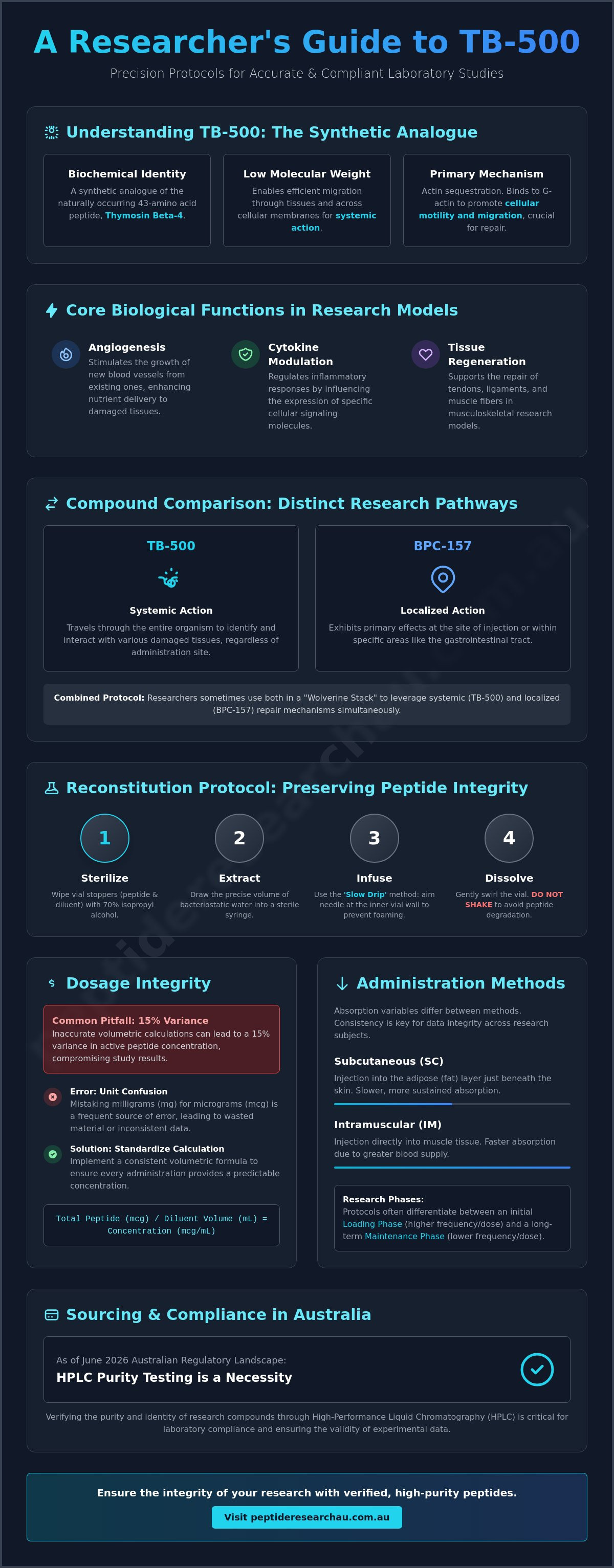
TB-500 is a synthetic analogue of the naturally occurring 43-amino acid peptide Thymosin Beta-4 (TB-500). In biological systems, this protein is found in almost all cells, but its highest concentrations are observed in blood platelets and wound fluid. The synthetic version used in laboratory settings is often a specific fragment of the full protein, engineered to retain the regenerative properties of the original molecule while improving molecular stability. Researchers prioritize this compound for its low molecular weight, which enables it to migrate through tissues and cross cellular membranes with high efficiency. This systemic capability is a primary factor when calculating the tb-500 dosage for research, as the compound doesn't rely on site-specific administration to reach distant target tissues.
The Biological Mechanism of Action
The primary function of TB-500 in research models is actin sequestration. Actin is a vital protein involved in cellular structure and movement; by binding to G-actin, TB-500 promotes cellular motility and migration. This mechanism is essential for wound healing studies, as it facilitates the movement of cells to the site of injury. Additionally, TB-500 demonstrates a significant capacity for:
Angiogenesis: It stimulates the growth of new blood vessels from existing ones, improving nutrient delivery to damaged tissues.
Cytokine Modulation: It regulates inflammatory responses by influencing the expression of specific signaling molecules.
Tissue Regeneration: It supports the repair of tendons, ligaments, and muscle fibers in musculoskeletal research models.
TB-500 vs. BPC-157: Complementary Research Paths
While both compounds are studied for their regenerative potential, they operate through distinct pathways. BPC-157 is often noted for its localized action, particularly within the gastrointestinal tract and at specific injection sites. In contrast, TB-500 is inherently systemic. It travels through the entire organism to identify and interact with damaged tissue. Scientists frequently utilize both in a protocol known as the 'Wolverine Stack' to leverage these complementary effects. This combination aims to target both the systemic repair mechanisms of TB-500 and the localized healing properties of BPC-157.
The stability of TB-500 in laboratory environments is generally higher than many other peptides, though its half-life remains a critical variable. When establishing a tb-500 dosage for research, investigators must account for its systemic distribution and the cumulative effect of repeated administrations. Unlike localized compounds, TB-500's efficacy is measured by its ability to maintain consistent serum levels over the duration of the study. This requires a precise understanding of volumetric reconstitution to ensure that each administration provides a predictable concentration for the research subject.
Calculating TB-500 Reconstitution and Concentration
Precision in laboratory settings begins with a sterile environment. Before starting the reconstitution process, investigators must ensure all surfaces are disinfected and vial stoppers are wiped with 70 percent isopropyl alcohol. Standardizing the tb-500 dosage for research requires a consistent volumetric approach to avoid concentration variances that could skew experimental outcomes. Since TB-500 is provided as a lyophilized (freeze-dried) powder, it's highly susceptible to structural damage if handled incorrectly during the transition to a liquid state.
The reconstitution process requires the careful introduction of a diluent to the powder cake. The 'Slow Drip' technique is the industry standard for preserving peptide integrity. By aiming the needle toward the inner wall of the glass vial, the researcher allows the liquid to slide down the side rather than impacting the peptide directly. This prevents foaming and minimizes the risk of mechanical degradation. Once the diluent is added, the following steps ensure a homogenous solution:
Sterilization: Wipe the tops of both the diluent and peptide vials.
Extraction: Draw the required volume of bacteriostatic water into a sterile syringe.
Infusion: Introduce the liquid slowly via the 'Slow Drip' method.
Dissolution: Gently swirl the vial; don't shake it.
The Reconstitution Mathematics
Accurate dosing depends on a fundamental formula: divide the total milligrams of the peptide by the volume of the diluent in milliliters. For instance, adding 2ml of bacteriostatic water to a 5mg vial of TB-500 yields a concentration of 2.5mg per ml. In a standard 1ml research syringe with 100 graduations (units), each 'tick' represents 25mcg of the compound. Researchers must verify these calculations before administration to maintain protocol integrity. Utilizing high-quality laboratory diluents is essential for maintaining the stability of the solution during multi-dose studies.
Stability and Handling Protocols
Peptides are chemically sensitive molecules. Once reconstituted, TB-500 must be stored in a refrigerated environment between 2°C and 8°C. Exposure to room temperature for extended periods accelerates the degradation of the amino acid chain. Mechanical agitation is another significant risk factor. You should never shake the vial, as the kinetic energy can shear the delicate peptide bonds. Instead, allow the liquid to sit or gently rotate the vial until the solution is clear. While lyophilized vials remain stable for long periods when frozen, the vacuum seal's breach marks the beginning of a limited shelf life. Most protocols suggest using the reconstituted solution within 21 to 28 days for optimal potency. Validating these steps ensures that research on Thymosin β4 applications remains consistent and reproducible across different experimental trials.
Standard TB-500 Dosage Protocols in Scientific Literature
Scientific literature regarding TB-500 focuses primarily on animal models, as there's no established recommended dosage for human use. In these research environments, investigators typically observe tb-500 dosage for research ranging from 2mg to 5mg per week for musculoskeletal studies. Published data on rodent models shows a broader range of 2mg to 10mg per administration, though standardized protocols for larger animal models often favor a bi-weekly frequency. This schedule aligns with the compound's biological half-life, ensuring that serum levels remain sufficient to trigger cellular migration and tissue repair without requiring daily administration.
The Loading Phase Protocol
The primary objective of a loading phase is to rapidly saturate the target tissues and achieve a steady-state concentration. Literature suggests these phases typically last between 4 and 6 weeks. During this period, the cumulative weekly total is often split into two separate administrations of 2mg to 2.5mg each. This front-loading approach is designed to maximize the initial upregulation of actin and promote immediate angiogenesis. Researchers adjust these metrics based on the subject's mass; a 500kg equine model requires significantly higher volumetric totals than a rodent model to achieve comparable therapeutic markers. Achieving this baseline is essential for observing Thymosin β4's regenerative properties in a controlled laboratory setting.
The Maintenance Phase Protocol
Once the initial saturation period concludes, the protocol transitions into a maintenance phase. This stage focuses on sustaining the regenerative signals while reducing the frequency of administration to prevent potential receptor desensitization. A typical maintenance tb-500 dosage for research involves a single administration of 2mg to 5mg once every 7 to 14 days. Long-term observation during this phase allows investigators to monitor the sustainability of tissue repair markers and the durability of newly formed vascular structures.
Standard laboratory practices also dictate specific rest periods between research cycles. These breaks, often lasting 4 to 8 weeks, ensure that the biological system returns to its baseline state, allowing for a comparative analysis of the compound's long-term efficacy. By adhering to these structured methodologies, researchers can generate reproducible data that accounts for both the acute and chronic biological responses to the peptide.
Administration Methods and Research Variables
TB-500 differs from many regenerative compounds because it doesn't require site-specific administration to be effective. Its molecular structure allows it to travel through the circulatory system, identifying and interacting with damaged tissues regardless of the injection site. When determining the tb-500 dosage for research, investigators must choose between subcutaneous and intramuscular methods. Subcutaneous administration is the most common choice in laboratory settings. It provides a steady release into the bloodstream and maintains consistent plasma levels over time. Intramuscular administration may lead to slightly faster absorption peaks, but current research hasn't proven this offers a significant advantage for cellular migration outcomes.
Systemic Bioavailability
The efficacy of Thymosin Beta-4 relies on its ability to circulate freely. Distal administration is effective because the peptide's low molecular weight allows it to cross cellular membranes and reach target areas with ease. Subcutaneous absorption peaks typically occur within a few hours of administration. This makes the specific injection site less critical than the accuracy of the tb-500 dosage for research. Consistency in the timing of administration is also vital for data integrity. While some peptides are influenced by diurnal rhythms, TB-500's primary focus on actin sequestration means that maintaining a stable cumulative weekly total is more important than the specific hour of the day.
Identifying Research Variables
Researchers often explore synergistic effects by combining TB-500 with other compounds like PT-141. While PT-141 is primarily studied for its effects on the central nervous system, its combination with TB-500 can provide a broader view of systemic biological responses in regenerative models. Activity levels of the research subject also play a role; increased blood flow through movement can potentially enhance peptide utilization. To measure success, laboratories track specific markers such as hydroxyproline levels, which indicate collagen turnover and tissue repair progress. Monitoring these biochemical markers provides concrete data on the compound's physiological impact.
Rigid documentation standards are non-negotiable in professional research. Every log must track the date, time, volume, and concentration of each administration. This ensures that the data remains auditable and that any deviations in subject response can be mapped back to the protocol. For investigators seeking high-purity materials to ensure experimental reliability, it's essential to buy research peptides from providers that supply comprehensive analytical data. Maintaining these standards prevents the introduction of external variables that could compromise the validity of the study results.
Sourcing and Handling Laboratory-Grade TB-500 in Australia
As of June 2026, the Australian regulatory environment for peptides has become increasingly stringent. The Therapeutic Goods Administration (TGA) issued a safety advisory in April 2026 regarding the importation of unapproved peptides, emphasizing that unauthorized entry of compounds like TB-500 is unlawful. For investigators, this makes domestic sourcing not just a matter of convenience, but one of compliance and quality control. Sourcing laboratory-grade materials within Australia ensures that the cold-chain remains intact, preventing the thermal degradation that often occurs during extended international transit and customs delays. When establishing a tb-500 dosage for research, the purity of the compound is the most critical variable. Peptide Research AU addresses this by providing research peptides that meet rigorous analytical standards, ensuring that every vial contains the precise molecular identity required for professional scientific study.
Quality Assurance Standards
Every batch must be accompanied by a Certificate of Analysis (CoA) that includes both High-Performance Liquid Chromatography (HPLC) and Mass Spectrometry (MS) data. HPLC determines the purity level by separating the components of the mixture, while MS confirms the peptide's specific sequence and molecular weight. Researchers should identify red flags in international suppliers, such as unusually low prices or the absence of batch-specific testing. Impurities in a research compound can lead to unpredictable off-target effects, which compromises the accuracy of research data. A purity level below 98 percent is generally unacceptable for high-level musculoskeletal research. Ensuring high purity allows for a more accurate tb-500 dosage for research, as there are no unknown contaminants to interfere with the biological response.
Storage and Longevity
Lyophilized TB-500 is highly stable when stored under optimal conditions. For long-term preservation, vials should be kept in deep-freeze environments at -20°C, where they can remain viable for several years. For active studies, refrigeration between 2°C and 8°C is appropriate for up to 12 months in powder form. Researchers must protect the vials from UV light exposure and significant thermal fluctuations by utilizing secondary opaque containers. Before initiating a TB-500 study, investigators should verify the integrity of the vacuum seal and the absence of moisture in the lyophilized cake. Adhering to these handling protocols ensures that the peptide remains structurally sound and that the experimental outcomes are reproducible and scientifically valid.
Advancing Precision in Peptide Methodology
Achieving reproducible data in regenerative studies requires a standardized approach to peptide preparation and administration. Establishing an accurate tb-500 dosage for research is the primary step in ensuring experimental integrity. Success depends on maintaining strict volumetric math during reconstitution and adhering to the hierarchical loading and maintenance protocols defined in this guide. By prioritizing HPLC-verified purity and temperature-controlled storage, investigators eliminate the variables that often lead to inconsistent or compromised experimental outcomes.
Professional researchers must rely on compounds that meet rigorous analytical benchmarks to ensure laboratory compliance and data validity. You can Source Laboratory-Grade TB-500 for Your Next Research Project through Peptide Research AU. Every compound is third-party HPLC tested for purity and managed through secure, temperature-controlled handling to preserve molecular stability. We provide express domestic shipping across Australia to facilitate timely study initiation and maintain the cold-chain integrity of your research materials. Implementing these methodology-driven standards will strengthen the reliability of your longitudinal data and advance the quality of your scientific contributions.
Frequently Asked Questions
What is the standard TB-500 dosage for research subjects?
The standard tb-500 dosage for research in animal models typically ranges from 2mg to 5mg per week for musculoskeletal studies. Rodent models often receive between 250mcg and 1mg per administration, with sessions conducted two to three times weekly. These protocols are adjusted based on the subject's total mass and the specific regenerative markers being analyzed. Investigators must maintain consistent serum levels to ensure the validity of their longitudinal data.
How do I calculate the amount of bacteriostatic water needed for TB-500?
You calculate the required volume by dividing the total milligrams of the peptide by your target concentration in milligrams per milliliter. For a 5mg vial, adding 2ml of bacteriostatic water creates a concentration of 2.5mg per ml. This ratio allows for precise measurements on a standard research syringe. Each 10-unit mark on a 100-unit syringe will then represent exactly 250mcg of the compound.
Is there a difference between TB-500 and Thymosin Beta-4?
TB-500 is a synthetic analogue that represents a specific active fragment of the full 43-amino acid Thymosin Beta-4 protein. While the naturally occurring protein exists in high concentrations in platelets, the synthetic version is engineered for improved stability in laboratory settings. Researchers use this fragment because it retains the regenerative properties of the full protein, such as actin sequestration, while being easier to manufacture and stabilize.
Can TB-500 be used alongside BPC-157 in the same research study?
Yes, researchers frequently utilize both TB-500 and BPC-157 in the same study to observe their synergistic effects on tissue repair. This combination leverages the systemic distribution of TB-500 alongside the localized healing mechanisms of BPC-157. It's essential to administer the compounds separately and document their individual impacts on the research subject. This dual-protocol approach is often used in complex musculoskeletal regeneration studies.
How long does a typical TB-500 research cycle last?
A typical tb-500 dosage for research cycle lasts between 4 and 6 weeks during the initial loading phase. Literature suggests this period is necessary to achieve steady-state concentrations in the target tissues. Following this, a maintenance phase may continue for several weeks, or the protocol may include a scheduled rest period of 4 to 8 weeks. These cycles allow researchers to compare baseline data against active treatment phases.
What is the shelf life of TB-500 after it has been reconstituted?
The shelf life of reconstituted TB-500 is approximately 21 to 28 days when stored in a controlled refrigerated environment between 2°C and 8°C. Beyond this timeframe, the peptide's amino acid chains begin to degrade, which compromises the accuracy of the research results. Investigators should discard any solution that shows signs of precipitation or cloudiness. Lyophilized powder remains stable for significantly longer periods when stored in deep-freeze conditions.
Is TB-500 legal for research purposes in Australia in 2026?
As of June 2026, TB-500 is classified as a Schedule 4 Prescription Only Medicine in Australia. It's legal to source for legitimate laboratory research and "research use only" purposes. However, the TGA issued a safety advisory in April 2026 regarding the illegal importation of unapproved peptides. Researchers must ensure they source materials from domestic providers that comply with Australian laboratory standards to avoid unlawful importation issues.
Does TB-500 need to be administered at the site of the injury?
TB-500 doesn't require site-specific administration because it functions as a systemic compound. Once introduced into the circulatory system, its low molecular weight allows it to cross cellular membranes and migrate to damaged tissues throughout the body. Distal subcutaneous injections are the standard in research environments because they provide consistent bioavailability without the need for localized trauma. This systemic nature is a primary advantage for studying multi-site injuries.


Comments