

Australian Domestic Peptide Shipping: A Researcher’s Guide to Logistics and Quality (2026)
- peptideresearchau
- 1 day ago
- 11 min read
Every hour a research compound spends in international transit increases the risk of irreversible molecular degradation. For scientists operating within strict parameters, the uncertainty of international logistics often results in compromised data or the total loss of material through Border Force seizures. Utilizing australian domestic peptide shipping is no longer just a convenience; it's a fundamental requirement for researchers who prioritize molecular stability and reliable delivery.
You understand that even minor temperature fluctuations can render a peptide sequence useless for precise study. This guide outlines how domestic logistics protocols minimize thermal stress and ensure compounds arrive in discrete, professional packaging without the risk of customs interference. We'll examine the technical standards of cold chain management and the regulatory framework that makes local sourcing the most authoritative choice for your laboratory requirements. By prioritizing domestic logistics, you ensure that your research peptides maintain the high manufacturing standards and chemical nomenclature integrity required for professional study.
Key Takeaways
Understand the scientific necessity of rapid domestic transit to maintain the delicate peptide bonds and molecular integrity of your research compounds.
Identify why australian domestic peptide shipping is essential for avoiding the regulatory risks and thermal degradation associated with international transit.
Evaluate the protocols required for secure delivery, including the selection of appropriate carriers and the use of signature-on-delivery to mitigate heat exposure.
Master the professional arrival protocol for laboratory materials, focusing on seal verification and the correct interpretation of vial temperature assessment.
Gain insights into how 24-48 hour dispatch cycles and HPLC-tested purity standards contribute to consistent and reliable research outcomes.
Table of Contents
The Strategic Importance of Australian Domestic Peptide Shipping
The viability of laboratory-grade research compounds depends entirely on the efficiency of the final mile. In the context of Australian research, domestic shipping refers to the logistical movement of peptides from within national borders directly to the researcher. This process is governed by stringent documentation standards that align with current Australian regulations. Unlike international procurement, australian domestic peptide shipping functions as an extension of the laboratory's own quality control protocols. It ensures that the chain of custody remains transparent and that the chemical nomenclature on the documentation matches local regulatory requirements.
Choosing a domestic logistics pathway is the primary method for avoiding complications with the Australian Border Force (ABF). While international imports are subject to unpredictable screening and potential seizures, domestic parcels move through a streamlined internal network. This positioning is critical for maintaining a reliable supply of research peptides and compounds. Researchers who view logistics as a component of their methodology understand that a shorter transit time is a scientific necessity, not a mere convenience.
Customs and Regulatory Compliance in 2026
Regulatory scrutiny by the Therapeutic Goods Administration (TGA) reached new heights in 2026. This increased oversight makes international sourcing a high-risk strategy. Domestic shipping bypasses the primary failure point of the peptide supply chain: the border. By utilizing local fulfillment, researchers ensure their materials are accompanied by Australian-compliant labeling. This reduces the risk of administrative delays that can lead to the loss of sensitive materials. Proper documentation during domestic transit confirms that the compounds are intended for professional study, maintaining compliance with state and territory laws regarding Schedule 4 substances.
Mitigating the Risks of International Sourcing
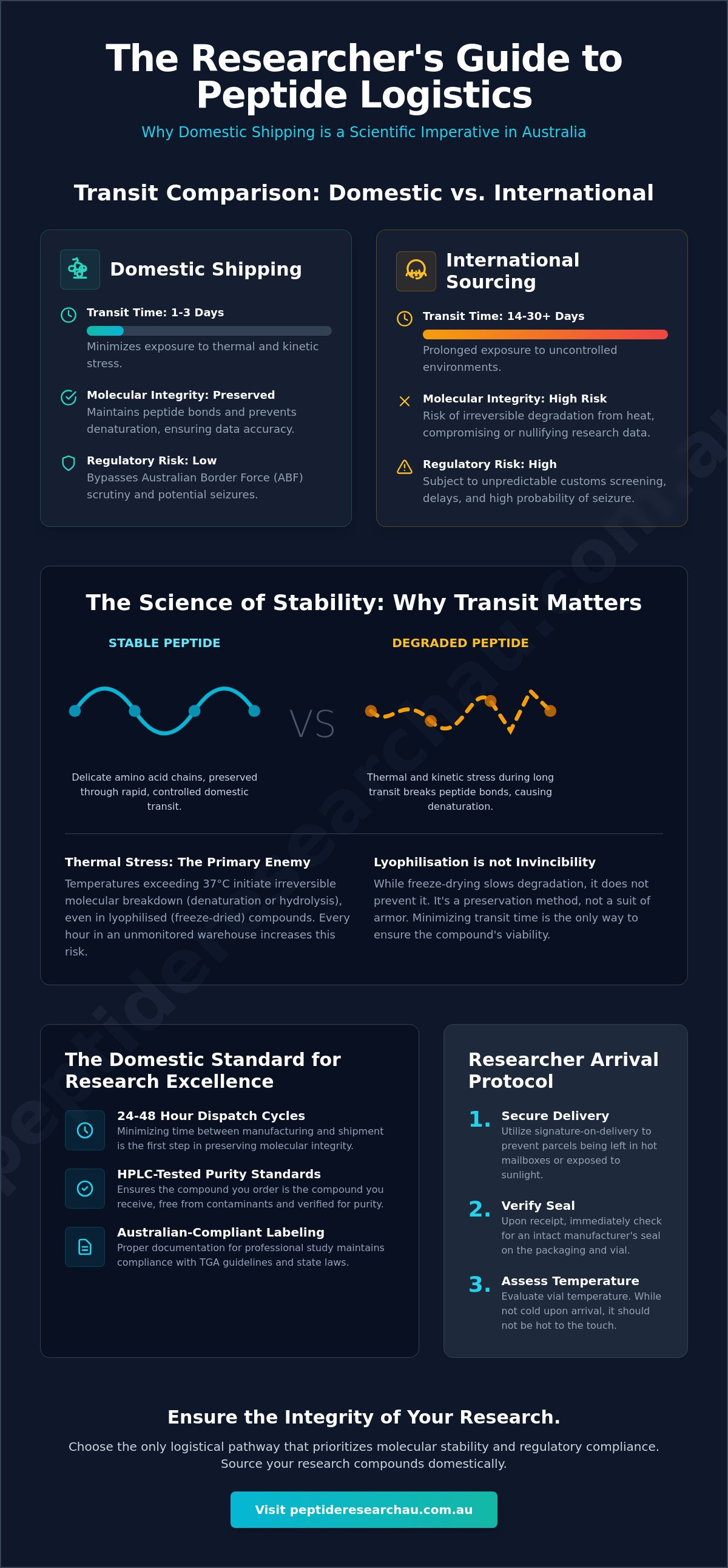
The contrast between international and domestic transit is stark. International shipments often endure 14 to 30 days of transit, exposing fragile peptide bonds to extreme thermal and kinetic stress. In contrast, domestic transit typically concludes within 1 to 3 days. These shorter windows are essential for maintaining cold chain logistics, preventing the degradation that occurs when parcels sit in unmonitored customs warehouses. The hidden costs of international sourcing go beyond the initial price; they include import duties, the high probability of seizure, and the scientific cost of compromised data. For a deeper analysis of these standards, consult Peptides Australia: The Researcher’s Guide to Quality, Sourcing, and Standards in 2026. Domestic shipping remains the only way to guarantee that the molecular integrity of research compounds is preserved from the point of manufacture to the laboratory bench.
Molecular Integrity: The Science of Peptide Stability During Transit
Peptide bonds are inherently fragile biochemical structures. They consist of short chains of amino acids linked by amide bonds, which are highly susceptible to thermal degradation. When these compounds are exposed to heat, the energy disrupts the secondary structure of the molecule, leading to denaturation or hydrolysis. Thermal stress is the primary enemy of peptide potency during long-haul shipping. While some research compounds, such as BPC-157, demonstrate relatively high stability at ambient temperatures, exposure to environments exceeding 37°C for extended periods initiates molecular breakdown. This chemical instability is why australian domestic peptide shipping is a critical requirement for maintaining research accuracy.
Lyophilisation, or freeze-drying, is the industry standard for preserving these compounds. By removing moisture through sublimation, the peptide is "locked" into a solid state, which significantly slows the rate of chemical degradation. However, it's a common misconception that lyophilised peptides are indestructible. High temperatures still facilitate deamidation or oxidation, even in a powdered state. Minimizing the duration of exposure to uncontrolled environments is the only reliable way to ensure that the compound remains viable for laboratory use.
Kinetic Stress and Peptide Structure
Excessive vibration and mechanical agitation during long-distance air freight can impact the structural integrity of research materials. Reconstituted peptides are particularly vulnerable, as kinetic energy can cause the molecules to aggregate or precipitate out of the solution. Lyophilised powders are more resilient to these forces, yet domestic road and express air networks still offer a superior alternative to international freight by drastically reducing the duration of mechanical agitation. Shorter last-mile delivery ensures the package spends less time in sorting facilities where temperature and handling protocols are often outside of the researcher's control. This professional handling aligns with the current TGA compliance focus on the secure and precise transport of research materials.
The Role of Lyophilisation in Shipping
Peptide Research AU ships all research compounds in lyophilised powder form to maximize stability during transit. This technical choice ensures that the peptide bonds remain intact even if the parcel encounters minor temperature fluctuations. You can learn more about these molecular structures in our guide: What are Peptides? A Comprehensive Guide to Research and Science in 2026. Within a typical 48-hour domestic window, these lyophilised compounds maintain their purity and potency at ambient temperatures. This reliability allows scientists to view our catalog of research compounds with the confidence that the materials will arrive ready for precise study.
Evaluating Australian Logistics: Carriers and Protocols
The selection of a logistics partner is a technical decision that directly impacts the final purity of a research compound. Within the framework of australian domestic peptide shipping, the choice typically rests between Australia Post Express and StarTrack Premium. Each carrier offers distinct advantages based on the geographical location of the laboratory and the specific sensitivity of the shipment. While standard couriers may suffice for durable goods, research materials require the precision of specialised pharmaceutical logistics protocols to maintain structural integrity.
StarTrack vs. Australia Post for Research Compounds
StarTrack Premium is often preferred for business-to-business (B2B) transactions due to its dedicated freight network and higher reliability in handling laboratory supplies. It operates a logistics chain that minimizes the number of touchpoints, reducing the risk of mechanical agitation discussed in previous sections. Australia Post Express remains the primary option for reaching regional research facilities where specialized couriers may have limited reach. In 2026, delivery windows for major metropolitan hubs like Sydney, Melbourne, and Brisbane are consistently maintained at 24 to 48 hours. Shipments to Perth or Darwin from eastern distribution centers typically require a 72-hour window, making the use of high-grade lyophilised forms essential for these routes.
A non-negotiable protocol for sensitive research materials is the requirement for "Signature on Delivery." This prevents parcels from being left in high-heat environments, such as metal mailboxes or exposed doorsteps. In Australian summer conditions, internal temperatures of unshaded mailboxes can exceed 60°C, a level that triggers rapid molecular degradation. Tracking transparency allows researchers to schedule their laboratory work around the arrival of the compounds, ensuring the material is transferred to controlled storage immediately upon receipt.
Stealth and Security Protocols
Maintaining a professional "Research Only" context requires discrete, non-descript packaging. This approach ensures that the contents remain private and don't attract unnecessary attention during transit. Tamper-evident seals are utilized to protect the chain of custody, providing a clear visual indicator if the package has been compromised. These security measures address the primary concern regarding the safety of high-value laboratory-grade materials. Professional packaging also includes internal padding to protect glass vials from accidental damage during sorting and transport, ensuring that the physical and chemical integrity of the shipment remains uncompromised.
Researcher Protocol: Handling Domestic Shipments Upon Arrival
The researcher's responsibility begins the moment the parcel is delivered. While the efficiency of australian domestic peptide shipping minimizes exposure to environmental stressors, the final transition from the courier to the laboratory environment is a critical phase. Standardized handling protocols ensure that the chemical integrity established during manufacturing is preserved until the point of reconstitution. Integrity is paramount. Following a rigid intake procedure allows for the early detection of any rare logistical anomalies and secures the validity of future data.
Step 1: Physical Inspection. Verify the tamper-evident seal is intact. Inspect the glass vial for micro-fractures or stress marks that may have occurred during sorting. Any breach in the primary packaging suggests a compromised chain of custody.
Step 2: Temperature Assessment. It's a common misconception that vials must arrive cold to be viable. Lyophilised powder is stable at ambient temperatures for the duration of a standard domestic transit window. The absence of moisture in the freeze-dried cake prevents the rapid enzymatic degradation that affects liquid compounds.
Step 3: Storage Transition. Move the compounds to a controlled environment immediately. While the powder is resilient, long-term stability requires a consistent temperature-controlled setting to prevent deamidation.
Step 4: Inventory Logging. Record the batch number and date of receipt. Cross-reference these details with the provided HPLC and MS reports to ensure the material matches the expected specifications for your study.
Storage Requirements for Lyophilised Peptides
Optimal storage conditions depend on the intended duration of the research. For studies occurring within 90 days, a standard laboratory refrigerator set between 2°C and 8°C is sufficient. For long-term preservation exceeding three months, vials should be stored in a freezer at -20°C or -80°C to halt all molecular motion. Light exposure is another factor that researchers often overlook. UV radiation can catalyze the oxidation of specific amino acids, so vials should remain in their original opaque packaging or be stored in a dark environment. You can find specific stability data for individual sequences in our BPC-157: A Comprehensive Guide for Scientific Research in Australia.
Reconstitution Preparation
Don't reconstitute a vial immediately after removing it from cold storage. Cold glass attracts atmospheric moisture, which leads to condensation inside the vial when opened. This introduced moisture can degrade the peptide before the diluent is even added. Allow the vial to reach room temperature in a desiccator or a controlled dry area. Always use fresh laboratory-grade diluents for every new research cycle to prevent cross-contamination. Once you've prepared your environment, you can order laboratory-grade research compounds to begin your next phase of study with confidence in your material's purity.
Peptide Research AU: Setting the Standard for Domestic Logistics
Peptide Research AU operates at the intersection of biochemical precision and logistical excellence. Our commitment to a 24-48 hour dispatch cycle ensures that the high manufacturing standards established in the laboratory are not compromised by administrative delays. We recognize that HPLC-tested purity is only valuable if the molecular integrity is maintained until the moment of receipt. By integrating rigorous analytical testing with rapid fulfillment, we provide a reliable supply chain that meets the exacting requirements of the Australian scientific community. This synergy between science and logistics is what defines our role as a professional provider of research compounds.
Our Australian-based support team provides a level of technical accountability that international providers cannot replicate. If transit anomalies occur, our local presence allows for immediate resolution, ensuring your research schedule remains on track. For serious researchers in 2026, australian domestic peptide shipping is the only logical choice to eliminate the variables of international customs and thermal degradation. It's about maintaining a chain of custody that respects the fragile nature of the amide bonds you're studying.
Our 2026 Logistics Infrastructure
We maintain local fulfillment centers equipped with climate-controlled environments to house our inventory before dispatch. These facilities are designed to prevent the baseline thermal stress that occurs in standard warehousing. Our selection of carrier partners is not arbitrary; it's based on continuous analysis of real-world delivery performance data across all Australian states and territories. This data-driven approach allows us to optimize routes and carrier tiers for maximum speed and safety. The Peptide Research AU Guarantee on domestic delivery success reflects our confidence in this infrastructure, providing researchers with the certainty required for high-stakes laboratory work. We don't just ship parcels; we manage a technical distribution network.
Supporting the Australian Scientific Community
Access to high-purity research compounds shouldn't be hindered by the complexities of international trade. We specialize in providing reliable domestic access to essential sequences, including GHK-Cu, PT-141, and TB-500. By removing the hurdles of international sourcing, we allow scientists to focus on data collection and methodology rather than logistical troubleshooting. Our role is to serve as a dependable provider of laboratory-grade materials that adhere to strict chemical nomenclature and purity standards. To secure materials for your next study, explore our range of domestically shipped research peptides.
Securing Research Integrity through Local Logistics
The transition from manufacturer to laboratory is the most vulnerable phase for any research compound. By prioritizing australian domestic peptide shipping, you eliminate the unpredictable variables of international transit, such as customs delays and unmonitored thermal exposure. This commitment to local fulfillment ensures that the chemical nomenclature and molecular potency of your peptides remain intact for precise study. The integration of HPLC-tested purity with rapid, 24-48 hour dispatch cycles provides a foundation of reliability that international sourcing cannot match.
Peptide Research AU is 100% Australian owned and operated, providing the scientific community with a secure supply chain for high-grade research materials. We offer same-day dispatch for orders placed before 12 PM, utilizing express StarTrack and Australia Post networks for maximum efficiency. Your research demands precision; ensure your logistics match those standards.
Frequently Asked Questions
How long does domestic peptide shipping take within Australia in 2026?
Domestic shipping typically takes 24 to 48 hours for metropolitan hubs like Sydney, Melbourne, and Brisbane. Regional or remote areas generally require 72 hours for delivery. We prioritize express networks to minimize the duration research compounds spend in uncontrolled environments. This efficiency allows scientists to maintain strict experimental timelines without the risk of long-term storage in transit facilities.
Will my peptides degrade if they are not shipped on ice?
Lyophilised peptides don't require shipping on ice for standard domestic transit windows. The freeze-drying process removes moisture, which stabilizes the molecular structure against ambient temperature fluctuations. Thermal degradation is a cumulative process; a 48-hour window at room temperature is insufficient to compromise the integrity of high-purity research compounds. Express domestic shipping effectively avoids the prolonged heat exposure that leads to degradation.
Is it legal to ship research peptides domestically in Australia?
The domestic transport of research peptides is legal when intended for professional laboratory study and compliant with state-level regulations. Peptides are classified as Schedule 4 substances in Australia; this requires adherence to specific documentation and labeling standards. Utilizing australian domestic peptide shipping ensures that your materials move through a legal framework that avoids the complications associated with international border screening.
What happens if my domestic peptide shipment is lost or delayed?
We monitor all shipments through a centralized tracking system to identify and resolve logistical anomalies immediately. If a parcel is lost or significantly delayed, our Australian-based support team initiates a formal investigation with the carrier. We maintain a delivery success protocol that prioritizes the replacement of materials if the chain of custody is permanently broken or if transit times exceed safety thresholds.
Why do you use discrete packaging for research compounds?
Discrete packaging is a standard security protocol designed to protect the privacy and professional context of your research. We use non-descript, tamper-evident materials to ensure the contents aren't identifiable to unauthorized parties during transit. This approach mitigates the risk of interference and maintains a secure chain of custody from our fulfillment center to your laboratory bench.
Can I track my peptide order in real-time?
Every order includes a unique tracking identifier that provides real-time updates through the carrier's digital interface. Researchers can monitor the parcel's progression from dispatch to the final delivery milestone. This transparency is essential for scheduling laboratory work and ensuring that a qualified individual is available to receive and store the compounds immediately upon arrival.
Does Peptide Research AU ship to regional and remote areas of Australia?
We provide comprehensive coverage across all Australian states and territories, including regional and remote research facilities. We utilize the Australia Post Express network for these locations because it offers the most reliable reach beyond metropolitan areas. While transit times may extend to 72 hours, the lyophilised form of our research compounds ensures stability throughout the journey.
What should I do if my package arrives damaged?
If a package arrives with visible damage or a compromised tamper-evident seal, you must document the condition immediately. Take high-resolution photographs of the external packaging and the internal vials before contacting our support team. We'll assess the impact on molecular integrity and provide instructions for a replacement or return, ensuring your research data isn't compromised by faulty materials.


Comments