
Peptide Research for Anti-Ageing AU: A 2026 Scientific Overview
- peptideresearchau
- 2 days ago
- 11 min read
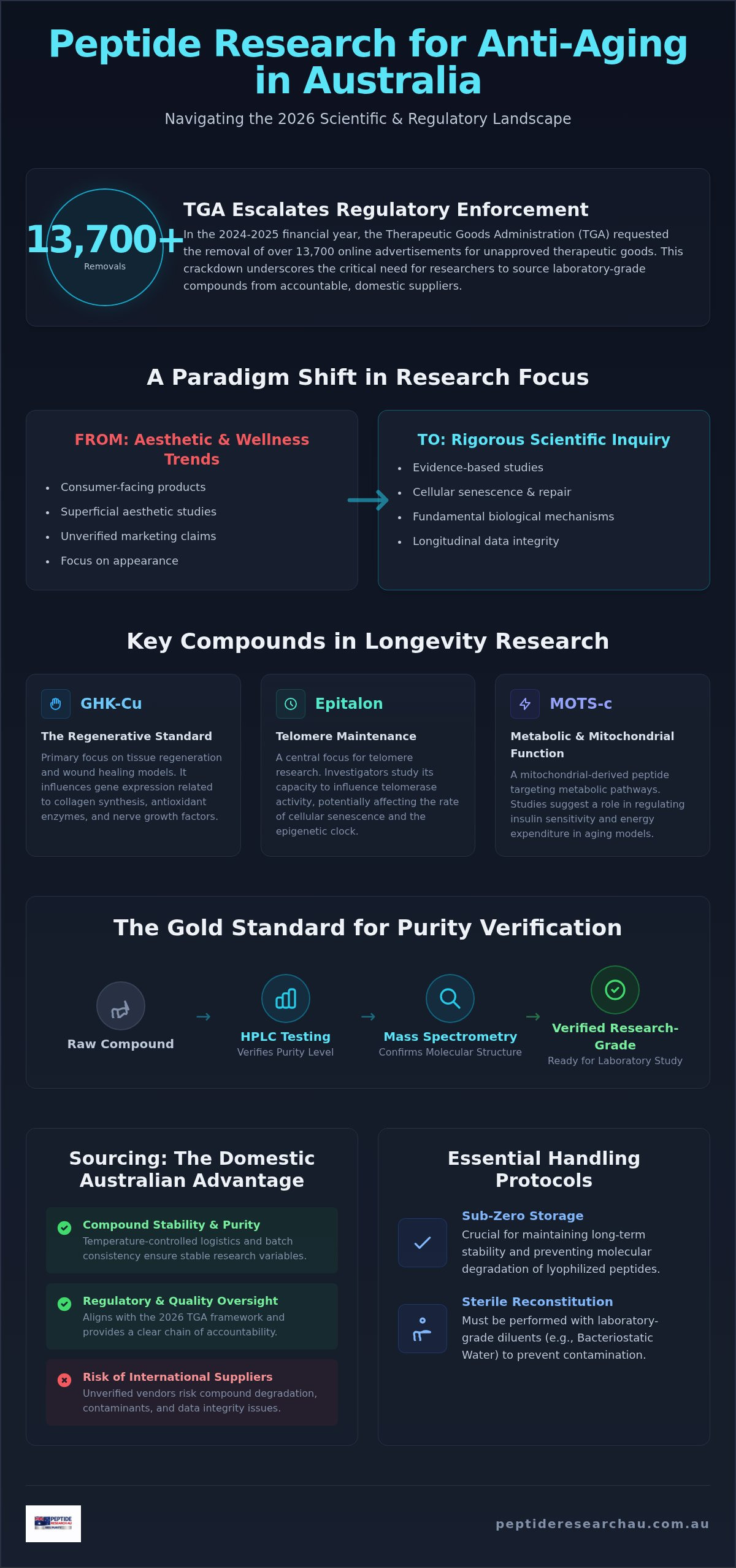
In the 2024-2025 financial year, the TGA requested the removal of more than 13,700 online advertisements for therapeutic goods, signaling a major escalation in regulatory enforcement. For specialists conducting peptide research for anti-aging AU, these statistics emphasize the critical need for laboratory-grade purity and domestic accountability. The current 2026 landscape makes it difficult to identify high-purity compounds that meet Australian research standards while avoiding the risks associated with unverified international suppliers.
Researchers recognize that the transition from consumer-facing wellness trends to rigorous scientific inquiry requires a meticulous approach to sourcing and compliance. This article offers a professional analysis of longevity-focused peptide compounds and the specific laboratory-grade protocols required for professional study. We'll examine the biochemical mechanisms of GHK-Cu, discuss the necessity of HPLC and mass spectrometry testing, and provide a clear framework for securing reliable domestic research materials.
Table of Contents
The Landscape of Peptide Research for Anti-Ageing in Australia (2026)
Peptides function as precise signalling molecules within complex biochemical pathways. These short chains of amino acids serve as the primary messengers that instruct cells to initiate repair, synthesize structural proteins, or modulate energy production. In the specific field of peptide research for anti-aging AU, investigators study how these compounds interact with cell surface receptors to influence the rate of cellular senescence. By 2026, the Australian scientific focus has transitioned from superficial aesthetic studies toward rigorous longevity science. This research prioritizes the fundamental biological mechanisms that drive aging at a molecular level.
Investigators currently focus on three primary pillars of cellular maintenance: collagen synthesis, mitochondrial function, and DNA repair. For example, researchers often examine how the Copper Peptide GHK-Cu influences gene expression related to tissue regeneration and antioxidant defense. Unlike finished consumer products, laboratory-grade compounds are utilized to determine the exact dosage-response curves required for cellular recovery. This distinction is essential for maintaining the integrity of data in longitudinal studies.
Cellular Senescence and the Role of Signalling Peptides
Cellular senescence occurs when cells cease to divide but remain metabolically active, often secreting pro-inflammatory factors that damage surrounding tissue. Signalling peptides are evaluated in lab models for their capacity to alter these epigenetic markers. Current Australian research explores how specific amino acid sequences might "reprogram" senescent cells or facilitate their clearance. These studies require high-purity compounds to ensure that observed biological responses are attributable solely to the peptide's molecular structure rather than contaminants. Laboratory models demonstrate that these compounds can influence the epigenetic clock, potentially slowing the accumulation of cellular damage.
Why Research Context Matters in Australia
Distinguishing between clinical therapy and laboratory-based study is vital for regulatory compliance. In 2026, the Australian Therapeutic Goods Administration (TGA) has designated unapproved peptides as a compliance priority. Consequently, peptide research for anti-aging AU must operate strictly within a "research purposes only" framework. Domestic sourcing has become the standard for laboratory accountability. Australian-based suppliers provide a level of oversight that international vendors cannot match, particularly regarding batch consistency and temperature-controlled logistics. Using domestic sources ensures that compounds haven't been degraded by extreme heat or transit delays, which is critical for maintaining stable variables in any research project.
Key Compounds in Longevity and Cellular Repair Research
Modern peptide research for anti-aging AU focuses on identifying compounds that modulate specific cellular repair pathways. In 2026, investigators prioritize laboratory-grade molecules over consumer-grade alternatives to ensure data accuracy. This scientific rigor is necessary because the biological effects of these compounds are highly dependent on molecular purity and precise concentration. The TGA Warning on Unapproved Peptides highlights the risks associated with unverified sourcing, making it imperative for researchers to use established domestic providers for their study materials.
Beyond the well-known regenerative compounds, researchers are exploring mitochondrial-derived peptides like MOTS-c. This molecule specifically targets metabolic pathways and mitochondrial function. Studies suggest it may play a role in regulating insulin sensitivity and energy expenditure in aging models. Similarly, Epitalon (Epithalon) remains a central focus for telomere research. Investigators study its capacity to influence telomerase activity and its potential effect on the pineal gland's secretion of melatonin. These compounds represent the frontier of longevity science in Australia.
GHK-Cu: The Regenerative Research Standard
GHK-Cu is a tripeptide with a high affinity for copper ions. This copper-binding capability is central to its biological activity. It influences gene expression related to collagen synthesis, antioxidant enzymes, and nerve growth factors. Researchers utilize this compound in skin aging and wound healing models to observe its impact on the extracellular matrix. For a technical analysis of this molecule's application, investigators should refer to the GHK-Cu Peptide: A Comprehensive Research Guide for 2026. The clinical focus remains on how GHK-Cu modulates inflammatory cytokines and promotes cellular migration in damaged tissues.
Investigating BPC-157 and TB-500 Synergies
The synergy between BPC-157 and TB-500 is a significant area of interest for systemic repair research. BPC-157, a gastric-derived peptide, is studied for its role in tendon-to-bone healing and ligament repair. It appears to promote angiogenesis through the upregulation of vascular endothelial growth factor (VEGF). In contrast, TB-500 (Thymosin Beta-4) influences actin-mediated cellular migration. This mechanism is critical for moving repair cells to the site of injury. When studied together, these compounds provide a multi-faceted approach to tissue regeneration. Detailed protocols for these studies are available in the guide on BPC-157: A Comprehensive Guide for Scientific Research in Australia. To maintain experimental integrity, researchers often source high-purity research compounds that meet strict Australian laboratory standards.
Evaluating Purity and Laboratory Standards for AU Researchers
Scientific integrity in peptide research for anti-aging AU relies on the rigorous verification of chemical purity. High-Performance Liquid Chromatography (HPLC) is the primary tool for determining the quantitative purity of a sample. It operates by separating the target peptide from residual solvents, reagents, or truncated sequences that may have formed during synthesis. Complementary to this, Mass Spectrometry (MS) provides qualitative confirmation. It measures the precise molecular weight of the peptide chain to ensure it matches the theoretical mass. Without these two tests, a researcher cannot be certain of the material's identity or its actual concentration.
For legitimate laboratory research, a purity benchmark of 99% is the standard. Lower purity levels introduce uncontrolled variables into a study, potentially leading to false-positive or false-negative results. Degraded peptides present an equal risk. These molecules are highly sensitive to environmental factors. Exposure to UV light, excessive heat, or improper synthesis protocols can result in a total loss of biological activity. Researchers must prioritize compounds that have been handled with meticulous care from the point of manufacture to the laboratory bench.
Interpreting Certificates of Analysis (COA)
A Certificate of Analysis (COA) is a mandatory document for any high-level research project. It provides a transparent record of the peptide's chemical profile. When evaluating a COA, researchers focus on the purity percentage and the sequence verification data. It's critical to identify whether the testing was conducted by an independent third-party laboratory. Internal manufacturer claims often lack the objectivity required for professional research. Batch-specific testing is the only way to ensure consistency across multiple phases of a long-term study. If a supplier cannot provide a batch-specific COA, the compound's reliability is compromised.
Research Grade vs. Consumer Grade: The Technical Gap
There's a significant technical gap between consumer-grade peptides and laboratory-grade compounds. Cosmetic peptides found in retail serums often contain additives and preservatives that interfere with cellular assays. Professional research requires pure, lyophilised (freeze-dried) peptides. Lyophilisation removes moisture without damaging the molecular structure, which ensures long-term stability and easier reconstitution. This process is essential for peptides that must survive domestic transit while maintaining their structural integrity. For more information on maintaining these technical standards, researchers can refer to Peptides Australia: The Researcher’s Guide to Quality, Sourcing, and Standards in 2026. Using laboratory-grade compounds ensures that the research remains focused on the peptide's actual mechanism of action rather than the effects of contaminants.
Handling and Regulatory Compliance for Australian Research Projects
Effective peptide research for anti-aging AU requires strict adherence to laboratory handling protocols. These compounds are delicate biochemical structures. Improper storage or contamination can invalidate an entire research project. Lyophilized peptides must be stored at sub-zero temperatures, typically -20°C, to maintain long-term molecular stability. Exposure to room temperature for extended periods leads to peptide degradation. This process alters the amino acid sequence and renders the compound useless for scientific study. Researchers must ensure that their cold chain logistics are verified from the point of domestic dispatch to final laboratory arrival.
Contamination prevention is equally critical. All handling should occur in a controlled environment using sterile equipment. Research vials should never be exposed to direct sunlight or moisture. These environmental factors accelerate the breakdown of the peptide bonds. By maintaining a rigorous chain of custody and environmental control, investigators can ensure that the biological responses observed in their models are the result of the peptide itself rather than degraded byproducts or external pollutants.
Peptide Reconstitution and Diluent Selection
Reconstitution is the process of returning a freeze-dried peptide to a liquid state for research application. Selecting the correct diluent is vital. While sterile water is often used for immediate, single-use applications, it's insufficient for multi-use research vials. Bacteriostatic water is the preferred choice for laboratory study. It contains 0.9% benzyl alcohol, which acts as a preservative to inhibit bacterial growth. This allows for a longer shelf life once the vial has been opened. Accurate calculation of concentrations is essential for data consistency. Researchers typically use a basic volume-to-mass ratio to determine the exact milligram-per-milliliter concentration required for their specific assays. To maintain high experimental standards, you can source laboratory diluents and research compounds directly from domestic specialists.
Australian Regulatory Environment in 2026
The legal landscape for peptide research for anti-aging AU in 2026 is defined by the Therapeutic Goods Administration (TGA) guidelines. Many peptides are classified under Schedule 4 as restricted substances. However, legitimate laboratory research operates under specific exemptions when the compounds are strictly for "research purposes only" and not for human consumption. This distinction is the foundation of the Australian research framework. Ethical compliance requires researchers to document their sourcing and usage protocols clearly. Domestic Australian suppliers provide a higher level of regulatory transparency than international vendors. They ensure that all compounds meet local safety standards and that the necessary documentation for institutional oversight is readily available.
Sourcing High-Purity Research Peptides in Australia
Procuring high-purity compounds is the final critical step in any experimental design. For investigators involved in peptide research for anti-aging AU, the source of these molecules determines the validity of the entire study. While international markets offer a broad range of options, the logistical and regulatory risks associated with overseas procurement have increased significantly in 2026. The success of peptide research for anti-aging AU depends on the reliability of the supply chain and the chromatographic verification of each batch. Domestic sourcing provides a level of accountability that is essential for maintaining the scientific standards discussed throughout this overview.
Establishing a relationship with a domestic provider ensures that technical specifications are met before the compounds reach the laboratory. This transparency is vital for researchers who require exact molecular weights and purity percentages to calibrate their assays. By prioritizing suppliers that specialize in chemical nomenclature and technical purity, investigators can focus on the biological outcomes of their studies rather than the variables of inconsistent sourcing.
The Advantage of Australian-Based Sourcing
Australian-based sourcing offers distinct advantages regarding transit times and climate stability. Peptides are thermally sensitive molecules. Prolonged exposure to high temperatures during international transit or customs delays can lead to irreversible molecular degradation. By utilizing domestic shipping, researchers reduce the window of environmental exposure. This ensures that the lyophilised compounds arrive with their structural integrity intact. Domestic suppliers are also subject to Australian consumer laws and regulatory oversight. This provides a clear path for quality control and batch verification. It's a level of security that international vendors can't guarantee under the 2026 regulatory framework. Researchers also gain direct access to essential laboratory supplies and diluents, ensuring that the entire research kit is compatible and verified.
Peptide Research AU: Commitment to Quality
Peptide Research AU focuses on providing precision-engineered research compounds for the professional scientific community. Our commitment to quality is evidenced by our rigorous testing protocols and technical transparency. We provide access to high-purity peptides and essential laboratory supplies, ensuring that researchers have the tools necessary for precise reconstitution and handling. Our role extends beyond simple supply. We aim to bridge the gap between technical data and successful research execution by providing reliable, batch-verified materials. Accessing high-quality compounds is straightforward for those within the AU research sector. To begin your project with verified materials, explore our full range of research peptides and laboratory supplies. We support the Australian scientific community by ensuring every compound meets the stringent requirements of modern longevity research.
Advancing Scientific Standards in Longevity Research
The 2026 landscape of peptide research for anti-aging AU demands a commitment to technical precision and regulatory transparency. Researchers must look beyond consumer-grade marketing to find compounds verified by HPLC and Mass Spectrometry. Establishing a domestic supply chain isn't just about convenience. It's about protecting the stability of temperature-sensitive molecules during transit across the Australian climate. Accountability and quality control are the foundations of successful longevity studies and provide the necessary data for institutional oversight.
By prioritizing laboratory-grade purity standards and a specialized research supply range, investigators ensure their data remains valid and reproducible. High manufacturing standards and direct access to necessary diluents allow for more accurate experimental execution. It's essential to maintain these rigorous protocols to achieve meaningful insights into cellular repair and senescence. Secure high-purity compounds for your next research project at Peptide Research AU. Professional sourcing remains the most reliable way to maintain the integrity of your scientific findings and advance the future of longevity science.
Frequently Asked Questions
Are peptides for anti-ageing research legal to buy in Australia?
Peptides are legal to purchase in Australia strictly for laboratory and scientific research purposes. While many compounds are listed under Schedule 4 of the Poisons Standard for therapeutic use, these regulations don't prohibit the acquisition of materials intended for non-human study. Researchers must ensure their procurement aligns with the "research purposes only" framework to remain compliant with the 2026 TGA guidelines. Sourcing from domestic providers ensures better oversight of these regulatory standards.
What is the difference between research-grade and cosmetic-grade peptides?
Research-grade peptides must meet a purity benchmark of at least 99% as verified by HPLC testing. In contrast, cosmetic-grade peptides often contain preservatives, stabilizers, or fillers that interfere with scientific assays. Laboratory-grade compounds are typically provided in a lyophilized state to ensure molecular stability. This technical precision is essential for anyone conducting peptide research for anti-aging AU, as it ensures that experimental variables remain controlled and results are reproducible.
Why is GHK-Cu frequently used in longevity research?
GHK-Cu is prioritized in longevity research due to its high affinity for copper ions and its influence on gene expression. This tripeptide serves as a signaling molecule that modulates the synthesis of collagen and glycosaminoglycans. Investigators study its role in tissue regeneration and its capacity to upregulate antioxidant enzymes. Its ability to influence multiple biochemical pathways makes it a fundamental compound for exploring the mechanisms of cellular repair and aging.
How should research peptides be stored to maintain their integrity?
Research peptides should be stored in a temperature-controlled environment at -20°C to ensure long-term molecular stability. Exposure to heat, UV light, or moisture can cause rapid degradation of the amino acid chain. While lyophilized peptides are stable at room temperature for short durations during transit, they must be returned to sub-zero storage upon arrival. Once reconstituted, these compounds are significantly more fragile and must be kept refrigerated at 2°C to 8°C.
What is the role of bacteriostatic water in peptide research?
Bacteriostatic water is the standard diluent for peptide research because it contains 0.9% benzyl alcohol to inhibit bacterial growth. This preservative is essential for maintaining the sterility of multi-use vials over an extended research period. While sterile water is suitable for immediate application, it doesn't prevent contamination once a vial has been punctured. Using bacteriostatic water ensures that the peptide's chemical integrity isn't compromised by microbial activity during long-term studies.
How can I verify the purity of a peptide compound in Australia?
Verification of peptide purity requires a batch-specific Certificate of Analysis (COA) that includes HPLC and Mass Spectrometry data. HPLC determines the quantitative purity of the sample, while Mass Spectrometry confirms the molecular weight of the peptide sequence. Researchers should prioritize third-party testing results over internal manufacturer claims to ensure objectivity. In the context of peptide research for anti-aging AU, these documents provide the transparency necessary for institutional accountability and scientific rigor.
What are the primary anti-ageing mechanisms studied in peptide research?
Peptide research primarily investigates mechanisms such as cellular senescence, mitochondrial energy production, and DNA repair. Scientists study how signaling molecules can influence the rate at which cells enter a non-dividing state or how they might clear damaged cellular components. Other focus areas include the modulation of the epigenetic clock and the upregulation of structural proteins. These studies aim to define the precise biochemical triggers that govern the biological aging process.
Can research peptides be shipped domestically within Australia?
Research peptides can be shipped domestically within Australia, which is the preferred method for maintaining compound stability. Domestic transit significantly reduces the risk of extreme temperature fluctuations and customs delays associated with international procurement. This ensures that the cold chain remains intact and the lyophilized peptides aren't exposed to environmental stressors. Reliable domestic providers utilize expedited logistics to deliver laboratory-grade materials while preserving their structural and chemical integrity.


Comments